FRENCH ALPS | SOUTH OF FRANCE | PYRENEES | RIDING STYLES | BIKE RENTAL & TRANSPORT | GEAR GUIDE | PLAN YOUR TRIP
France has more than 62,000 km of waymarked mountain bike trails, over 40 lift-accessed bike parks, and a riding culture that runs from the glacier-ringed passes of the Mont Blanc massif to the dry, dusty singletrack of the Mediterranean hinterland — and it’s been building trails longer and harder than almost anywhere else in Europe.
The numbers tell part of the story: the Portes du Soleil alone — spanning 12 resorts across France and Switzerland — offers over 600 km of marked trails and 22 bike lifts under a single pass. But France’s strength isn’t just scale. It’s variety. You can ride World Cup-standard downhill in Morzine on Monday, pedal a 60 km high-alpine XC loop above Briançon on Wednesday, and be threading natural singletrack through the lavender and limestone of the Verdon on Friday — all within the same country, often the same week.
The Fédération Française de Cyclisme (FFC) and local cycling clubs have spent decades developing and waymarking trail networks across every mountain range in France. Ski resorts — sitting idle from June to September — have invested heavily in bike-specific infrastructure: gondolas fitted with bike carriers, purpose-built flow trails, graded bike parks, and skills areas. The result is a mountain biking destination that works whether you’re a first-timer doing green laps on a rented hardtail or an experienced rider planning a multi-day enduro traverse.
This page is designed to help you plan the trip. Below you’ll find our pick of the best resorts and riding areas across the three main mountain biking regions — the French Alps, the South of France and the Pyrenees — plus everything you need to know about riding styles, trail grading, bike rental, getting your bike to France, and when to go.
France’s Best Bike Parks Compared — 2026
Every big French bike park runs to its own calendar — some spin lifts from May, others don’t open until July and shut the day the schools go back. Here’s how the headline parks compare for summer 2026. Full lift-by-lift dates for every resort are on the regional guides: French Alps, South of France and Pyrenees.
| Bike park | Region | 2026 season | Adult day pass | Best for |
|---|---|---|---|---|
| Morzine / Portes du Soleil | French Alps | 12 Jun – 13 Sep | €39* | The world’s biggest linked bike area |
| Les Gets | French Alps | 19 Jun – 13 Sep | €39* | World-class bike park, UCI pedigree |
| Alpe d’Huez | French Alps | 26 Jun – 30 Aug | €25 | Megavalanche & massive descents |
| Les 2 Alpes | French Alps | 13 Jun – 30 Aug | €33 | High-alpine DH, glacier backdrop |
| Chamonix (Balme) | French Alps | 20 Jun – 20 Sep | €28 | Singletrack with Mont Blanc views |
| Serre Chevalier | South of France | 20 Jun – 30 Aug | €28 | Four linked sectors, long descents |
| Isola 2000 | South of France | Jul – Aug (TBC) | ~€20 | Southern Alps DH, 2,000 m+ riding |
| Les Orres | South of France | 13 Jun – 13 Sep | €28 | Longest southern season, Euro DH Cup |
| Cauterets | Pyrenees | 4 Jul – 30 Aug | €23 | Cirque du Lys gravity riding |
| Saint-Lary | Pyrenees | 4 Jul – 30 Aug | €26 | The Pyrenees’ benchmark bike park |
| Peyragudes / Loudenvielle | Pyrenees | 8 May – 18 Oct† | €33 | Longest season in France, Skyvall access |
Mountain Biking in the French Alps
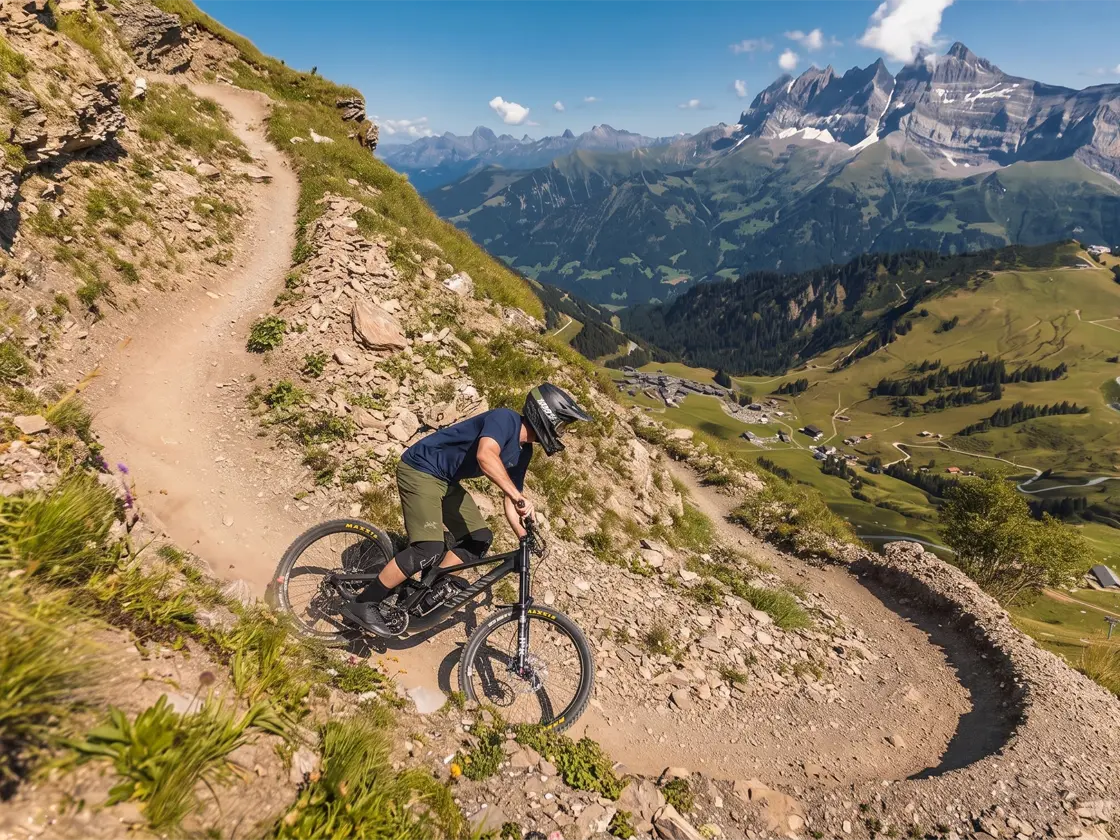
The French Alps are the epicentre of European mountain biking — and the place where lift-accessed riding was effectively invented. In the early 1990s, ski resorts in the Haute-Savoie began strapping bikes to chairlifts and letting riders figure out the rest. Three decades later, the infrastructure is unmatched anywhere in Europe: over 40 lift-accessed bike parks, thousands of kilometres of waymarked XC and enduro trails, and a competitive pedigree that no other region can match.
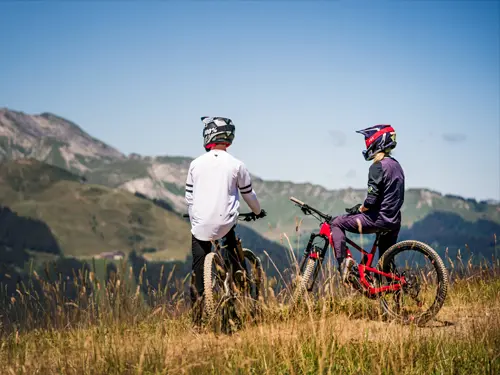
Les Gets hosted the UCI MTB World Championships in both 2004 and 2022 — the latter producing one of the most iconic moments in the sport’s history when Loïc Bruni, Amaury Pierron and Loris Vergier swept the elite men’s downhill podium for a historic all-French 1-2-3 on home soil. The Haute-Savoie continues to host UCI World Cup rounds — with both DH and enduro legs scheduled for 2025 and 2026 — cementing the region’s status as the spiritual home of gravity racing in Europe. Meanwhile, the Portes du Soleil — 12 resorts, 600+ km of marked trails, 22 bike lifts — remains the largest interconnected mountain biking area on the continent.
But the Alps aren’t just about bike parks. Above the treeline, the terrain opens up into high-alpine XC and enduro riding that’s on another scale entirely — long, relentless climbs rewarded with descents of 1,500m or more on natural singletrack through glacial valleys, across scree fields and down into larch forests. Every July, the Megavalanche at Alpe d’Huez sends hundreds of riders from the glacier at 3,330m to the town at 720m — 2,600m of vertical in a single mass-start descent. It’s one of the most spectacular events in mountain biking, and it’s open to amateurs. The season runs from mid-June to mid-September, with July and August the busiest months.
Morzine & Portes du Soleil
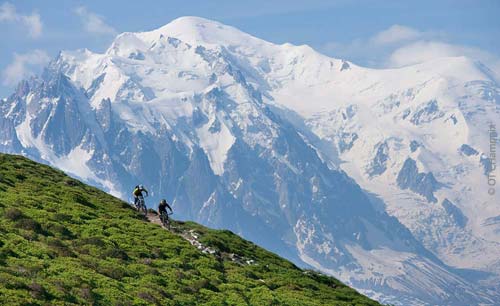
Chamonix
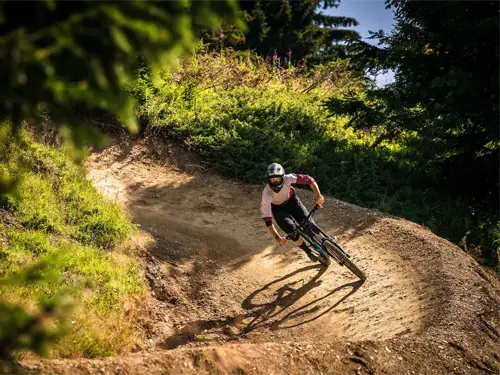
Les Gets
Mountain Biking in the South of France
The South of France is mountain biking’s best-kept open secret — and the region that produced more world-class downhill riders than anywhere else on earth. Loïc Bruni, five-time UCI DH World Champion, grew up riding the trails above Nice and Cagnes-sur-Mer. His father Jean-Pierre — himself a former world champion — coached Nicolas Vouilloz (seven elite DH world titles) and Fabien Barel from the same Côte d’Azur riding grounds. Loris Vergier, who completed that historic all-French podium at Les Gets in 2022, is also from Nice. There’s something in the dry, rocky, sun-baked terrain of the Alpes-Maritimes that breeds exceptional riders — and it’s all rideable.
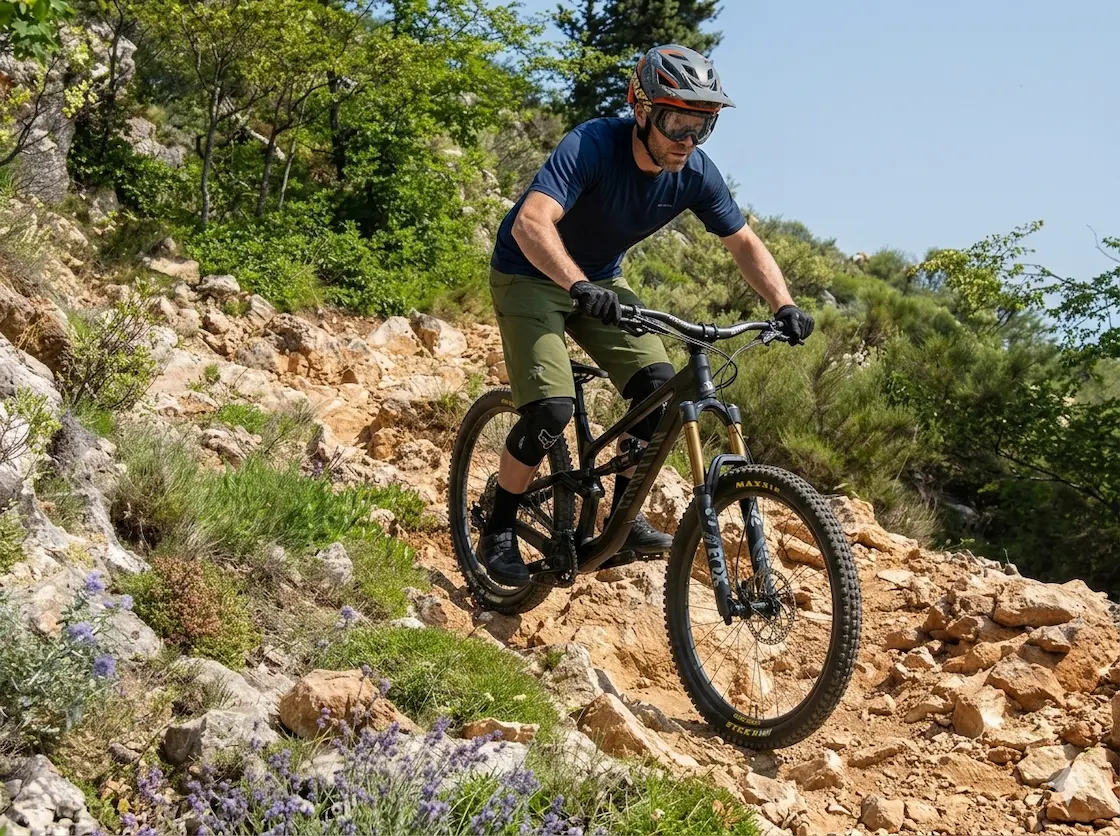
The terrain is completely different from the northern Alps: drier, rockier, more exposed, with Mediterranean light and dust instead of Alpine mud. The riding season is dramatically longer — you can ride year-round in the lower valleys and coastal ranges, with the high-altitude bike parks above 1,500m opening from June to September. The southern Alps offer everything from graded bike parks at ski stations like Isola 2000, Les Orres and Pra Loup to wild, unmarked singletrack through the terres noires badlands near Digne-les-Bains and the vertiginous trails threading the Gorges du Verdon.
This is also where the Roc d’Azur takes place each October in Fréjus — Europe’s largest mountain biking festival, attracting over 20,000 participants across XC, enduro, e-MTB and gravel events. And the Trans-Provence, one of the most prestigious multi-day enduro stage races in the world, winds through the backcountry of the Var and Alpes-Maritimes. Fewer crowds, warmer weather, longer days — and a riding heritage that runs deeper than most people realise.
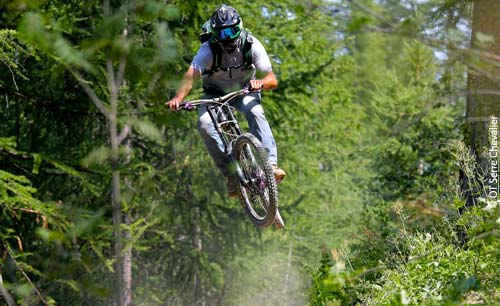
Serre Chevalier
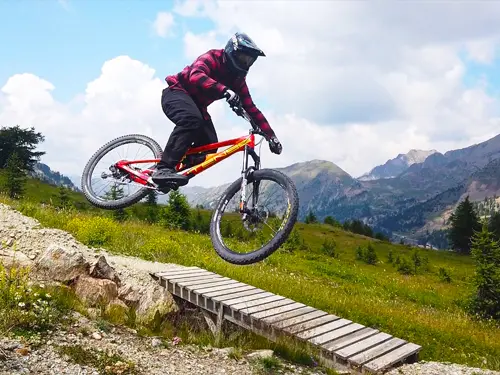
Isola 2000
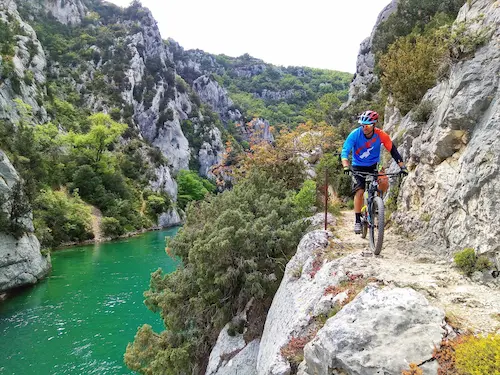
Verdon & Haute-Provence
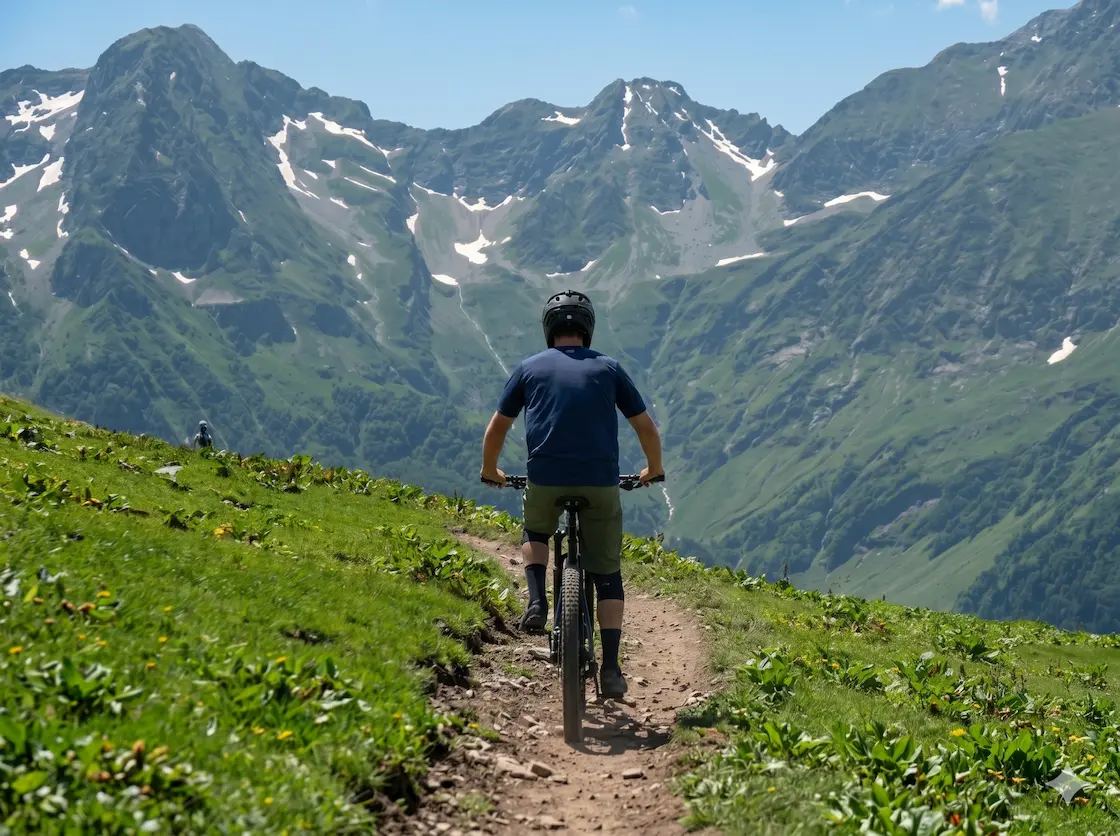
Mountain Biking in the Pyrenees
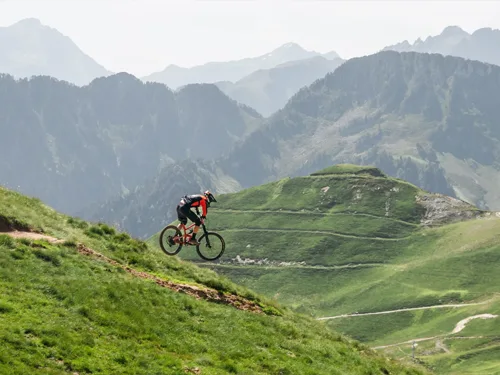
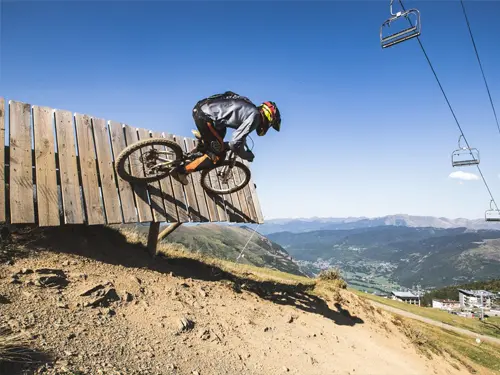
The Pyrenees are the wild card — less developed than the Alps, less crowded, less expensive, and increasingly on the radar of riders looking for something different. The mountains here are lower but steeper, the valleys narrower, the towns more authentically French (or Basque, depending on which end you’re at). The natural riding — ancient pastoral tracks, high cols with views into Spain, forest singletrack through beech and pine — has always been exceptional. What’s changed in recent years is the infrastructure.
Loudenvielle-Peyragudes has emerged as the Pyrenees’ flagship gravity destination, hosting UCI World Cup DH and enduro rounds in 2024 and 2025, with another gravity weekend confirmed for the 2026 season. Home wins for Benoît Coulanges (DH) and Morgane Charre (enduro) at Loudenvielle in 2024 put the venue — and the Pyrenees — firmly on the international racing map. The investment is visible on the ground: 19 enduro trails, two dedicated DH courses, and the longest green run in the Pyrenees at 13 km from the 2,200m summit. Saint-Lary, Cauterets and Les Angles have all followed suit with bike park development.
But the Pyrenees’ real strength is what the Alps are gradually losing to popularity: space, quiet, and the sense that you’re discovering something rather than consuming it. A Thursday in July on a Pyrenean singletrack feels like a Tuesday in September in the Alps — which is to say, you’ll often have the trail to yourself. The season runs June to October, with lower-altitude trails rideable from April. Bike park lifts typically operate July and August only.
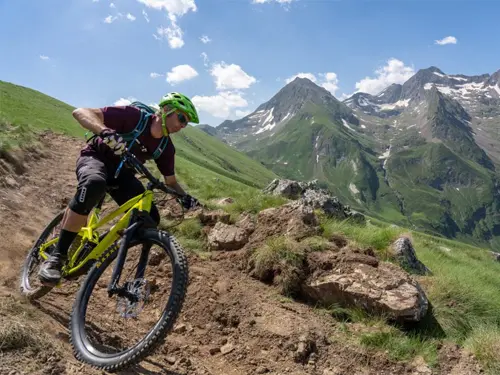
Loudenvielle / Peyragudes
Cauterets
Saint-Lary-Soulan
Riding Styles in France
France caters for every discipline of mountain biking — and the infrastructure to support each style is more developed here than almost anywhere else in Europe. Here’s what to expect.
Downhill & Bike Parks
France’s lift-accessed bike parks are among the best in the world. Ski resorts adapt their gondolas and chairlifts for bikes from mid-June, and purpose-built DH trails — graded green through black, maintained by dedicated bike patrol teams — give you maximum vertical with minimum pedalling. The biggest concentrations are in the northern Alps (Portes du Soleil, Les 2 Alpes, La Plagne, Tignes) and increasingly the southern Alps (Isola 2000, Les Orres) and Pyrenees (Loudenvielle, Les Angles). Expect to pay approximately €25–40 for a day lift pass at most resorts. A full-suspension bike with 160mm+ travel and body armour (full-face helmet, knee/elbow pads, back protector) is required — rental is available at every bike park resort.
Enduro
Enduro — timed descents linked by untimed climbs — has exploded in France, and the trail networks reflect it. Most alpine resorts now maintain graded enduro trails alongside their DH runs, and events like the Trans-Provence and the Enduro World Series stages have put French enduro riding on the global map. The terrain ranges from high-alpine rock gardens and exposed ridgelines in the Alps to dry, rooty forest descents in the South and Pyrenees. A 150–170mm travel trail/enduro bike is ideal. Many resorts offer “enduro shuttles” — minibus services that drive you and your bike to trailheads — as an alternative to full lift access.
Cross-Country & Trail Riding
France’s XC and trail riding is world-class but often overlooked by visitors who come only for the bike parks. The FFC (Fédération Française de Cyclisme) maintains approximately 180 dedicated Espaces VTT-FFC — waymarked trail centres with graded routes from green to black, repair facilities and maps — covering some 62,000 km of trails across the country. These are the backbone of French mountain biking: carefully waymarked loops through forests, across cols and along ridgelines, with difficulty ratings and distance clearly marked. You’ll find Espaces VTT everywhere there are hills — from the Vosges to the Massif Central, the Jura to the Pyrenees. The riding is on another level of scale compared to the UK — French XC climbs are long, steep and relentless, but the reward is descents of thousands of metres of vertical on fast, natural singletrack.
E-MTB
E-mountain biking — VTT à assistance électrique or VTTAE — is the fastest-growing segment in France, and the infrastructure has kept pace. Most major resorts now have dedicated e-MTB trails, and rental shops across the Alps, South France and Pyrenees stock modern full-suspension e-bikes. E-MTB opens up terrain that would otherwise require serious fitness: high-altitude XC loops, multi-day traverses, and long valley-to-peak rides that let you focus on the descents rather than the climbs. Les Gets, Serre Chevalier and the Portes du Soleil are particularly well set up for e-MTB, with specific trails and charging facilities. Expect to pay approximately €80–120 per day for e-MTB rental with a quality full-suspension bike.
Bikepacking & Multi-Day Traverses
France has some of the best bikepacking routes in Europe — and they’re far less crowded than the hiking equivalents. The Grandes Traversées VTT are seven waymarked long-distance MTB routes, maintained by the FFC, crossing entire mountain ranges over multiple days. They include the Traversée des Alpes (French Alps from Lake Geneva to the Mediterranean), the Traversée du Massif Central, and routes through the Jura, Vosges and Pyrenees. These are serious undertakings — typically 300–600 km with significant altitude gain — but the trails are marked and mapped, and gîtes d’étape along the routes provide accommodation and meals. For something shorter, self-guided loop tours of 3–5 days are easy to plan in the southern Alps, the Verdon and the Pyrenees.
Trail Grading System
Mountain bike trails in France use a colour-coded grading system similar to ski runs. Green trails are suitable for beginners and families — wide paths, gentle gradients, no technical features. Blue trails are for intermediate riders — narrower singletrack, moderate gradient, some roots and rocks. Red trails are for experienced riders — steep, technical, with features like drops, tight switchbacks and exposure. Black trails are expert-only — steep, very technical, with significant obstacles and consequence. This system is consistent across all FFC-managed trail centres and most bike parks. Be aware that a green trail in mountain biking is more demanding than a green ski run — even the easiest trails require basic bike handling skills.
Bike Rental & Transport
Renting a Bike in France
Every major mountain biking resort in France has at least one — usually several — bike rental shops offering current-model trail, enduro and DH bikes. Expect to pay approximately €50–80 per day for a quality full-suspension enduro bike and €60–90 per day for a DH bike with body armour. Multi-day rentals reduce the daily rate significantly — a week typically costs 4–5 times the daily rate, not seven. E-MTB rental runs approximately €80–120 per day. Book ahead in July and August, especially at popular resorts like Morzine and Les Gets where demand is high. Most shops also offer basic hardtails from around €30 per day — good for XC trails and family riding.
Bringing Your Own Bike
If you’re driving to France from the UK, getting your bike there is straightforward — roof rack or inside the vehicle via the Eurotunnel or ferry. Flying with a bike is more involved. Most airlines accept bikes as oversized baggage at a surcharge of €50–100 each way — you’ll need a padded bike bag or hard case (essential for the return journey, too). Budget airlines have stricter limits and higher fees. Geneva, Lyon and Grenoble are the main airports for the northern Alps; Nice and Marseille for the South; Toulouse and Pau for the Pyrenees.
Bikes on French Trains
SNCF allows bikes on most regional TER trains for free — but space is limited and not guaranteed. High-speed TGV trains require a bike reservation (approximately €10) and your bike must be partially disassembled and bagged. The Eurostar also accepts bagged bikes. For alpine destinations, the most reliable option is to fly or drive and use local shuttles or transfers. Most resort transfer companies (airport to resort) accept bikes — confirm when booking.
MTB Gear Guide
From Alpine downpours on an August afternoon to the dry, dusty heat of a Provençal descent, the gear you bring to France makes a real difference. Our MTB gear guides cover the essentials — tested on the trails and conditions you’ll actually ride.
New: Arc’teryx Rhoam MTB Collection
Arc’teryx launched their first dedicated mountain bike clothing line in April 2026 — the Rhoam collection. Three pieces: a hybrid jacket combining Gore-Tex with softshell (€450), riding pants with mapped stretch zones (€280), and shorts (€180). All designed and tested on Vancouver’s North Shore trails, with PFAS-free fabrics and an emphasis on durability over disposability. The jacket features a helmet-compatible hood, on-bike pockets, and sealed seams in the areas that take the most weather. Early reviews suggest the fit and tech are genuinely impressive — though the price asks you to commit. Worth it if you ride in wet alpine conditions regularly and want gear that lasts years rather than seasons.
MTB Events in France
France hosts some of the biggest and most prestigious mountain biking events in the world. If you can time your trip around one of these, you’ll see the best riders on the planet — and ride trails that are in peak condition.
Megavalanche — Alpe d’Huez, July. A mass-start downhill race from the glacier at 3,330m to the town at 720m — 2,600m of vertical drop in a single run. Chaotic, spectacular, and open to amateurs.
Pass’Portes du Soleil — Morzine / Portes du Soleil, late June. A three-day MTB festival covering 80 km across all 12 Portes du Soleil resorts with 1,000m of climbing and 6,000m of descent. Open to all riders.
Roc d’Azur — Fréjus, October. The largest MTB festival in Europe — four days of racing, demo rides, and expo on the Mediterranean coast. XC, enduro, e-MTB and gravel events for all levels. Over 20,000 participants.
Trans-Vésubié / Trans-Provence — South of France, various dates. Multi-day enduro stage races through the backcountry of the Alpes-Maritimes and Var — raw, challenging, and extraordinarily beautiful.
UCI Mountain Bike World Cup — Haute-Savoie and Loudenvielle-Peyragudes host DH, XC and enduro rounds in both 2025 and 2026.
Plan Your Trip
Best Time to Ride
French Alps: Mid-June to mid-September is the core bike park and trail season. Lifts typically open from the second or third week of June — exact dates vary by resort and snow conditions. July and August are peak season: everything is open, but trails are busy and accommodation books up fast. September is the insider’s choice — quieter trails, stable weather, autumn light in the forests, and lower prices.
South of France: This is where you ride when the Alps season is closed. Lower-altitude trails around the Verdon, Haute-Provence and the Mercantour foothills are rideable year-round, with spring (March–June) and autumn (September–November) the sweet spots — warm, dry, uncrowded. High-altitude bike parks (Isola 2000, Les Orres) open mid-June to early September. Avoid July–August below 1,000m unless you enjoy riding in 35°C heat.
Pyrenees: June to October, with bike parks operating July–August only. The shoulder months are excellent for XC and enduro riding — lower trails are accessible from April in good years. October can be outstanding: warm, dry, golden light in the beech forests.
Lift Pass Costs
Bike park lift passes in France typically cost €25–40 for a single day. Multi-day passes offer better value — a 6-day Portes du Soleil pass is approximately €170–200 (under 16s significantly cheaper). Some resorts — notably Tignes — include bike lift access in their all-activity summer cards. Season passes, where available, run €250–400 depending on the resort and network. Passes are usually available online at a discount — buy at least a day ahead to skip queues.
Getting There
By air: Geneva (for Portes du Soleil, Chamonix), Lyon and Grenoble (for Tarentaise, Oisans resorts), Nice (for southern Alps — Isola, Auron, Serre Chevalier via A51), Toulouse and Pau (for Pyrenees). Airport transfer services accept bikes — book in advance and confirm bike capacity.
By car/tunnel: Eurotunnel or Channel ferry to Calais, then autoroute south. The most flexible option — drive with your bike on a roof rack or inside the vehicle, stop when you want, and easily combine multiple resorts.
By train: Eurostar to Paris or Lille, then TGV connections to Grenoble, Chambéry, Briançon, Toulouse or Pau. Regional TER trains cover the last miles to resort towns. Bikes ride free on TER trains; TGV requires a reservation and bike bag.
Mountain Biking in France — FAQ
For the French Alps, mid-June to mid-September — with September often the best month for trail conditions, weather and crowds. For the South of France, you can ride year-round at lower altitudes, with spring and autumn the sweet spots. The Pyrenees run June to October, with bike parks operating in July and August only.
Les Gets and Saint-Lary are the standout choices. Both have well-graded progression trails from green upward, skills areas, pump tracks, and bike schools with qualified instructors. La Plagne’s Colorado Bike Park is another excellent option. Remember that a green trail in mountain biking is more demanding than a green ski run — basic bike handling skills are essential even at the easiest level.
Yes — every mountain biking resort in France has rental shops offering current-model bikes. Expect to pay approximately €50–80 per day for a full-suspension enduro bike, €60–90 for a DH bike with body armour, and €80–120 for an e-MTB. Multi-day rates are significantly cheaper. Book ahead in July and August at popular resorts.
Day passes at most French bike parks cost approximately €25–40 per adult. Multi-day passes offer better value — a 6-day Portes du Soleil pass runs approximately €170–200. Children and under-16s are significantly discounted. Some resorts include bike lift access in all-activity summer cards. Buy passes online in advance for the best rates.
France is one of the best destinations in Europe for e-MTB. Most major resorts now have dedicated e-MTB trails, and rental shops stock modern full-suspension e-bikes. Les Gets, Serre Chevalier and the Portes du Soleil are particularly well set up, with marked e-MTB routes, charging facilities and guided tours. Expect to pay €80–120 per day for rental.
Yes — strongly recommended. Standard travel insurance policies often exclude mountain biking, particularly lift-accessed riding and downhill, which may be classified as “hazardous activity.” Check your policy carefully and take out specialist sports travel insurance if needed. Rescue and medical treatment in remote mountain areas can be extremely expensive without appropriate cover.
The easiest option is driving — Eurotunnel or ferry, bike on a roof rack or in the vehicle. Flying with a bike is possible on most airlines at a surcharge of €50–100 each way — you’ll need a padded bike bag or hard case. Alternatively, rent a bike on arrival — the quality of rental bikes in France is excellent. Eurostar accepts bagged bikes; SNCF regional trains carry bikes free.
The Alps have the most developed infrastructure — the biggest bike parks, the most lifts, the best-known resorts. The South of France is drier, quieter, and rideable year-round — best for adventure riding, natural singletrack and bikepacking. The Pyrenees are the wild card: less infrastructure, but growing fast, with raw natural trails, authentic mountain towns, and far fewer riders.
Not in the Alps or Pyrenees at altitude — snow closes the high trails from November to May. But the South of France — particularly the Verdon, Haute-Provence, and the Mediterranean hinterland — offers genuine year-round riding at lower altitudes. Spring and autumn are the best seasons for the South.
Watch This: South Crew X Isola 2000
Isola 2000’s bike park sits at the crossroads of the Alps and the Mediterranean — high-altitude gravity riding just 90 minutes from Nice. This edit from South Crew captures the raw, rocky character of the trails above the Tinée valley.
Mountain Biking France — Instagram
Tag your mountain biking pics and clips @ultimatefrance to be featured.
Please leave a comment below if you need specific advice for your mountain biking trip to France, or if you have any recommendations to help us improve this page. Happy trails!