Paragliding in the French Alps
The best paragliding sites in the French Alps — flying site info, best time to fly, site rules, and tandem flights
HAUTE-SAVOIE | SAVOIE | ISÈRE | SEASON GUIDE | TANDEM FLIGHTS | LEARN TO FLY | RULES | WHAT TO PACK | WEATHER | BEYOND THE FLYING | FAQ
The French Alps is home to some of the best flying sites in Europe. The high mountain terrain and reliable weather create ideal flying conditions suitable for all pilots from beginner to pro. Experienced pilots will appreciate the lift infrastructure in the French Alps ski resorts, which provides easy access to some amazing high-altitude take-off sites. If you’re new to the sport, or considering taking lessons, a tandem flight with a qualified instructor is a superb way to experience the thrill of free-flight, and it’s hard to beat the French Alps for jaw-dropping mountain scenery.
This guide covers 12 flying sites across three départements — Haute-Savoie, Savoie, and Isère — with launch and landing coordinates, hazards, club contacts, and honest assessments of what to expect in the air. Whether you’re planning a week of XC flying, a tandem flight over Lac d’Annecy, or your first paragliding course, you’ll find everything you need to plan your trip below.
Experience the thrill of a tandem paragliding flight and see the French Alps from above, or take part in a course and learn to pilot your own wing. Paragliding schools offering tandem flights, discovery courses, pilot training and fly guiding operate throughout the region.
When to Fly — Paragliding Season in the French Alps
You can fly year round in the French Alps. Paragliding schools and tandem pilots generally operate from April to November when longer daylight hours mean you can take advantage of morning and evening flying and avoid the bumpy air often experienced during the middle of the day. In the winter, smooth, cold air, gentle thermals and light valley winds means flying can also be very pleasant. With an average of 24 flying days per month and with most days suitable for beginner training, you can be confident that you’ll get some good flying days in during your paragliding holiday.
The thermal season runs from late April through September. Thermals typically start triggering by mid-morning as the sun heats south-facing slopes, peak between 1 pm and 4 pm — when conditions can be punchy and turbulent — and smooth out in the late afternoon for some of the best flying of the day. June through August gives you the highest cloud bases (often above 3,000 m) and the longest daylight window, making this the prime season for cross-country flying. The downside is crowds — popular sites like Col de la Forclaz and Saint-Hilaire-du-Touvet get seriously busy at weekends.
Spring and autumn are underrated. May and September offer good thermals with fewer pilots on launch, and the lower sun angle creates beautiful flying light. October can still produce excellent days, particularly in the southern Isère sites, though the window shortens fast.
Winter flying is a different proposition entirely. Short days, low sun, and weak thermals limit your airtime, but the air is silky smooth and the mountain scenery — snow-covered peaks under blue skies — is spectacular. Some lift-accessed launches close during the ski season (La Cachette at Bourg-Saint-Maurice, for example), so check before you drive up.
French Alps Paragliding Sites Map
Use the interactive map below to explore all the flying sites covered in this guide. Click on a marker for launch altitude, orientation, and a link to the site’s live FFVL weather station where available.
Haute-Savoie — Paragliding Sites
Haute-Savoie borders Lac Léman and Switzerland to the north and Italy to the west, and is home to the majestic Mont Blanc, the highest mountain in the Alps. It’s also here that you’ll find some of the best known ski resorts in the French Alps, including Chamonix, La Clusaz and Morzine. Short transfer times from Geneva airport make Haute-Savoie in the northern French Alps a favourite destination for paraglider pilots arriving by plane.
Haute-Savoie is also where paragliding was born — at Mieussy in 1978 — and today it’s where you’ll find the highest concentration of flying sites, schools, and tandem operators in the Alps. From the world-famous Col de la Forclaz above Lac d’Annecy to the glacier-flanked launches of the Chamonix Valley, this département alone could keep a pilot busy for a season.
1. Annecy — Col de la Forclaz
Altitude: 1,240 m. Orientation: N, NW, W, SW. Local Club: Annecy Vol Libre. Nearest Airport: Geneva (1 h). Launch Lat/Long: 45.810, 6.220. Land Lat/Long: 45.783, 6.218 (Doussard). Hazards: Extremely crowded in peak season; regulator at take-off; overflight of the réserve du bout du lac prohibited below 200 m AGL; vehicle access badge required. Season: Mid-April–October (tandem); all year (solo pilots in suitable conditions). Live Wind: Check conditions on Balise Météo →
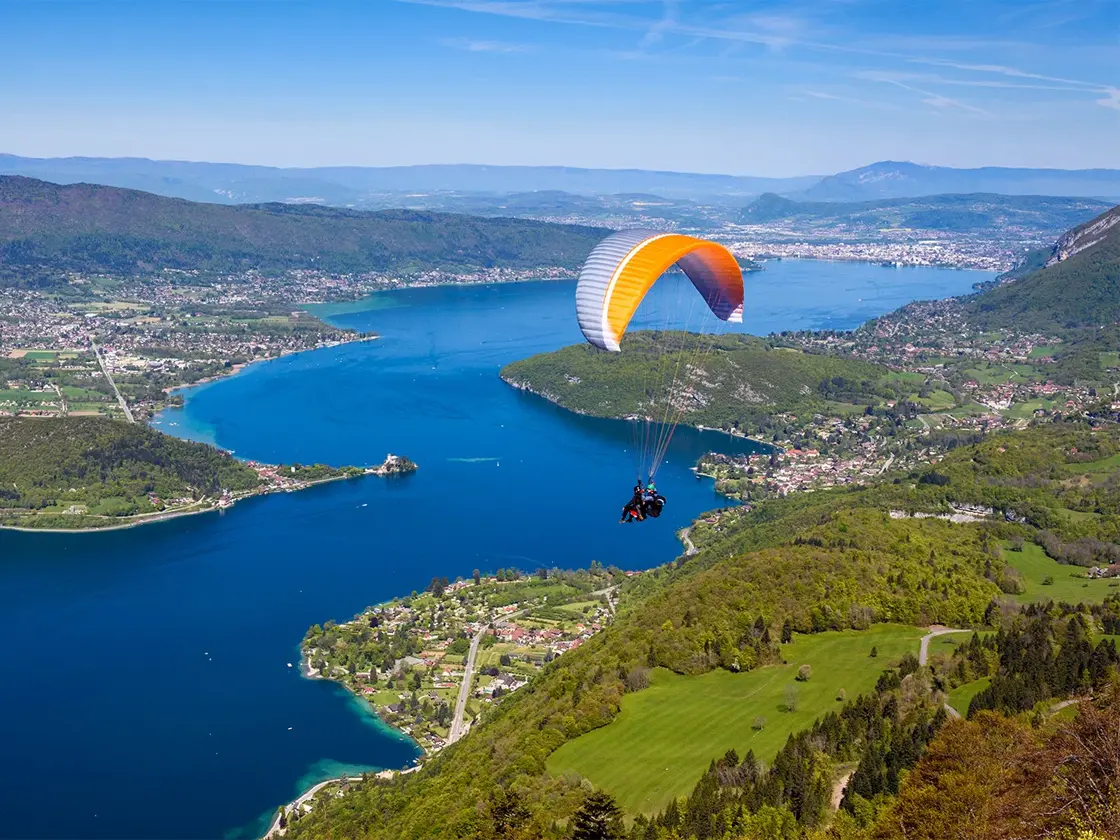
If there’s one paragliding site in France that needs no introduction, it’s the Col de la Forclaz above Lac d’Annecy. This is the most famous tandem site in the Alps and one of the busiest launch areas in Europe — over 1,000 take-offs per day in peak summer. The reason is obvious the moment you’re airborne: the turquoise lake below, La Tournette and the Dents de Lanfon rising on either side, and on clear days, Mont Blanc on the horizon. It’s a view that chastens even the most hardcore XC pilots.
The main launch at 1,240 m faces north-west to south-west, which means it works in the dominant afternoon valley breeze. Vehicle access to the launch road now requires a paid badge — pick one up from the Mairie de Doussard or Talloires before you drive up. In peak season, a regulator controls the flow of pilots on take-off. If you’re flying solo, the right-hand side of the launch is reserved for autonomous pilots; tandem operators use the left. The main landing is at Doussard at the southern end of the lake — a big field with shuttle buses back up to the col in summer. The Doussard landing is straightforward in calm conditions, but watch for gradient in a strong northerly, which gets redirected by the Roc des Bœufs ridge.
The Col de la Forclaz is also a top spot for SIV courses, with a designated training zone over the lake. Annecy Vol Libre, the local club, is a good first contact for visiting pilots.
2. Planfait
Altitude: 960 m.Orientation: NW, W, SW. Local Club: Les Chamois Volants. Nearest Airport: Geneva (1 h). Launch Lat/Long: 45.8532, 6.223. Land Lat/Long: Perroix, Talloires. Hazards: Turbulent in NE wind; do not overfly “la maison du plombier”; gradient at landing in strong breeze. Season: April–October. Live Wind: Check conditions on Balise Météo →
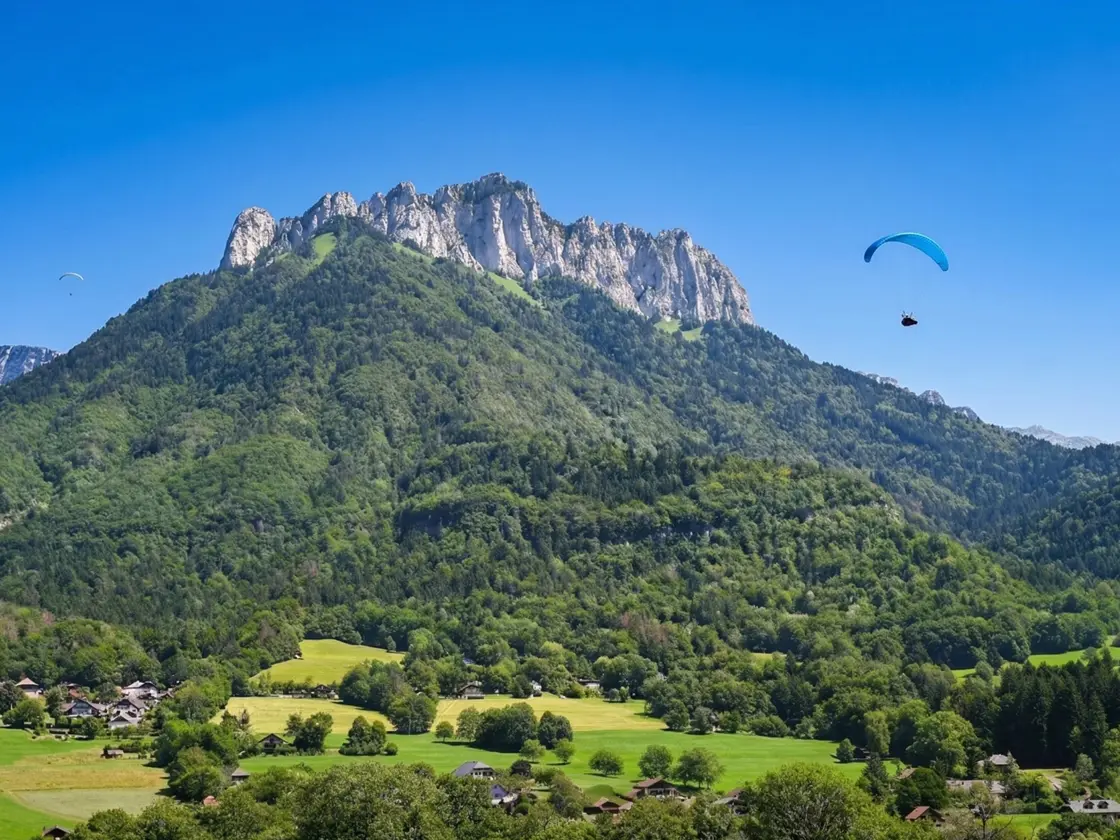
Planfait sits just above Talloires-Montmin on the eastern shore of Lac d’Annecy and offers a quieter alternative to the Col de la Forclaz. The launch is lower at 950 m, which means less vertical to play with on a top-to-bottom, but in thermal conditions Planfait is the fastest route to the Dents de Lanfon — a natural XC stepping stone toward the Bauges massif or the classic petit tour du lac.
The take-off is well laid out with a carpeted area and windsock. Access is by car (15 min climb from Talloires, follow signs for Acro’Aventure) or by the eco-navette shuttle from the landing in summer for €2. Conditions are very different to Forclaz in a north-easterly wind — Planfait becomes turbulent and potentially dangerous while the col may still be flyable. In a southerly, the opposite applies: Planfait handles it better. Check with the local club before committing. Landing is at Perroix in Talloires — watch for gradient in a strong afternoon breeze.
3. Paragliding in the Chamonix Valley
Altitude: 3,700 m (Aiguille du Midi); 2,000 m (Plan Praz). Local Club: Les Gratte-Ciel. Nearest Airport: Geneva (1 h 10 min). Launch Lat/Long: 45.918234, 6.870099 (Plan Praz). Land Lat/Long: Bois du Bouchet / Savoy — check arrêtés. Hazards: LF-R30 restricted airspace over Mont Blanc massif; helicopter activity; enclavé landings; strong valley breeze in afternoon; Gravière at Cachat landing for confirmed pilots only. Season: All year (conditions permitting; some landings closed in winter). Live Wind: Check conditions on Balise Météo →
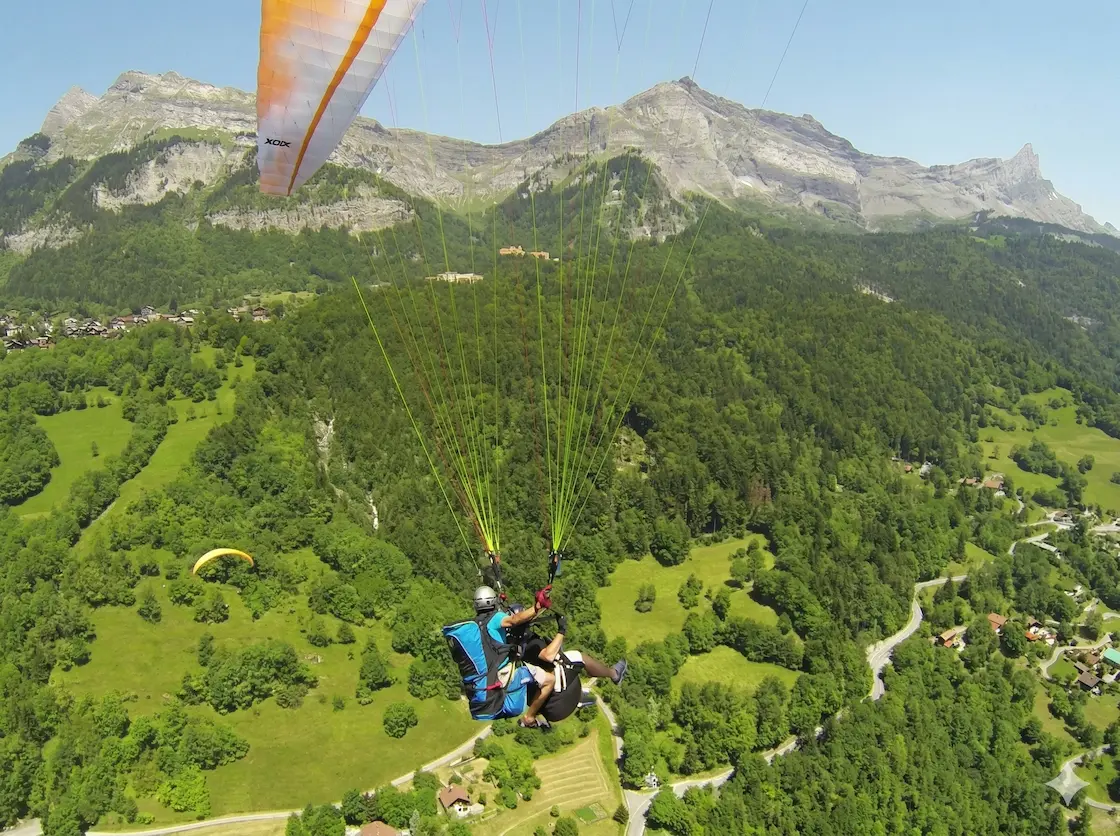
Chamonix is the epicentre for mountain sports in France and paragliding is well established here with well-run launch and landing sites and good transport links. With lift accessible launch sites including the Grands Montets (3200 m) and the Aiguille du Midi (3700 m), the paragliding in the Chamonix Valley is incredible. The out and returns, triangles and open distance possibilities are limitless. A highlight for cross country pilots is the Plan Praz launch site accessible from Chamonix via the Brévent gondola.
Plan Praz at around 2,000 m is the most popular XC launch — it faces west and picks up thermals off the valley slopes beautifully from late morning. The Aiguille du Midi launch at 3,700 m is reserved for experienced mountain pilots only — the air is thin, the take-off is steep, and the consequences of getting it wrong at altitude are serious. The valley’s main landings are at Bois du Bouchet and the Savoy field — but both are subject to municipal arrêtés that can close them without notice, particularly during ski season and town events. Always check locally before flying.
The critical safety note for Chamonix: the LF-R30 restricted airspace zones cover the Mont Blanc massif. Paragliders and hang gliders must not penetrate LF-R30 A or B at any time. From July through August, take-off, overflight, and landing on the Mont Blanc summit are strictly prohibited. These zones exist to keep the corridor clear for mountain rescue helicopters — respect them.
4. Passy Plaine-Joux
Altitude: 1,360 m. Orientation: S, SE. Local Club: Club Vol Libre du Pays du Mont-Blanc. Nearest Airport: Geneva (1 h 20 min). Launch Lat/Long: 45.9496, 6.7398. Land Lat/Long: 45.9284, 6.7249 (Chedde). Hazards: Afternoon valley breeze reinforcement; helicopter activity near Mont Blanc. Season: All year. Live Wind: Check conditions on Balise Météo →
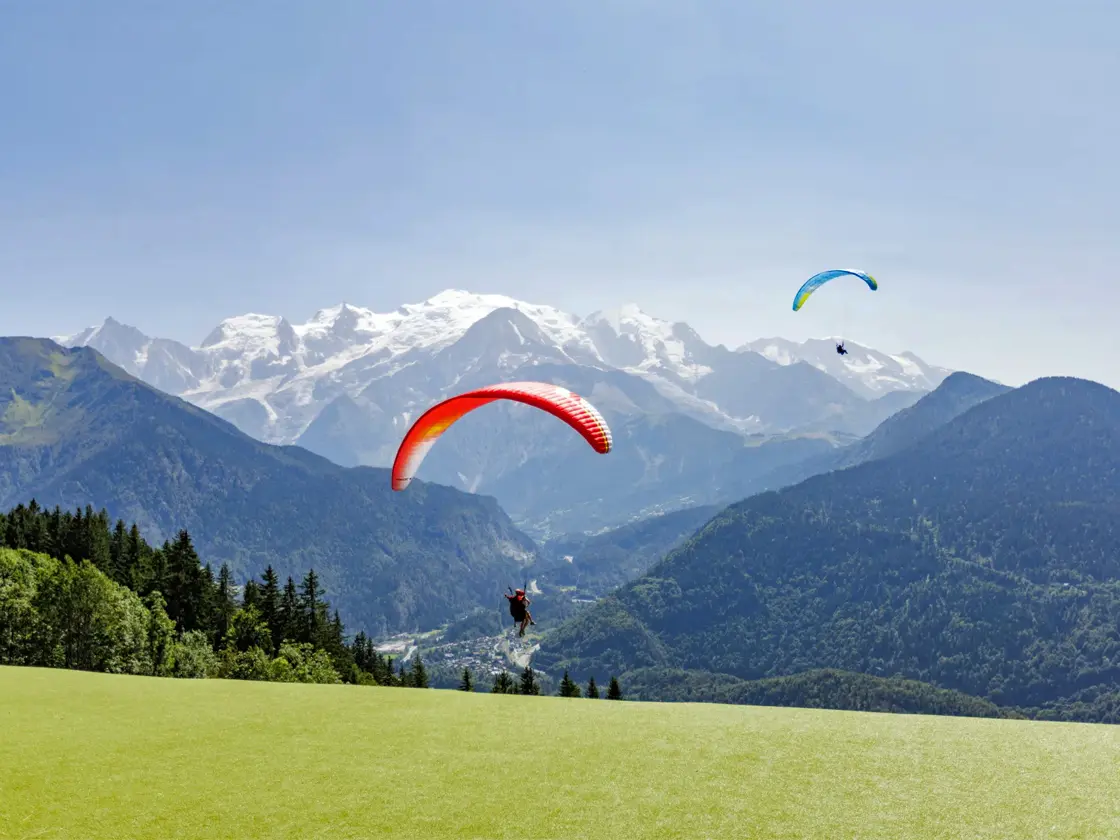
Plaine Joux is one of those sites where you spend the first five minutes after take-off just staring at the view. The launch faces south at 1,360 m on the flanks of the Chaîne des Fiz, and directly opposite you — filling the entire horizon — is the Mont Blanc massif. It’s arguably the best panorama from any paragliding launch in the Alps.
The take-off area was refurbished in 2018 with a proper carpeted surface and is easily accessed by road — park at the Plaine Joux car park and you’re practically on launch. This is a walk-up site only; there are no lifts. Landing is at Chedde in the valley, a straightforward field alongside the river. Be aware that the afternoon valley breeze strengthens considerably here — morning flying tends to be smoother and more predictable. Plaine Joux is both a popular tandem site and a genuine XC launch, with routes south toward the Aravis and connections to the broader Chamonix–Sallanches valley system.
5. Paragliding in Morzine
Altitude: 1,550 m. Local Club: Ailes Morzinoises. Nearest Airport: Geneva (1 h 20 min). Launch Lat/Long: 46.192500, 6.721681. Land Lat/Long: 46.179185, 6.703610. Hazards: Ski lift cables near Pleney landing site. Season: All year. Live Wind: Check conditions on Balise Météo →
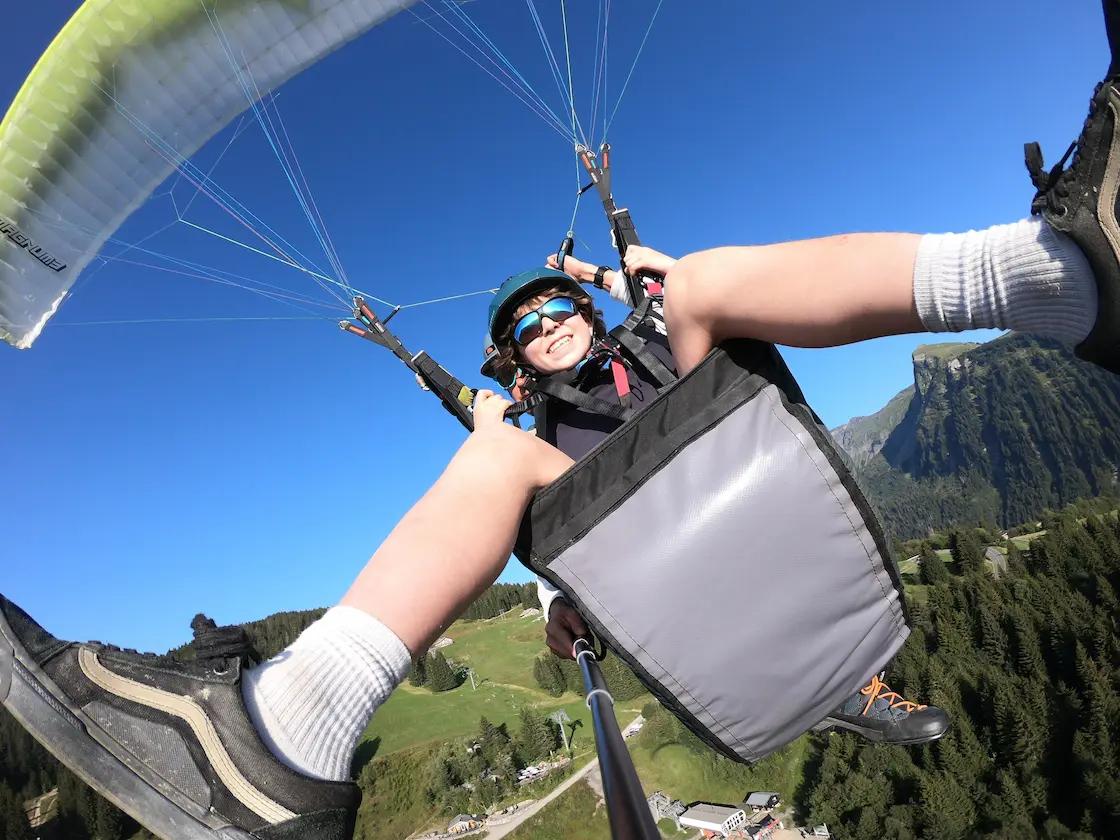
The official FFVL take-off in Morzine is located on the Super Morzine side of the valley on the road up to Avoriaz. The south facing slope works in southerly and westerly winds. There’s a choice of 2 official landing sites. The first is next to the Hotel Champs Fleuris by the Pleney lift in Morzine town, just watch out for the ski lift cable along the far side. The second is a straightforward landing spot located about 1 km out of town on the road to Avoriaz. Local paragliding schools operate a training field right in Morzine.
Morzine is a good all-round flying destination with plenty to do on the ground when conditions aren’t flyable. The town is a major mountain biking hub in summer and a busy ski resort in winter, so you won’t be short of rest-day activities. The Portes du Soleil lift system also opens up high-altitude launch possibilities in summer — check locally for current access.
6. Paragliding in Mieussy
Altitude: 1,640 m. Local Club: Démenciel Parapente. Nearest Airport: Geneva (1 h 12 min). Launch Lat/Long: 46.142947, 6.546104. Land Lat/Long: 46.130473, 6.526259.Hazards: Crowded at weekends. Season: All year. Live Wind: Check conditions on Balise Météo →
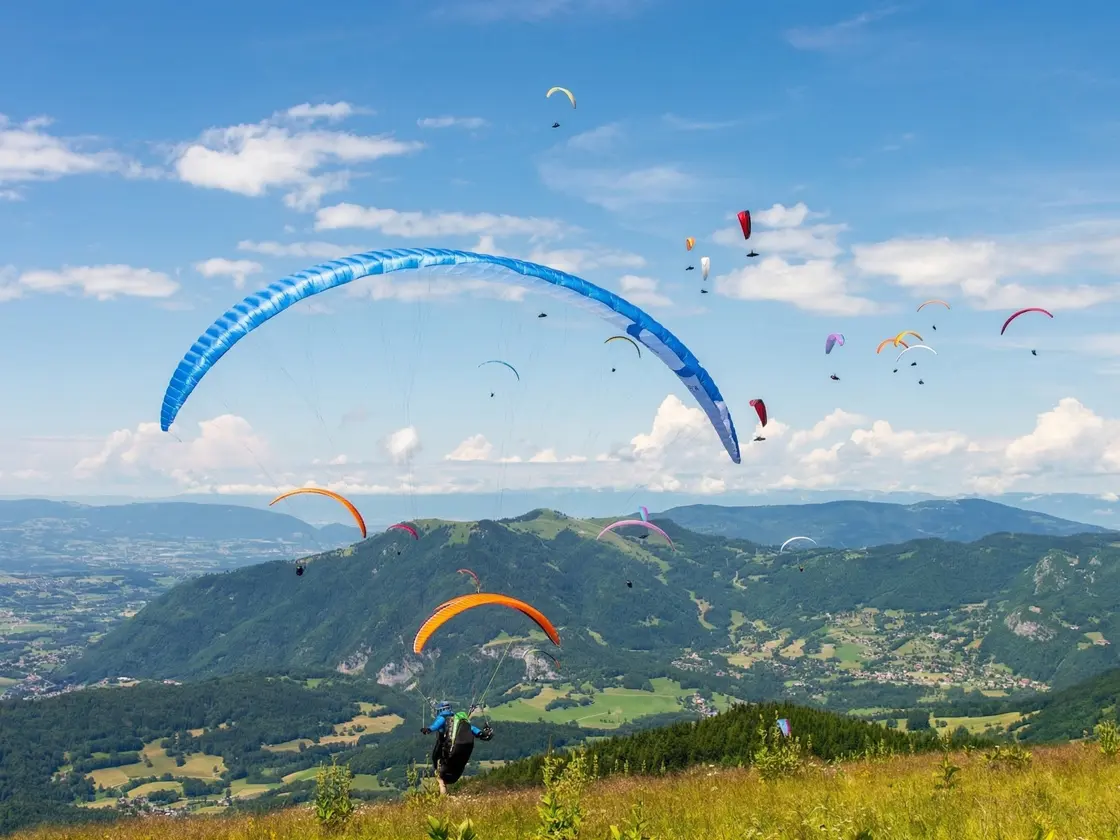
Mieussy in the Massif du Chablais became known as the birthplace of paragliding when in 1978 Jean-Claude Bétemps, André Bohn and Gérard Bosson successfully launched their rectangular parachutes from Pointe du Pertuiset. Slope soaring, or parapente was born! The main launch called Pertuiset on the Sommand Plateau, accessible via the Sommand resort road, is an easy 15 minute walk from the car park. Hike 20 minutes further up to Pointe de Perret, to avoid weekend crowds. Land in a field in the village at the end of Chemin Rural de Mieussy. Good cross-country flying opportunities from April through to the end of the summer with routes via the Col de la Colombière to Mont Lachat.
The historical significance of Mieussy gives the site a special atmosphere — you’re flying from the same slope where the sport was invented. It’s a nice, easy site and popular with local clubs, which means it does get busy at weekends. If the main launch is packed, the hike to Pointe de Perret is well worth the extra 20 minutes for a quieter take-off and a few hundred extra metres of altitude.
7. Samoëns
Altitude: ~1,100 m (launch). Local Club: Check FFVL carte interactive. Nearest Airport: Geneva (1 h 15 min). Launch Lat/Long: Check FFVL site database. Land Lat/Long: Check FFVL site database. Hazards: Afternoon valley breeze. Season: May–October. Live Wind: Check conditions on Balise Météo →
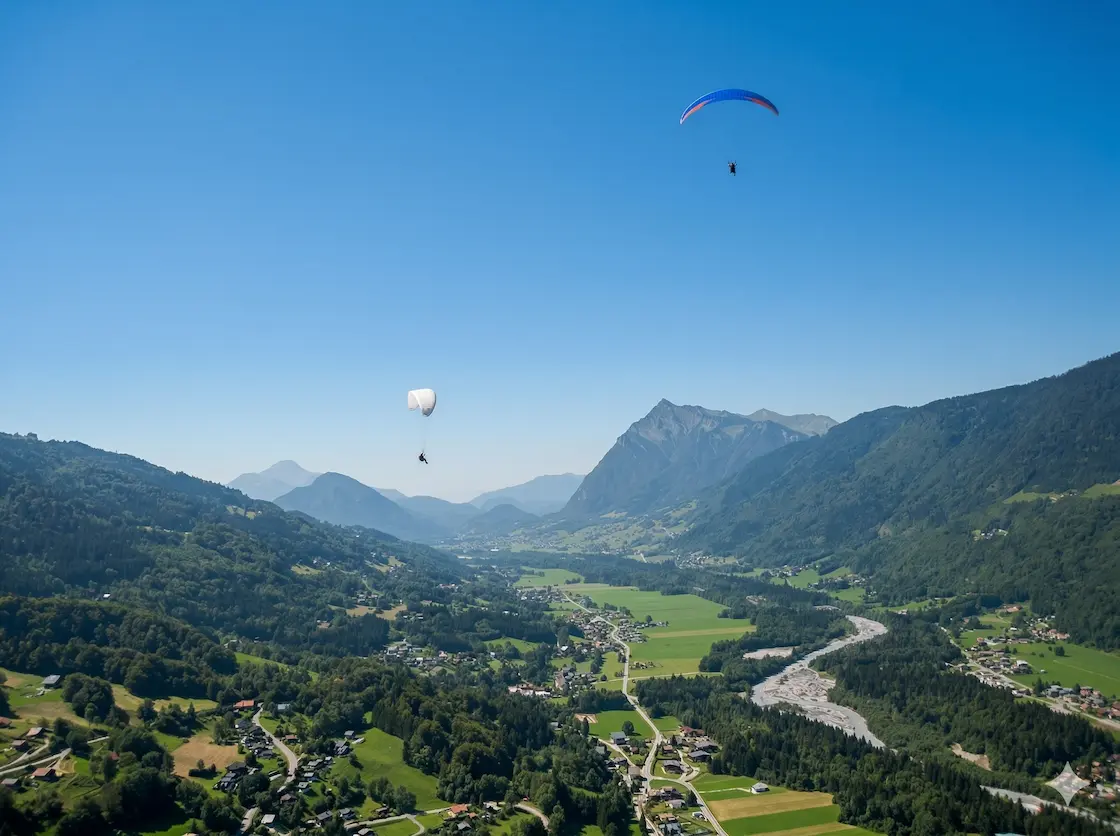
Samoëns sits in the Giffre valley between Cluses and Sixt-Fer-à-Cheval, and the flying here benefits from the same reliable valley breeze system that powers the bigger Arve valley sites. The main launch is from the top of the Grand Massif Express cable car. Land in the field behind Lac aux Dames. It’s a quieter alternative to the busier Haute-Savoie sites and connects well to the Plaine Joux area for longer XC routes.
Samoëns is also a great summer resort with hiking, biking, rafting, and via ferrata all easily available. As a mountain biking destination, it’s known for its steep natural trails through the forest with lift access in summer (June to end of August). This makes Samoëns a good base for pilots travelling with non-flying partners or families who want something to do on the ground.
Savoie — Paragliding Sites
Savoie is made up almost entirely of high altitude terrain including the vast mountain area of the Vanoise National Park and iconic peaks like Mont Pourri, the Dent Parrachée and La Grande Motte. It’s home to the largest number of ski resorts in France, including those of the 3 Valleys and the Tarentaise Valley. Paragliding highlights include Bourg-Saint-Maurice, Les Arcs and Tignes with several flying schools and the PCHT, a well-established paragliding club.
The big advantage of Savoie for paragliding is the ski resort lift infrastructure. In summer, gondolas and chairlifts that serve skiers in winter give pilots easy access to high-altitude launches without the hike. The Tarentaise Valley — running from Bourg-Saint-Maurice through Moûtiers to Albertville — is a natural XC corridor with thermals triggering off both flanks.
8. Paragliding in Bourg-Saint-Maurice
Altitude: 2,131 m. Local Club: PCHT. Nearest Airport: Geneva (2 h) / Chambéry (1 h 30 min). Launch Lat/Long: 45.576520, 6.799507. Land Lat/Long: 45.593208, 6.752219. Hazards: Ski lift cables; La Cachette closed during ski season. Season: All year (La Cachette: summer only). Live Wind: Check conditions on Balise Météo →
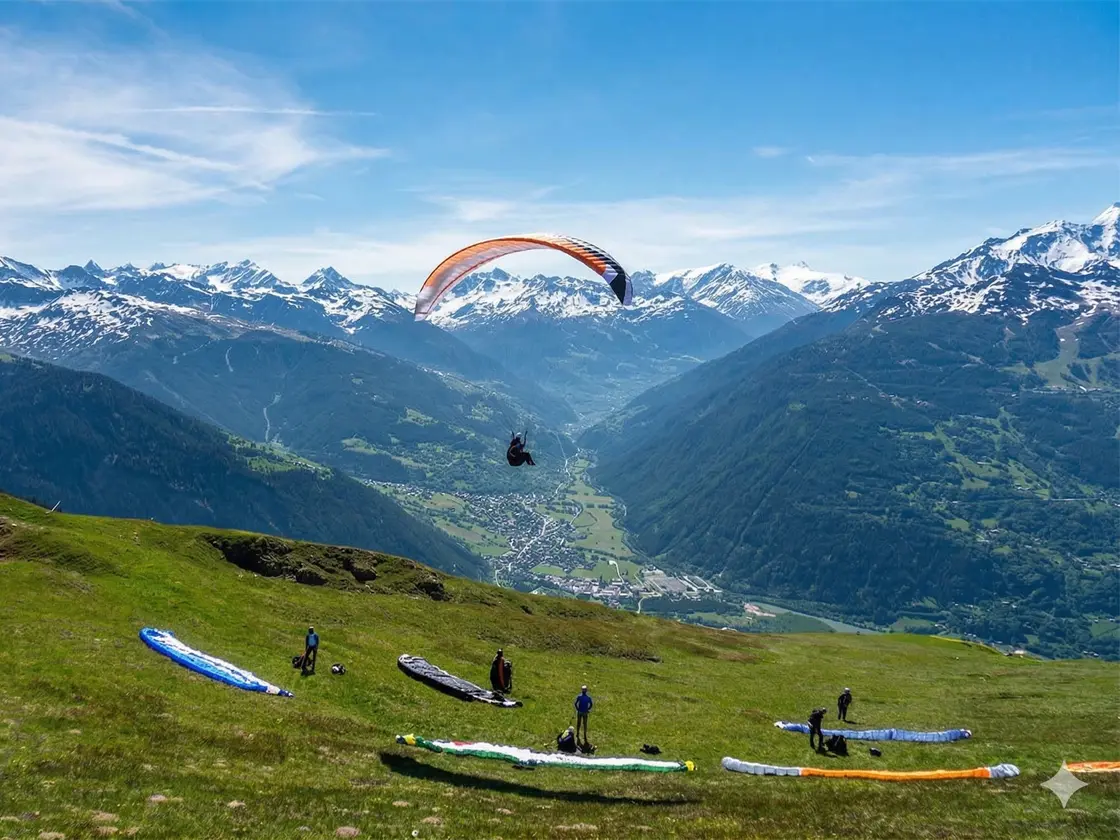
There’s great flying around Bourg-Saint-Maurice with lots of paragliding schools offering tandem flights and lessons, and a well-established paragliding club, the Parapente Club de Haute Tarentaise. There are 3 official launch sites from 1439 m to 2131 m in altitude. La Cachette is a straightforward launch site for newly qualified pilots and easy to reach using the funicular and La Cachette chairlift or on the road with the summer shuttle bus. It’s forbidden to fly from here during the ski season. The main official landing site called Atterrissage des Ilettes is 2 km south of Bourg in a big field alongside the Isère river.
The PCHT club is active and welcoming to visiting pilots — get in touch before you arrive and they’ll point you toward the best launches for the day’s conditions and let you know about any site restrictions.
9. Les Arcs / La Rosière
Altitude: ~2,000 m (lift-accessed). Local Club: PCHT. Nearest Airport: Geneva (2 h) / Chambéry (1 h 30 min). Launch Lat/Long: Check FFVL site database. Land Lat/Long: Les Ilettes (as per Bourg-Saint-Maurice). Hazards: Lift access dates vary; check resort opening schedules. Season: June–September (lift-dependent). Live Wind: Check conditions on Balise Météo →
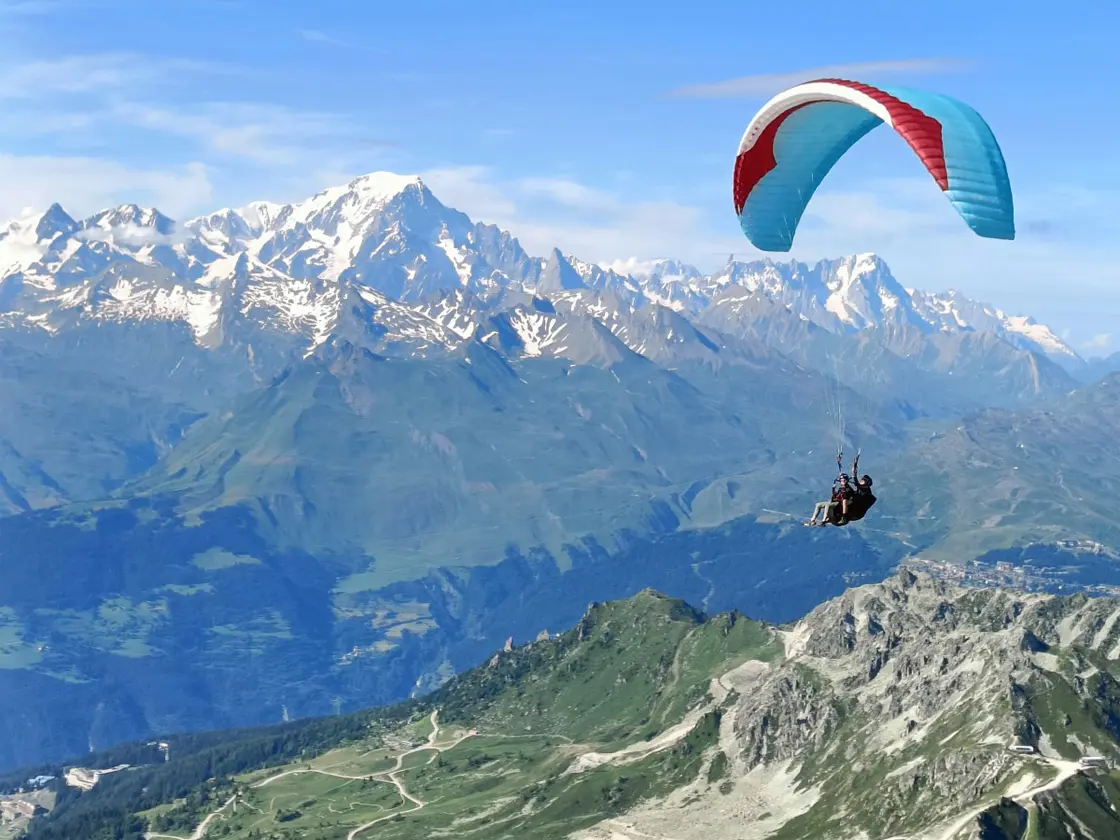
The ski resort infrastructure at Les Arcs gives pilots access to high-altitude launches via the Bourg-Saint-Maurice funicular and connecting chairlifts — in summer, this is one of the easiest ways to reach 2,000 m+ take-offs without walking. La Rosière, across the valley toward the Petit-Saint-Bernard pass, adds a second set of possibilities with west-facing slopes that catch the afternoon sun.
Flying here connects naturally with the Bourg-Saint-Maurice sites — the PCHT club covers the whole upper Tarentaise — and the big, open landing field at Les Ilettes serves both areas. Summer lift opening dates vary by year, so confirm with the resort before planning your trip around lift access.
10. Courchevel
Altitude: 2,740 m (Saulire). Local Club: Check FFVL carte interactive. Nearest Airport: Chambéry (1 h 30 min) / Geneva (2 h). Launch Lat/Long: Check FFVL site database. Land Lat/Long: Courchevel altiport area. Hazards: Complex valley wind convergence; helicopter traffic around the altiport. Season: June–September. Live Wind: Check conditions on Balise Météo →
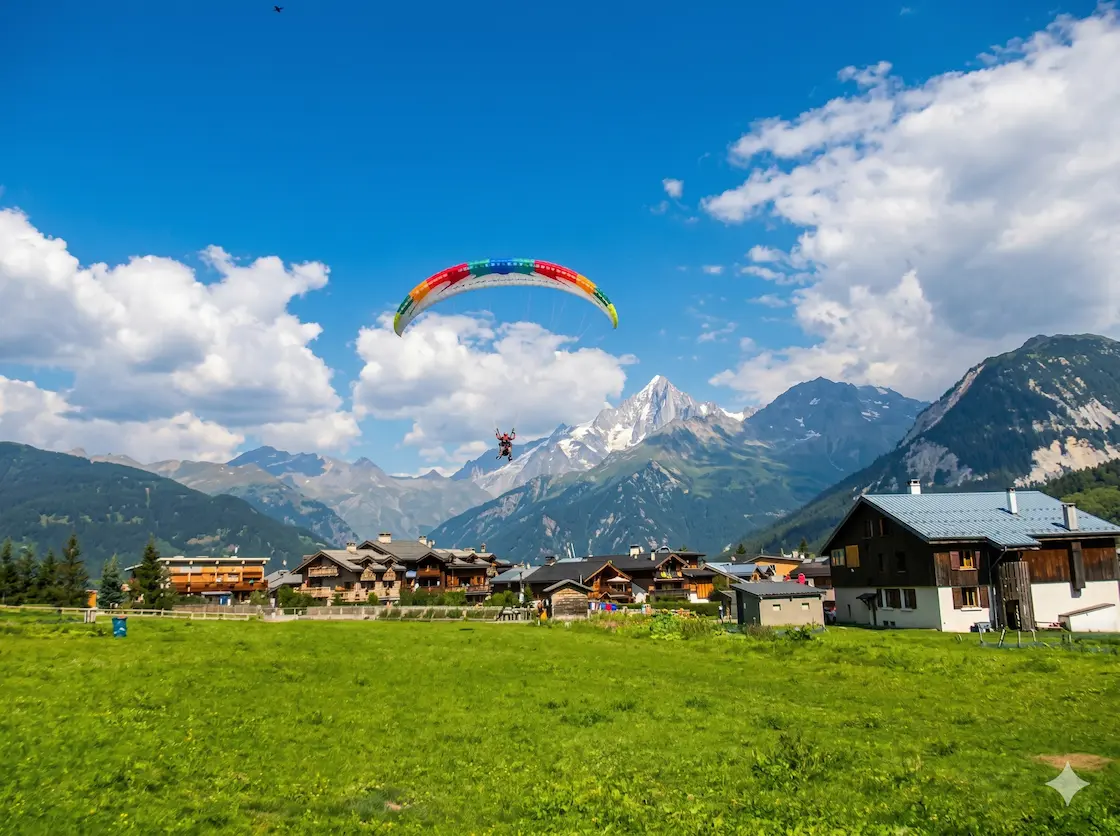
Courchevel offers summer tandem flights from the Dent de Burgin area near the top of the Saulire cable car at 2,740 m. The vertical drop to the altiport landing is over 1,000 m — which means long flights with sustained views over the Vanoise glaciers, the Belleville valley, and the Méribel basin. It’s an FFVL competition site, so the launch and landing infrastructure is well maintained.
The tandem paragliding companies here are primarily geared toward summer visitors staying in or near the resort, and it’s a spectacular way to see the 3 Valleys from a perspective most visitors never get. For solo pilots, the site works best in settled conditions — the converging valley systems can create complex and unpredictable airflow when it’s active.
Isère — Paragliding Sites
Isère stretches from the limestone ramparts of the Chartreuse and Vercors to the crystalline ridges of the Belledonne massif, with the broad Grésivaudan valley running between Grenoble and Chambéry. This is where you’ll find Saint-Hilaire-du-Touvet — arguably the most iconic free-flight site in the world — and the accessible flying above Chamrousse. Nearest airports are Grenoble-Isère (30 min to Saint-Hilaire) and Lyon-Saint-Exupéry (1 h 15 min).
The Grésivaudan valley is a natural flyway: wide enough that the valley breeze doesn’t become uncomfortably strong, bordered by mountains on both sides offering thermal triggers all day, and oriented north-south so the afternoon sun heats the west-facing Chartreuse cliffs and the east-facing Belledonne slopes in sequence. It’s a corridor that rewards patient, observant flying.
11. Saint-Hilaire-du-Touvet
Altitude: 1,100 m. Orientation: E. Local Club: Parateam Club. Nearest Airport: Grenoble-Isère (30 min). Launch Lat/Long: 45.31043, 5.89136. Land Lat/Long: 45.302622, 5.907379 (Lumbin). Hazards: Crowded during Coupe Icare week (special airspace restrictions apply); afternoon Grésivaudan valley breeze; respect hay-cutting zones on landing field; do not overfly houses at low altitude. Season: All year. Live Wind: Check conditions on Balise Météo →
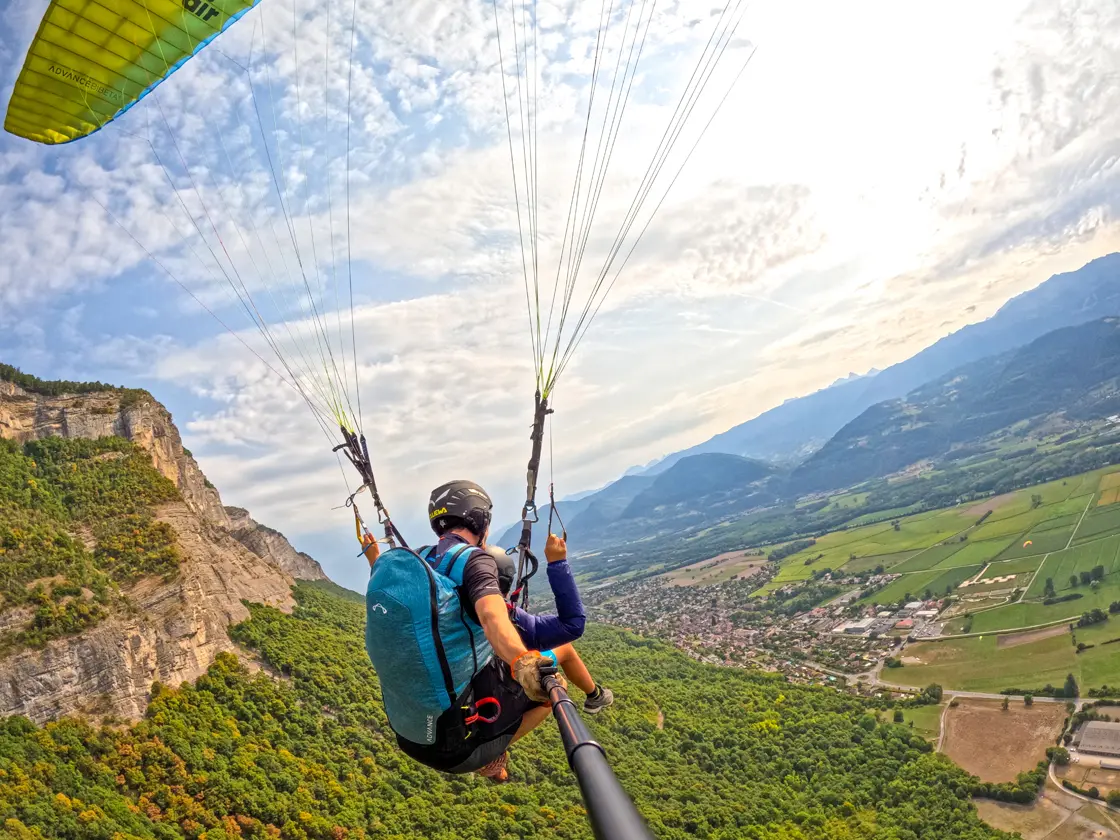
If Annecy is the most famous tandem site in the Alps, Saint-Hilaire-du-Touvet is the spiritual home of free flight. Every September, Saint-Hilaire hosts the Coupe Icare — the world’s largest free-flight festival, drawing over 100,000 visitors for a week of flying, cinema and spectacle. The 53rd edition runs from 15 to 20 September 2026, with costumed pilots launching from the Chartreuse escarpment, equipment demos from every manufacturer, and the Icare du Cinéma film festival running alongside.
Saint-Hilaire sits on a 1,000m plateau above, and north of Grenoble, at the junction of four major massifs — Chartreuse, Belledonne, Vercors and the Bauges. It’s arguably the most reliable flying site in the northern Alps: the plateau’s geography shields it from most bad weather systems, and it regularly flies when other sites in the region are shut down.
Three launches between 890m and 940m, a massive grass landing field at Lumbin, and a 700m vertical drop make it a serious site for pilots of all levels. Prevol Parapente has been running courses and tandem flights here since 1986. For XC pilots, it’s a hub for some of the best cross-country flying in the French Alps — with classic routes linking the Chartreuse ridge to Belledonne, and onwards toward Annecy.
Fly Saint-Hilaire is the go-to English-language resource for visiting pilots: flysainthilaire.com
Read more about paragliding in Saint-Hilaire →
12. Chamrousse
Altitude: ~1,650 m. Local Club: Check FFVL carte interactive. Nearest Airport: Grenoble-Isère (45 min). Launch Lat/Long: 45.12557, 5.90316. Land Lat/Long: Check FFVL site database. Hazards: Afternoon thermals can become punchy. Season: May–October. Live Wind: Check conditions on Balise Météo →
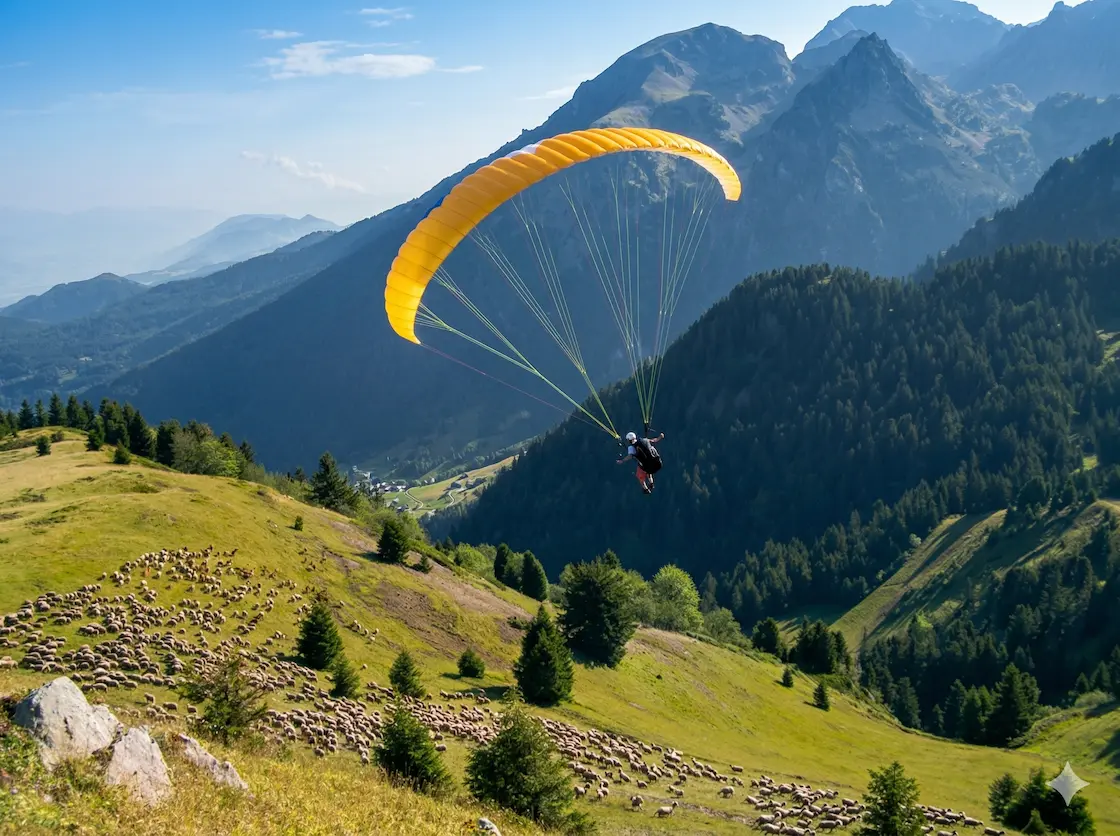
Chamrousse is the closest mountain flying to Grenoble — 30 minutes by car to 1,650 m on the Belledonne massif. The site is an FFVL competition venue with a well-established launch area and reliable summer thermals. It’s a good option for pilots based in the Grenoble area or for visiting pilots looking for a straightforward site without the crowds of Annecy or Saint-Hilaire.
The flying is reliable rather than spectacular: steady thermals in settled conditions, manageable valley breeze, and views west toward the Chartreuse and Vercors. For intermediate pilots building airtime and confidence, it’s hard to beat for accessibility and low-stress conditions.
Book a Tandem Paragliding Flight
A tandem flight is the easiest way to experience paragliding in the French Alps. You’re strapped into a harness in front of a certified instructor who handles take-off, flying, and landing — all you do is enjoy the view. No experience, no licence, no special fitness required beyond the ability to jog a few steps at take-off.
Tandem Paragliding
Soar over Lac d’Annecy, the Mont Blanc massif, and the Chamonix Valley on a tandem paragliding flight with a certified instructor. No experience needed — you’re strapped in, briefed, and airborne within minutes. Flights range from 15-minute discovery runs to hour-long thermal flights where your pilot climbs to cloudbase.
Choose from flights across Haute-Savoie — from the iconic Col de la Forclaz above Annecy to the glacier views of Plan de l’Aiguille in Chamonix. Book a tandem paragliding flight through our partner GetYourGuide.
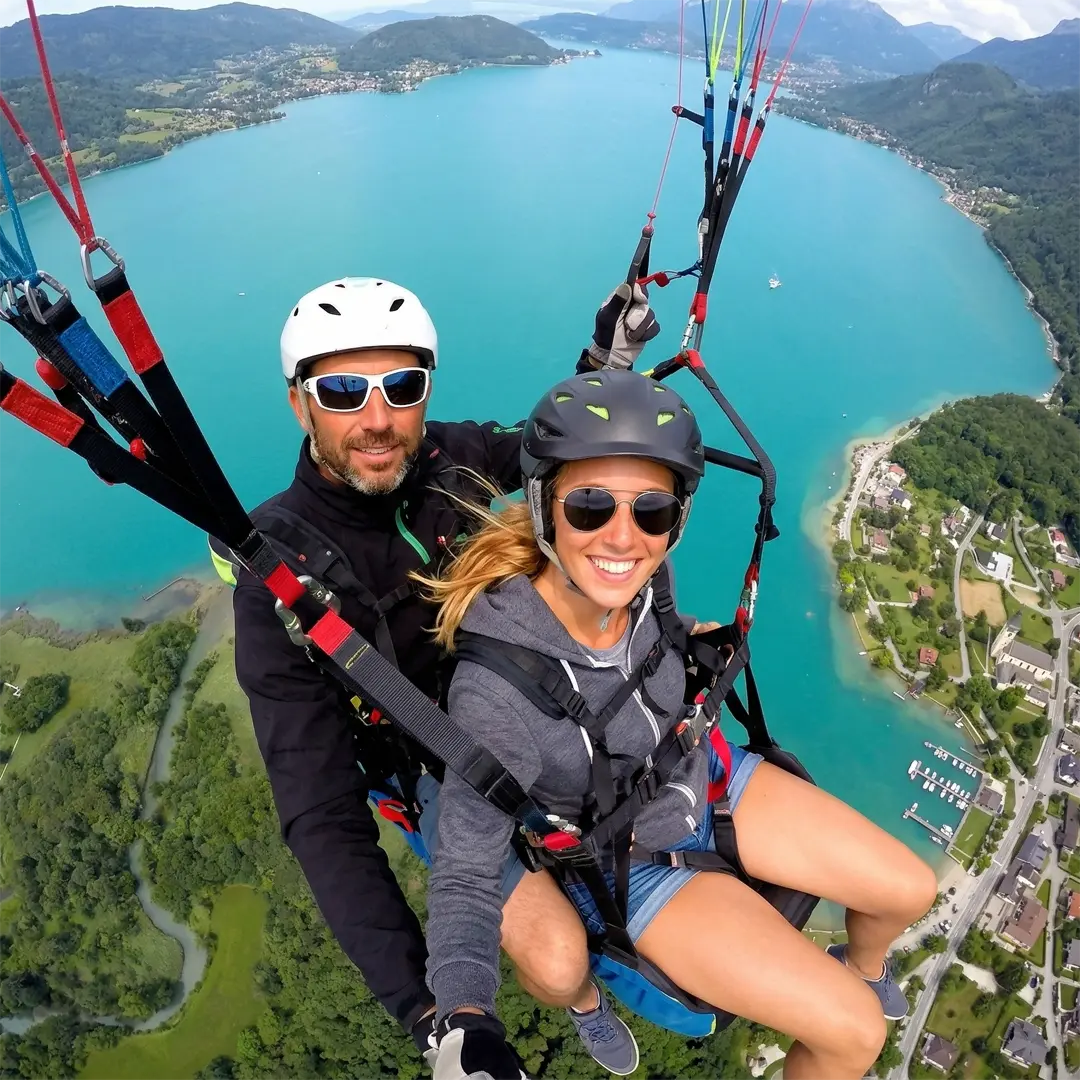
The top tandem experiences in the French Alps:
Annecy — Col de la Forclaz. The signature flight. You launch from 1,240 m and soar over Lac d’Annecy with La Tournette and the Dents de Lanfon rising around you. Flights range from 10-minute discovery runs (from ~€80) to 30–45 minute thermal flights (€120–€150) where your pilot climbs to cloudbase and you see the entire lake basin from above. Multiple schools operate from the col — Grands Espaces, K2 Parapente, Flyeo, and Annecy Aventure are all well established.
Book a flight: GetYourGuide →
Chamonix. Tandem flights from Plan Praz (Brévent gondola) with the Aiguille du Midi, Mont Blanc, and the Argentière glacier as your backdrop. Expect to pay €100–€180 depending on flight time. Chamonix Sport Aventure and Summits Parapente are reputable operators.
Book a flight: GetYourGuide →
Saint-Hilaire-du-Touvet. Launch from the Coupe Icare site with 900 m of vertical and views across the Grésivaudan to Belledonne. From ~€75. Pascal Chatanay’s team and Prevol Parapente have been flying here for over 20 years.
Book a flight: GetYourGuide →
Courchevel. Summer tandem from the Saulire at 2,740 m — a 1,000 m+ vertical drop over the 3 Valleys. Contact local operators through the Courchevel tourist office.
Book a flight: Manawa →
Learn to Paraglide in the French Alps
French paragliding schools structure their training through the FFVL’s colour-coded progression system — similar to judo belts.
A typical stage d’initiation (discovery course) runs for 3 to 5 days and takes you from zero to your first solo radio-guided flights. You’ll start with ground handling on a pente école (training slope), move to short tandem flights, then progress to solo flights from a proper launch site with your instructor guiding you by radio from the landing. Expect to reach “orange” level — solo flights in calm conditions with radio support. You won’t be thermalling independently after a week, but you’ll have experienced the magic of piloting your own wing.
Beyond the initiation, a stage de perfectionnement (improvement course) builds toward the brevet initial (green level — autonomous flying on a known site in calm conditions) and eventually the brevet de pilote (blue level — autonomy in varied conditions). This takes months of practice, not days.
Course prices range from €400 to €900 for a 5-day course depending on the school, location, and what’s included. You’ll need to purchase a temporary FFVL licence for insurance — typically €35–€85 depending on the cover level. All equipment is provided.
For UK pilots: Your BHPA qualification is recognised in France through the IPPI card (International Pilot Proficiency Information). Apply through the BHPA before you travel — it’s free for members. Carry both your BHPA membership card and your IPPI card when flying in France.
Learning to fly with Prevol Parapente
Paragliding Rules & Regulations in France
This section matters. France has specific licensing, insurance, and airspace requirements that differ from the UK system. And the Alps have some of the most complex controlled airspace in Europe. Getting this wrong can be dangerous — and expensive.
Licensing
France uses the FFVL brevet system. There are six levels from white (introduction) through brown (advanced autonomy). To fly solo on French sites, you need at minimum the brevet initial (green level), which grants autonomy on a known site in calm conditions.
UK and international pilots: Your national licence is recognised in France via the IPPI card. Apply for your IPPI card through your national federation (BHPA in the UK) before you travel. It costs nothing if you’re already a member. Carry both your BHPA card and IPPI card — some site regulators and clubs will ask to see both.
Insurance
Third-party liability insurance is mandatory for paragliding in France. No exceptions. If you cause damage — landing on a roof, hitting a car, injuring someone on the ground — you are personally liable without it.
BHPA membership includes third-party liability insurance that covers flying in France. Confirm with the BHPA that your specific membership tier includes overseas cover. FFVL licence holders are covered automatically through their federation membership.
Airspace
This is where the Alps get complicated. The French Alps sit beneath a patchwork of controlled airspace:
CTR and TMA around Geneva, Grenoble, Chambéry, Lyon, and Annecy airports. You cannot enter these zones without clearance — and as a paraglider, you won’t get clearance. Know where they are before you fly.
LTA (Libre Très Actif) — French military training zones. These activate without much notice and are regularly used in the Alps. Check NOTAMs on the morning of your flight.
LF-R30 A and B — The Mont Blanc restricted zones. Paragliders and hang gliders must not enter. In July and August, take-off, overflight, and landing on Mont Blanc summit are strictly prohibited. These zones exist to protect the helicopter rescue corridor.
Before every flight: Check NOTAMs on the SIA website. Use the BipBip app or the FFVL’s airspace tool for real-time airspace awareness. If you’re flying with a GPS logger, set up airspace alerts.
Site Rules
Many FFVL-conventioned sites require a déclaration de vol or registration with the local club before you fly. Some have specific rules about landing areas, operating hours, or seasonal closures — Chamonix’s landing fields are subject to municipal arrêtés, Col de la Forclaz requires a paid vehicle access badge, and La Cachette at Bourg-Saint-Maurice is closed during ski season. Always check the site notice board at launch and make contact with the local club if you’re visiting for the first time.
Radio
The standard French paragliding frequency is 143.9875 MHz. Carry a handheld radio and monitor this frequency when flying — it’s used for pilot-to-pilot communication, launch coordination, and in some cases safety warnings. Some sites use a local club frequency in addition to the standard one — check with the club.
Emergency Contacts
SAMU: 15 (medical emergency). Secours en Montagne / PGHM: Haute-Savoie: 04 50 53 16 89. Savoie: 04 79 96 24 01. Isère: 04 76 22 22 22. European emergency: 112. Save these numbers in your phone before you fly.
What to Pack
For Qualified Pilots
Wing, harness, reserve, helmet — the obvious kit. Check that your reserve has been repacked within the last 12 months (the French system expects this). Your wing should carry a valid EN certification.
Instruments: Vario, GPS (if you’re logging for the CFD or competitions, you’ll need a certified GPS track), phone with XCTrack or SeeYou Navigator. A backup power bank for long XC days.
Radio: Handheld VHF on 143.9875 MHz. A lightweight headset makes communication easier when you’re on bar.
Sun protection: You’re flying at altitude under intense UV, particularly in summer. Factor 50 sunscreen on face, ears, and the backs of your hands. Sunglasses — proper wrap-arounds, not fashion frames.
Footwear: Hiking boots or sturdy trail shoes for walk-up launches. Several Alpine sites involve a 15–30 minute hike from the car park to take-off.
Hydration and food: Carry at least a litre of water and snacks. If you’re planning hike-and-fly or bivouac flying, scale up accordingly.
For Tandem Passengers
Sturdy closed shoes — trainers are fine, but no sandals or flip-flops. You’ll be jogging a few steps at take-off and landing on uneven ground. A warm layer and a windproof jacket — it’s noticeably cooler at altitude even on a hot day. Sunglasses and sunscreen. Everything else — harness, helmet, wing — is provided by your instructor.
Weather & Forecast Resources
Good forecasting is the difference between an epic flight and a wasted drive. These are the tools French pilots use daily:
Météo Parapente — The purpose-built paragliding forecast. Shows thermal prediction, wind at altitude, cloud base, and convergence zones on an interactive map. This is your primary planning tool.
FFVL Balises Météo — The federation’s live weather station network. Stations at launch and landing sites across the Alps report real-time wind speed and direction. Check the balise for your target site before driving up.
Windy.com — Good for synoptic overview, wind at altitude, and multi-day planning. Use the ECMWF model for the Alps.
SIA — Service de l’Information Aéronautique. Check NOTAMs here before every flight. Non-negotiable.
Beyond the Flying — Rest Day Activities
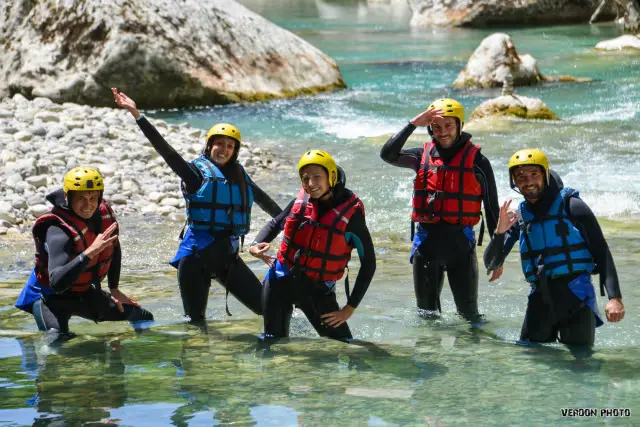
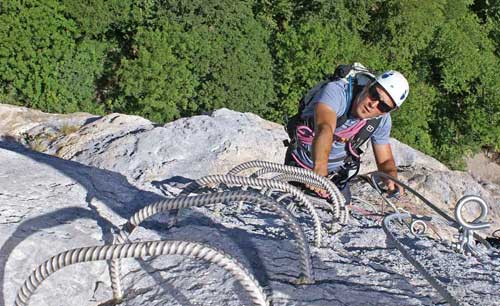
The big-mountain terrain of the French Alps means there’s lots of fun things to do when you’re not paragliding. The same resorts that give you lift access to high-altitude launches are home to some of Europe’s best mountain biking — Morzine, Les Gets, Chamonix, and Les Arcs all run lift-served bike parks through the summer. If you’d rather stay on foot, the hiking is world-class, from multi-day circuits like the Tour du Mont Blanc to day hikes in the Vanoise. And for the adrenaline-minded, there’s via ferrata, rock climbing, canyoning, and whitewater rafting on the Durance, Ubaye, and Giffre. If you’re visiting in winter, the resort infrastructure that serves summer paragliders serves winter skiers too.
Frequently Asked Questions
Yes — to fly solo on French sites you need at minimum an FFVL brevet initial (green level) or an equivalent international qualification recognised via the IPPI card. UK BHPA-qualified pilots can fly in France with their IPPI card. Tandem flights with a licensed instructor require no qualification — anyone can do one.
Tandem flights typically cost €80–€150 depending on the location, flight duration, and operator. A short discovery flight at Annecy starts from around €80, while a 30–45 minute thermal flight can reach €150. Photo and video packages are usually an additional €20–€30.
The prime season is May through September. June to August offers the strongest thermals, highest cloud bases, and longest days — ideal for XC flying. May and September are less crowded with good conditions. Winter flying is possible but limited by short days and weak thermals.
Your BHPA qualification is recognised through the IPPI card (International Pilot Proficiency Information). Apply through the BHPA before you travel — it’s free for members. Carry both your BHPA membership card and your IPPI card when flying.
It depends on what you’re after. Annecy (Col de la Forclaz) is the most spectacular tandem site. Chamonix offers the highest launches and the most dramatic scenery. Saint-Hilaire-du-Touvet is the spiritual home of free flight and hosts the Coupe Icare every September. Mieussy is the birthplace of paragliding. For pure XC potential, the Grésivaudan valley and Tarentaise corridor are both excellent.
It depends on conditions and the package you book. A discovery flight in calm conditions lasts 10–15 minutes. A thermal flight where your pilot climbs in thermals and covers distance can last 20–45 minutes. Some operators offer prestige flights of an hour or more when conditions allow.
Sturdy closed shoes (trainers are fine), a warm layer, a windproof jacket, and sunglasses. It’s cooler at altitude than on the ground, even in summer. No sandals, no loose scarves, no dangling accessories that could catch in lines.
The Coupe Icare is the world’s largest free-flight festival, held every September at Saint-Hilaire-du-Touvet near Grenoble. The 53rd edition runs from 15 to 20 September 2026. Highlights include the legendary costumed flight competition (Icarnaval), aerial demonstrations, a free-flight film festival, equipment testing, and a trade expo. Around 90,000 spectators attend each year. More info at coupe-icare.org.
Please leave a comment below if you need advice planning a paragliding trip to the French Alps, or if you have local site knowledge that could help other pilots. Happy flying!