
RIVERS: GUISANE | DURANCE | GUIL | UBAYE | BACHELARD | VERDON | VAR
PLAN YOUR TRIP: Book a trip | What to bring | Safety | Suitability | FAQ
Rafting in the Southern French Alps means warm Mediterranean sunshine, big Alpine scenery, and some of the best white water in Europe. The Hautes-Alpes and Alpes-de-Haute-Provence départements are cut through by fast, glacier- and snowmelt-fed rivers running from class II family floats to class V expert-only gorges — often within a few kilometres of each other.
This guide covers seven rivers — the Guisane, Durance, Guil, Ubaye, Bachelard, Verdon and Var — with grades, distances, best months, and the nearest town to base yourself for each. Every one of these rivers is run commercially by qualified guides, so no experience is needed. You turn up, get kitted out, get briefed, and paddle. Whether you’re looking for a gentle family float or a full-send class V descent, you’ll find it here. Scroll down for what to bring, what’s provided, and an honest overview of safety and suitability.
Ready to book? Jump straight to Book a Trip for a featured descent on the Guisane in Serre Chevalier, or read on for the full river-by-river breakdown.
Rafting the Guisane — Serre Chevalier
Grade: II (Leisure course) to IV (Lower Guisane). Flow: 100% natural — no dam. Peak flow: 25–30 m³/s during snowmelt. Season: May to August, with the biggest water from May to early July. Location: Serre Chevalier Vallée, Hautes-Alpes, between Le Monêtier-les-Bains and Briançon.

The Guisane flows down from the Col du Lautaret through the Serre Chevalier valley to Briançon, where it joins the Durance. Like the Ubaye further south, it’s 100% natural — no hydroelectric dam controls the flow. The water level tracks the season honestly, from a big snowmelt push in May and June to a gentler summer flow by August. That natural character, combined with the valley’s easy road access, makes the Guisane one of the most popular introductions to rafting in the Hautes-Alpes.
Two distinct stretches give the Guisane something for everyone. The leisure course, from Le Monêtier-les-Bains down to Saint-Chaffrey, is class II — fun, splashy, and ideal for a first rafting trip or a family outing. The Lower Guisane, closer to Briançon, steps up to class IV: a punchier, more technical run with continuous rapids that rewards a bit of paddling fitness. Most operators in Serre Chevalier and Briançon run both sections, plus variations like airboat, canoraft and hydrospeed if you fancy something a little different from a standard raft.
For a longer, more committing option, see the featured Guisane long descent in the Book a Trip section above.
Where to stay: Find places to stay in Briançon, the fortified Vauban citadel town at the foot of the valley. It’s the best-equipped base for the Guisane, with the widest choice of hotels and restaurants, plus easy links onward to Serre Chevalier’s villages.
Rafting the Durance
Grade: II to III. Section: Saint-Clément-sur-Durance to Lac de Serre-Ponçon. Season: Progressive water, runnable spring through summer. Location: Hautes-Alpes, near L’Argentière-la-Bessée.

The Durance runs from Saint-Clément-sur-Durance down to Lac de Serre-Ponçon and is graded class II to III — a step more progressive than the Ubaye or the Guil. That makes it a great place to nail your paddling technique before tackling bigger water later in the trip. The put-in at Saint-Clément is a beautiful starting point for exploring this wide, open valley.
The stretch around L’Argentière-la-Bessée is the whitewater sports hub of the valley — home to a canoe slalom stadium and the famous Rabioux wave. It’s a standing wave used for freestyle kayaking and river surfing, worth a stop even if you’re not paddling. If you’ve got some rafting experience already, this section is also a good one to self-paddle in a canoe-raft — a buoyant inflatable canoe you can hire and run yourself. Wherever the water takes you, Serre-Ponçon Lake at the end of the descent makes a scenic spot to pull out and have lunch.
Where to stay: Find places to stay in Embrun, a lakeside town on Serre-Ponçon with the best range of accommodation in the area. Or base yourself closer to the put-in in L’Argentière-la-Bessée, right at the whitewater stadium.
Rafting the Guil — Queyras Gorges
Grade: II to V depending on section — the Gorges du Guil section runs three hours of near-continuous class IV. Season: Mid-April to November, peak flow mid-May to mid-September. Location: Queyras Regional Natural Park, around Château-Ville-Vieille.

The Guil runs along the edge of the Écrins National Park and straight through the heart of the Queyras Regional Natural Park. It’s regularly described as one of the most beautiful rivers in France. It backs that up with a genuinely superb white-water experience. The Gorges du Guil section at Château-Ville-Vieille delivers roughly three hours of near-continuous class IV rapids through a dramatic, narrow gorge beneath the walls of Fort Queyras. It takes in the legendary Triple Chute — three rapids back to back that are not for the faint-hearted.
The Guil’s grading spans the full range depending which section you run and how much water is coming down. Expect anything from friendlier class II–III stretches, suitable for a first taste of moving water, to committing class V water in high flow. Local operators run the river commercially from mid-April through November, with the best and most consistent flow between mid-May and mid-September.
Where to stay: Find places to stay in Guillestre, the gateway town to the Queyras. It’s the best-connected base for the Guil, with easy access up the valley to Château-Ville-Vieille and the Guil gorges.
Rafting the Ubaye
Grade: II to V across more than 50 km of runnable water. Flow: Natural — the only major river system in the Southern French Alps that has escaped damming. Season: Spring through autumn, highest flow with the spring snowmelt. Location: Ubaye Valley, running from the Italian border to Lac de Serre-Ponçon.

Considered one of France’s top rafting and kayaking rivers, the Ubaye runs 80 km from its source near the Italian border to Lac de Serre-Ponçon, where it joins the Durance. Because it’s never been dammed, the flow tracks the seasons naturally: a big spring snowmelt push of up to 50 m³/s, settling to around 13 m³/s by late summer. Paddlers need to stay flexible and check conditions on the day. More than ten distinct sections of class II to V water span the 52 km between Saint-Paul-sur-Ubaye and Roche Rousse, where the river meets the lake.
The Ubaye Racecourse, from Martinet to Le Lauzet, is the classic commercial run. It’s a consistent class III+ to IV stretch with fifteen rapids in quick succession, including Dent de Requin (Shark’s Tooth) and Rouleau de Printemps (Spring Roll). Downstream, the Ubaye Gorge from Le Lauzet to Roche Rousse is the most technical and committing section in the valley. Its class V rapids carry names like Fosse aux Lions (Lion’s Den) and La Moulinette (The Blender), and it’s run commercially in August when the river is at its friendliest. For a gentler introduction, the Upper Ubaye between La Lauzière and Jausiers is class III boulder-dash water through superb Alpine scenery.
Where to stay: Find places to stay in Barcelonnette, the main town of the Ubaye Valley. It’s the natural base for every section of the river, from the Upper Ubaye down to the Gorge.
Rafting the Bachelard
Grade: IV to IV+ — steep and technical. Season: A short window in May and June only. Location: A tributary of the Ubaye, draining down from the Mercantour National Park.

A tributary of the Ubaye, the Bachelard is a steep, technical river that drains high country in the Mercantour National Park, and it will appeal to paddlers who love challenging whitewater. You put in at Le Grand Pont, the only high bridge over the river, and paddle roughly 6 km of solid class IV to IV+ water through the beautiful Vallée du Bachelard. Above Le Grand Pont the river tips into class VI, where paddling is prohibited.
The Bachelard only has a short paddling window, typically May and June, once the snowmelt has filled the river but before it drops too low to run. Hit it right and it’s a playboater’s dream, with rock spins and boofs all the way down. A handful of local operators run it commercially and describe the descent as technical and exciting. It’s a good idea to have a reasonable level of fitness before booking this one.
Where to stay: Find places to stay in Barcelonnette, a short drive from the Bachelard put-in and the same convenient base you’d use for the Ubaye.
Rafting the Verdon
Grade: V. Distance: 25 km through the Verdon Canyon. Season: Two dam-release days per week, July and August. Location: Gorges du Verdon, Alpes-de-Haute-Provence.

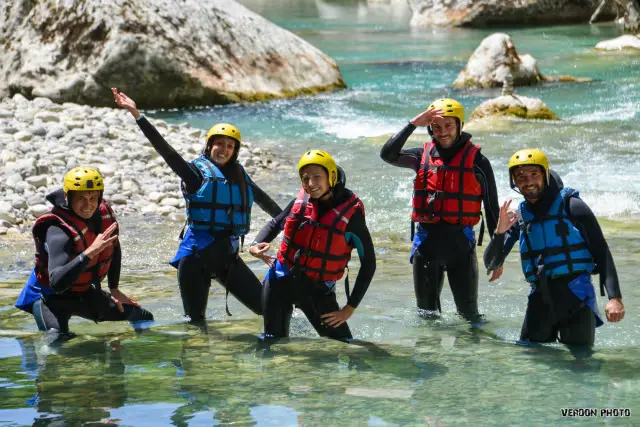
On two days a week through July and August, the Sainte-Croix dam releases a torrent of water and the Verdon comes alive. The resulting 25 km descent through the Gorges du Verdon is legendary and belongs on every thrill-seeker’s list. Expect class V rapids that demand fitness, commitment, and a real sense of adventure, all set beneath some of the most dramatic limestone cliffs in Europe.
You don’t have to be an expert kayaker to experience it. Paddlers without rafting experience can still tackle the canyon by joining a qualified guide in a tandem kayak, which handles the technical lines while you provide the paddle power. It’s one of the most memorable ways to see the Gorges du Verdon, rated among France’s most spectacular natural sites.
Where to stay: Find places to stay in Castellane, the classic base for the Gorges du Verdon. It has the biggest concentration of rafting and kayaking operators in the region.
Rafting the Var — Gorges de Daluis
Grade: III to IV (Gorges de Daluis) or II (lower section, family-friendly). Season: Spring, run commercially on snowmelt. Location: Alpes-Maritimes and Alpes-de-Haute-Provence.

The Var runs through the Alpes-Maritimes and Alpes-de-Haute-Provence départements before finally meeting the sea at Saint-Laurent-du-Var. The upper section runs through the astonishing Gorges de Daluis, nicknamed the Colorado Niçois for the red rock and turquoise water of the canyon. This class III to IV water is run commercially in spring, when melt-water from the Mercantour National Park feeds the flow.
Lower down, the stretch of the Var between Puget-Théniers and Touët-sur-Var eases off to gentle class II water — ideal for family trips and a first go at moving water without the commitment of the upper gorge.
Where to stay: Find places to stay in Guillaumes, the village at the heart of the Gorges de Daluis. Or base yourself downstream in Entrevaux if you’re running the gentler lower section.
Book a Rafting Trip in the Southern French Alps
Every river in this guide is run commercially by experienced, qualified guides, so you can turn up with zero experience and have a great day on the water. Trips typically run 1.5 to 2.5 hours and include all the safety kit — see What to Bring above for the details.
Guisane Long Descent — Serre Chevalier
Paddle the full-length Guisane descent through the Serre Chevalier valley from Briançon — an extended, adrenaline-packed route through the river’s best rapids, run by a qualified local guide. No experience needed; wetsuit, helmet and lifejacket all included.
Book this trip through our partner GetYourGuide.

Looking for a different river or grade? Local rafting and kayaking centres in Serre Chevalier, L’Argentière-la-Bessée, Guillestre, Barcelonnette, Castellane and the Var valley run trips on every river covered in this guide. Get in touch with an operator in your chosen base town to check availability and conditions on the day.
What to Bring Rafting
Rafting and kayaking operators in the Southern French Alps supply all the technical safety kit — you just need to turn up dressed sensibly and ready to get wet.
What’s Provided
Your guide will kit you out with a wetsuit (these rivers run cold, even in August — most are fed by snowmelt), a helmet, and a buoyancy aid or lifejacket. The raft or kayak, paddle, and a qualified guide are all included. Some operators also provide a splash top or cag for extra warmth on cooler days, plus neoprene boots or wetsuit socks. Worth asking about when you book if the weather looks changeable.
What to Bring
Footwear: Old trainers you don’t mind getting wet — something that stays firmly on your feet. Flip-flops and sandals aren’t suitable; they can come off in the current and won’t protect your feet on the riverbed.
Swimwear: Wear it under your wetsuit — you’ll get changed at the rafting base before and after.
Sun protection: Factor 50 sunscreen and a cap or sunglasses with a retainer strap. You’re on open water under a strong Mediterranean sun for a couple of hours, and it reflects off the surface as well as coming straight down.
A warm layer for afterwards: Even in high summer, snowmelt-fed rivers are genuinely cold, and you’ll be glad of a fleece or jumper once you’re out of the wetsuit.
A towel and dry clothes: Left at the rafting base for when you get back off the water.
A dry bag, if you want to bring a phone or camera: Many operators offer waterproof cases or GoPro filming as a paid extra. Ask when you book, rather than risking your own kit.
Rafting Safety in the French Alps
Rafting and kayaking are adventure sports, and how technical the safety picture is depends entirely on which river and section you choose. A class II family float on the Durance or the leisure course of the Guisane carries very little risk. A class V descent of the Ubaye Gorge or the Verdon in full flood is a serious undertaking that demands respect, fitness, and a cool head. Every commercial operator in the Southern French Alps runs with qualified, professional guides who brief you thoroughly before you get on the water. Listen carefully — their instructions are what keep the trip safe.
Before every trip, your guide will run through paddle commands (forward, back, stop, get down, high side) and what to do if you end up in the water. It’s worth knowing the basics in advance:
- Don’t try to stand up in fast-moving water. Your foot can wedge between rocks on the riverbed while the current keeps pushing — a serious entrapment hazard, even in water that only looks knee-deep.
- Lie on your back. Your lifejacket will keep you afloat, so let it do its job instead of fighting to get vertical.
- Point your feet downstream. This lets your legs absorb the impact and fend off any rocks, rather than your head or body taking the hit.
- Use your arms to steer toward the raft, your guide, or the nearest bank, and follow your guide’s shouted instructions — they can see the line down the river that you can’t.
Trip grading is your best guide to how technical a river is. Class II sections are gentle and forgiving. Class III to IV trips are genuinely exciting but don’t require prior experience — just a reasonable level of fitness and a willingness to get stuck in. Class V sections, like the Ubaye Gorge, the Bachelard, or the Verdon in full flow, are a different proposition. They suit confident swimmers who are comfortable with a more committing, physical day on the water — check the specific requirements when you book.
Is Rafting Suitable for Kids & Families?
Rafting is one of the best group and family activities in the French Alps. A single booking can mix nervous first-timers, kids, and hardcore adrenaline seekers on the same river system, just on different sections. Minimum ages vary by operator and by grade rather than by a single national rule, so always check when you book. As a rough guide, gentle class II sections (the Durance, the Guisane leisure course, the lower Var) typically welcome children from around 6 to 8 years old. Class III to IV trips usually set a minimum age of 8 to 12. Class V sections like the Bachelard, the Ubaye Gorge or the Verdon in flood are generally restricted to confident swimmers aged 14 and up.
You need to be able to swim to go rafting, though not necessarily strongly since your lifejacket does the floating for you. You should be comfortable having your face in the water and unfazed by a splash. No prior rafting or kayaking experience is required for any commercial trip. Your guide makes every technical decision about the line down the river — your job is simply to paddle when asked and follow instructions. That’s what makes it such an accessible adventure sport for a mixed group — everyone from grandparents to eight-year-olds can find a stretch of river graded for them.
Frequently Asked Questions
The Durance (class II–III) and the Guisane leisure course between Le Monêtier-les-Bains and Saint-Chafférey (class II) are the most forgiving introductions. Both are progressive, well-established commercial runs suitable for a first rafting trip or a family outing.
Yes, you need to be able to swim to go rafting, though you don’t need to be a strong swimmer — your lifejacket provides the flotation. You should be comfortable with your face in the water and unfazed by a splash. Non-swimmers are not accepted on commercial rafting trips.
It depends on the river grade and operator. Gentle class II sections typically accept children from around 6–8 years old. Class III–IV trips usually set a minimum age of 8–12. Class V sections like the Ubaye Gorge or the Bachelard generally require paddlers to be 14 or older. Always confirm the minimum age with your chosen operator when booking.
Wear swimwear under your own clothes so you can change easily, and bring old trainers you don’t mind getting wet — not sandals or flip-flops, which can come off in the current. Your operator provides a wetsuit, helmet and lifejacket. Bring sunscreen, sunglasses with a retainer strap, and a warm layer for after you get off the water.
Don’t try to stand up — fast-moving water can trap a foot between rocks on the riverbed. Instead, lie on your back with your feet pointed downstream to fend off rocks; your lifejacket will keep you afloat. Use your arms to steer toward the raft, your guide or the bank, and follow your guide’s instructions.
Most rivers run from May to September, with the biggest water in May and June during the spring snowmelt. The Verdon is the exception — it only flows on dam-release days in July and August — and the Bachelard has a very short window, typically limited to May and June.
Families should look at the Durance, the Guisane leisure course, or the lower Var near Toët-sur-Var — all gentle class II water. Experienced paddlers looking for a serious challenge should head for the Ubaye Gorge, the Bachelard, or the Verdon in full flow, all class V.
Please leave a comment below if you need advice planning a rafting or kayaking trip to the Southern French Alps, or if you have local river knowledge that could help other paddlers. Happy paddling!
[…] is in place to cater to the demands of the novice as well as the professional rafter. Rafts and inflatable canoes are available for anyone seeking a thrill on the surface of the […]