
By Matt W. · Last updated June 2026
Super accessible riding for all levels. Lifts are free!
High-altitude means it’s quite barren in places. Long transfer.
Elevation
Summit
Vertical Drop
Base
Lift
Total
Cable-Cars
Chairlifts
MTB Trail Highlights
XC
Downhill
eMTB
Total Riding
Bike Park
Bike Wash

Beginner Trails

Intermediate Trails

Advanced Trails

Expert Trails
Plan Your Trip
Everything you need to book your Tignes mountain biking trip — bike-friendly accommodation, the gear to pack, how to get there, and activities to book.

Practical Information
Opening times
Resort prices
Nearest airport
Tourist Office
Tignes Accommodation
Where you base yourself matters more on a biking trip than a ski one, because you’ll wheel a heavy, muddy bike to and from the lifts twice a day, and Tignes is spread across several villages at different altitudes. The riding clusters at 2,100m around the lake, so stay up there: the lower villages of Tignes 1800 and Tignes les Brévières are calmer and cheaper but sit a transfer below the action.
Up at 2,100m you’re choosing between Tignes le Lac and Val Claret, and they suit different riders. Le Lac is the lakeside all-rounder — the main hub, widest spread of shops and restaurants, and it sits on the Palafour lift that feeds the beginner-friendly green back into the village. It’s the natural pick for families and first-timers: gentle terrain, the lake on the doorstep, everything walkable. Le Lavachet, the quieter hamlet just below Le Lac, is the same lakeside position for a little less money and a lot less noise. Val Claret sits higher up-valley, livelier and more après-focused, on the Tufs and Fresse lifts that launch the longer flow and the harder reds — the rider’s base if you want gravity over gentle.
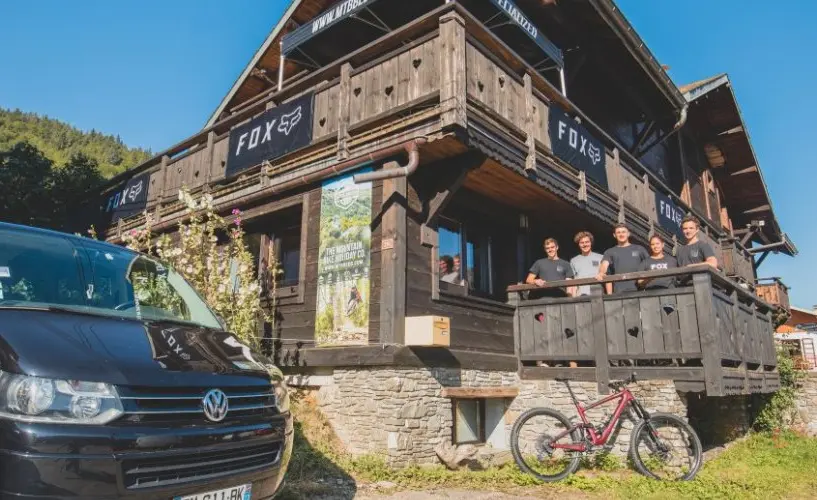
Prioritise places set up for bikes. The non-negotiables are somewhere secure and lockable to leave the bike overnight and easy access to a wash. The resort itself runs bike-wash stations and free uphill bike trailers on the shuttles, which take the sting out of resetting between laps and mean you’re never far from getting the worst of the mud off before it dries on. Secure in-house storage, though, varies property to property — purpose-built ski apartments often have a ski locker that doubles fine for a bike, but it’s worth a direct question when you book rather than an assumption. If you’re travelling with an expensive rig, that one answer can decide where you stay.
Families should anchor in Le Lac near the lake and the green return trail, where the kids can ride to the water and back without crossing anything serious. Riders chasing the steeper sectors and the later bars will be happier in Val Claret, on top of the lifts that launch the reds and blacks. And if budget or quiet matters more than ski-in convenience, the lower villages trade a short shuttle for noticeably cheaper beds — the free bike trailers run from there, so you’re not stranded. Use the map below to compare what’s genuinely walkable to the lifts before you book.
Use the live map below to compare prices and find places to stay in Tignes, from hotels near the lifts to self-catered apartments and chalets.
Tignes Guide
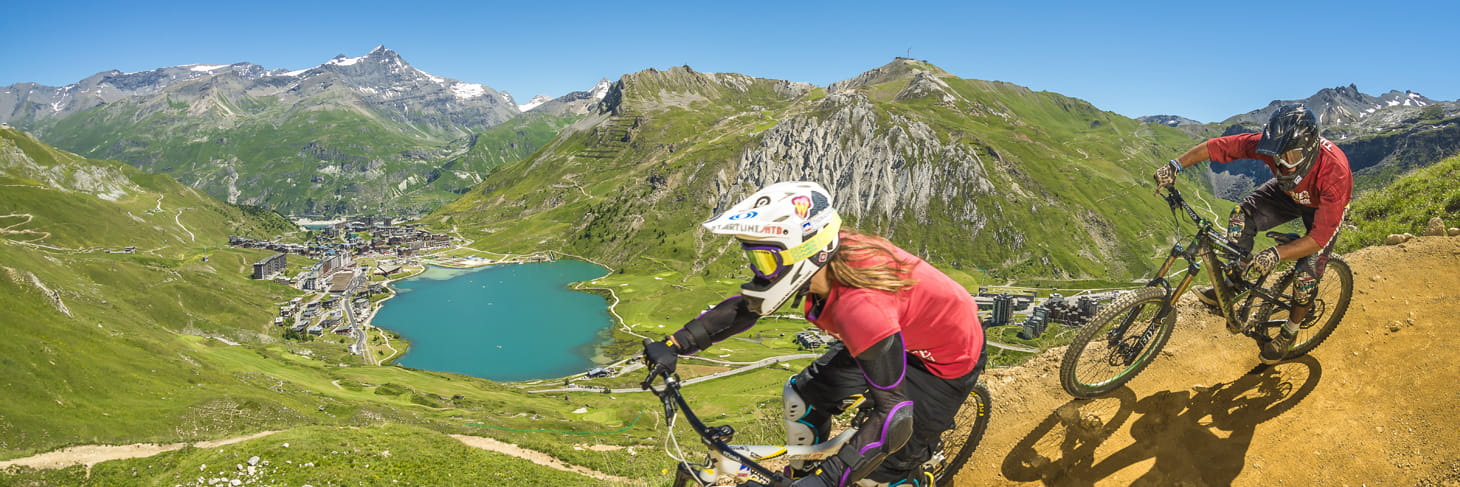
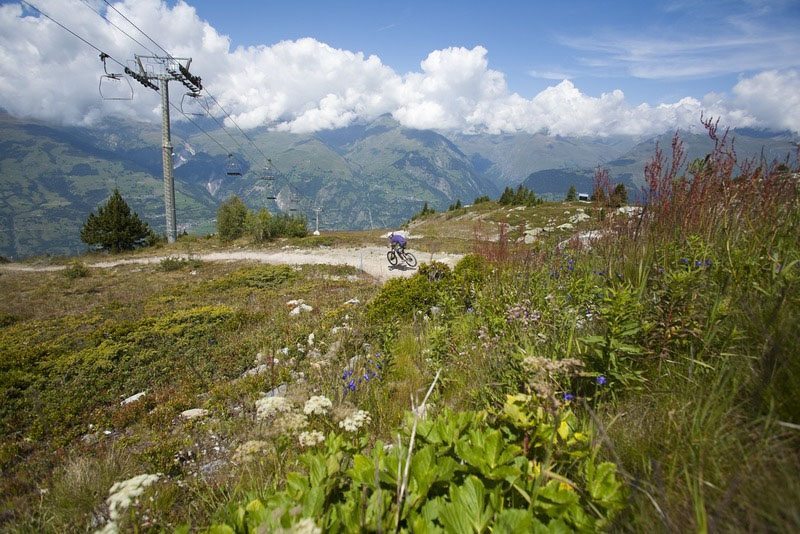
Tignes rides high. The resort sits at around 2,100m around the shore of Lac de Tignes, and the bike park you came for is stitched into one lift-linked network with Val d’Isère next door — the joint Bike Park Tignes–Val d’Isère, marketed at roughly 46 marked trails and over 220km of riding, free shuttles running seven days a week between the two valleys. That altitude is the headline. It buys you glacier views, cool air when the lower valleys bake, and a treeless, high-alpine feel you won’t get in the wooded Portes du Soleil. The trails read differently for it: open sightlines, loose alpine dirt rather than greasy roots, and weather that swings from t-shirt sun to a cold squall inside an hour. It also buys you a short season: the snow has to clear before the lifts can turn, so the Tignes side runs roughly late June to the end of August and not a day longer.
Whatever else you pack for Tignes, make sure your travel insurance covers mountain biking — see our travel insurance guide for what to check before you go.
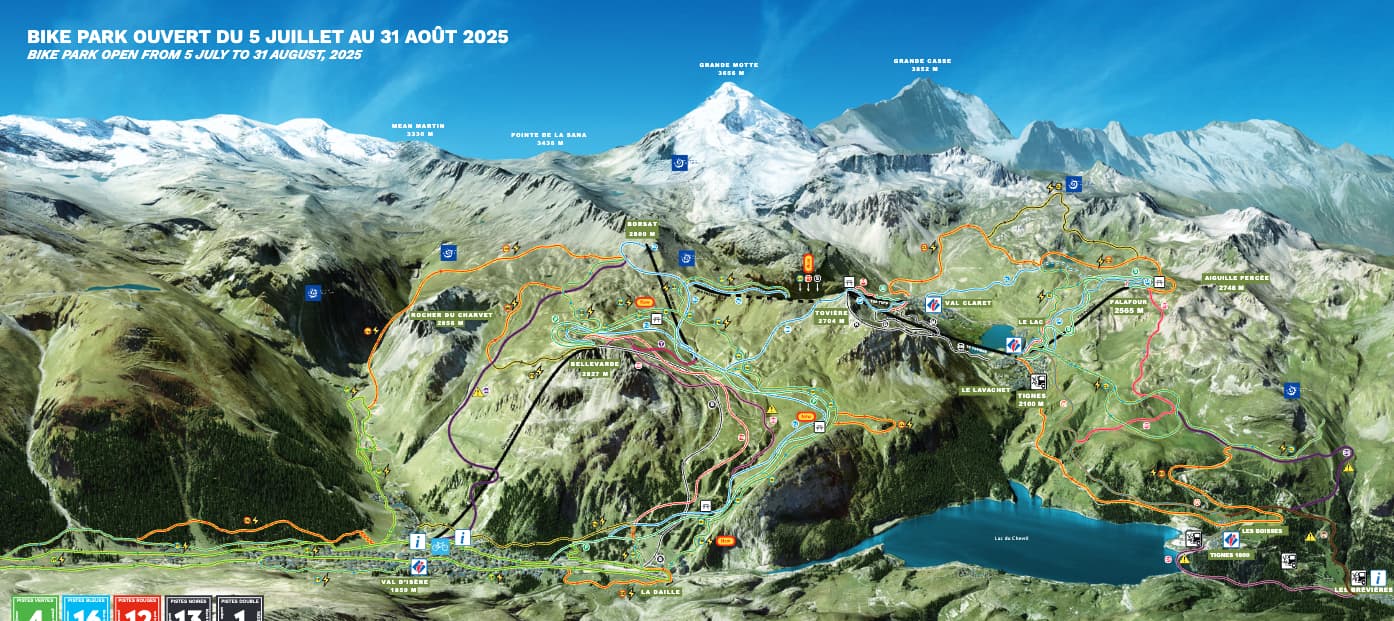
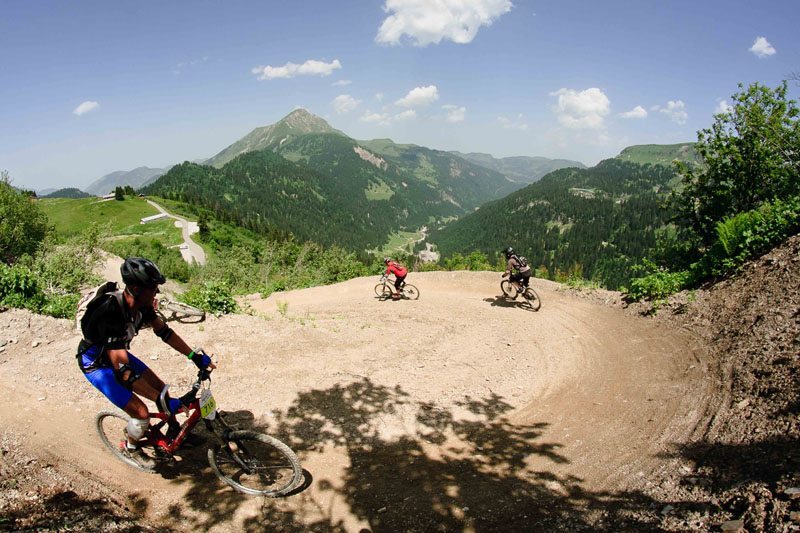
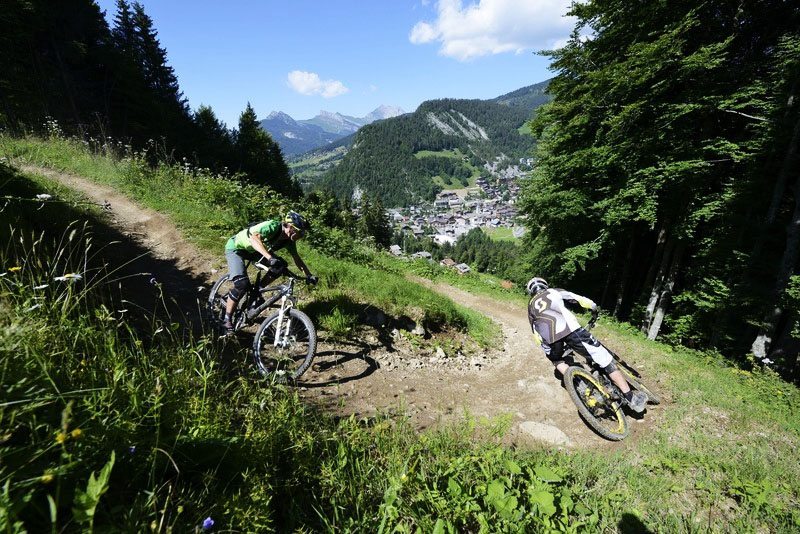
Trails are graded like a ski map: green, blue, red, black, and a double-black for the truly committed. The Tignes-proper riding hangs off two sectors — Palafour above Tignes le Lac and the Aeroski/Tufs lifts out of Val Claret — while the longest, most famous descents (the Bellevarde lines) sit across the link above Val d’Isère. Plan your days around the whole linked area rather than one hill. You can warm up on lakeside green flow in the morning, lap a Palafour red after lunch, and shuttle over to the Val d’Isère side whenever you want a bigger descent. The free shuttles carry bikes on trailers, so crossing the valley costs you nothing but a few minutes. Above the lift-served pistes, a set of waymarked e-MTB itineraries climb into genuinely wild high-mountain terrain around the lakes and the Aiguille Percée — riding that has no equivalent in the wooded parks further north.
One thing to know going in: this is a winter resort that runs a serious bike park for nine summer weeks, not a year-round bike town. That works in your favour. The pistes are quiet by Portes du Soleil standards, the queues short, and the scenery — glaciers above, the lake below — does the heavy lifting that trees do elsewhere. The flip side is the calendar. Get the dates right (see Practical Info), because miss the window by a week at either end and the lifts simply aren’t turning.
The Riding in Tignes
Beginner
Start by the lake, not on a black. The gentlest proper descent on the Tignes side is Smoothie, a green that drops off Palafour back toward Tignes le Lac (roughly 4.5–5.5km losing around 460m) — long, wide and forgiving, the run you lap until carrying speed feels natural. Easy Ride is its sister green off the same Palafour sector, similar length and gradient, so you can alternate the two and build a rhythm without queue boredom. Both feed straight into the village, which matters when little legs are tiring.
If you want the easiest possible introduction, the E-Zyride e-MTB loop starts right at the lake in Tignes le Lac: a short, mellow green-to-blue climb to the Lacs du Chardonnet plateau, then a descent on Smoothie. It’s the gentlest way to feel what a lift-served day will involve before you commit to one. Across the link, the Val d’Isère side adds long, very gentle green mileage — the Val d’Isère Green Trail runs around 12km off the Olympique lift, a proper distance for building stamina — and the family-flow Popeye, a wide green on the Bellevarde side that’s deliberately built for kids and nervous first-timers. Lap the greens until the berms feel automatic, then graduate to a blue on the same lift. If you’re brand new, book a morning with one of the resort’s bike schools and spend the rest of the day drilling what you learned. The lake setting helps here too: a green run that finishes by the water with a café in sight is a kinder place to learn than a black-stacked downhill hill.
Intermediate
This is where Tignes opens up. Off Palafour above Tignes le Lac, Jump Around is the run to learn on — a fast, flowy blue of around 3.4km dropping roughly 460m, with little jumps you roll until you’re ready to pop them. Red Hot (around 2km / 365m) is the only red on the Le Lac side of the valley and the obvious next step when the blues stop scaring you. Over on the Val Claret side, Gunpowder is a long blue singletrack (around 4.5km / 500m) off the Aeroski sector that links into the other blues, and Tart à Lognan (around 2km / 300m) drops off the top of Palafour toward Val Claret.
When you want red bite, the Val Claret sector delivers it. Funky Tufs (around 3.2km / 500m) throws berms, tabletops and a freeride zone at you — the run to session when you’re learning to jump rather than roll — and Gypsy (around 2.8km / 500m) goes narrower and steeper before finishing on the Rosset dual-slalom, a nice way to end on something playful. Across the link, the Val d’Isère side stacks up the distance: Val Bleue is a 6.5km blue losing around 680m off Bellevarde, the longest sustained flow on this trip, and the red Bellevarde descent (around 4.8km / 850m) off the Olympique lift is the big intermediate point-to-point — the one that turns a park day into a proper cross-valley outing. That 850m of vertical in a single run is the kind of leg-burner you remember. Refuel at the bottom, jump the lift, ride home.
Advanced
The Val Claret sector is the proving ground for the Tignes-side blacks. Black Metal and Moustache (both around 1km / 250m off the Aeroski sector) are the short, sharp tests — very steep, very loose, very narrow, the kind of trail that punishes hesitation. They’re loose alpine dirt rather than wooded roots, so they reward a light touch and an eye reading well ahead.
The biggest hits, though, are across the link on the Val d’Isère side, and that’s where a 2026 logistics check earns its keep (see the lift note below). Kamasutrail is the area’s standout black (around 2.5km / 340m through a gypsum sinkhole, with road-gaps and a famous step-up), and Scarefresse carries the resort’s only “Elite”/double-black label — the gnarliest line on the map, committed drops, doubles and gaps over barely a kilometre. The headline descent is Bellev’hard, the black DH that plunges down the village-facing flank of Bellevarde, raw and committing top to bottom and the trail that draws racers when the enduro round is in town. Don’t confuse it with the Bellevarde name itself, which refers to the sector and a red trail, not this black; the spelling collision catches people out, and the consequences don’t match.
Treat all of these as ride-them-when-you’re-ready trails. Session the reds first, learn where the lifts put you, scope the steeper sections from the side of the trail before you commit, and earn the blacks rather than dropping into one cold off the gondola. The altitude adds a wrinkle too — at 2,100m and up, the air is thinner and you tire faster than you expect, so leave more in the tank than you would lower down.
Lift note for summer 2026: the Tovière gondola is the usual high-speed link to the Val d’Isère side, and the resort’s own bike-park page has flagged it for a maintenance closure across summer 2026 (other timetables still show it running, so the picture isn’t settled). The Val d’Isère lines stay reachable regardless — the Olympique cable car and Borsat chairlift open the Bellevarde sector from 4 July, and the free bike shuttles cross the valley seven days a week — but check the live summer-2026 lift calendar before you bank a day on a specific Tovière-served run. On the Tignes side, Palafour (Le Lac) and Tufs/Fresse (Val Claret) are confirmed open and carry the local riding on their own.
eMTB
Tignes is made for an e-bike, because here the altitude is the reward, not the obstacle. The resort marks a full set of Smart Bike e-MTB itineraries that climb into terrain the lifts don’t reach. Cow Lanta (around 7km, climbing roughly +320m) is the gentle balcony route, opening views over Lac du Chevril and the Grande Sassière. Chardon’Up (around 10km, +730m) is the flagship: it starts lakeside in Tignes le Lac, climbs past the Lacs du Chardonnet to the foot of the Aiguille Percée, tops out at Palafour, and drops you back down Smoothie. Gara T Fresse (around 4.6km, +450m) climbs to the Col de Fresse and tips you over toward Val d’Isère — the natural pedal-powered crossover when the lifts feel limiting. Strong riders can link Chardon’Up into the black Dark Jadore for a Col du Palet loop.
There’s a longer game too. The La Fario route runs up the Haute Tarentaise valley from Bourg-Saint-Maurice into Tignes — a full day’s point-to-point that turns the drive in into a ride in, opening for the season from 12 June. It’s the kind of itinerary that only makes sense on an e-bike, and the kind Tignes is quietly good at.
You don’t need to bring your own. Several resort shops rent current e-MTBs alongside their downhill fleets, so you can hire for the day, ride the marked Smart Bike routes, and still lap the lift-served park on the same pass. An e-bike rewrites the geography here more than almost anywhere in the Alps: instead of waiting on the snow line, you climb above it. Pack layers and water — these routes climb fast and the weather at altitude turns quickly, even in July.
The Trails & Facilities for Mountain Bikers
Beyond the graded park lines, the linked Bike Park Tignes–Val d’Isère packs a big spread of marked riding and rider facilities into a compact, high-altitude domain. Here’s what you’ll find across the network:
- Ride roughly 46 marked trails and over 220km across the joint Tignes–Val d’Isère bike park, graded green through double-black.
- Lap two home sectors on the Tignes side — Palafour above Tignes le Lac and the Aeroski/Tufs lifts out of Val Claret.
- Cross to the Val d’Isère side for the longest, most famous descents — the Bellevarde lines, including the 6.5km Val Bleue and the big 850m-vertical Bellevarde red.
- Climb above the pistes on a full set of waymarked Smart Bike e-MTB itineraries around the lakes and the Aiguille Percée.
- Hop the valley for nothing on free bike shuttles running seven days a week between Tignes and Val d’Isère.
The facilities are built around the high-altitude, lift-linked setup:
- A modern, free lift system — no MTB pass needed to ride the chairs and cable cars on the Tignes 2100 side.
- Bike-wash stations and free uphill bike trailers on the shuttles, so resetting between laps is quick and clean.
- An airbag and water jump for practising big moves with a soft landing.
- Hire, repair and e-MTB shops in both 2,100m villages, most with a workshop on site and protective gear included.
Bike Hire & Repairs
You don’t need to box up your own bike to ride Tignes well. Both 2,100m villages run ski-and-bike shops that switch to downhill, enduro and e-MTB fleets for the summer, most with a workshop on site and protective gear included.
- Yab Sports (Go Sport Montagne) — the convenient pick at the Val Claret lift base, renting downhill and e-MTBs with an on-site workshop for repairs. Best for grabbing a rental and rolling straight onto the Tufs/Fresse lifts. (437 Avenue de la Grande Motte, Immeuble Le Diva, Val Claret, 73320 Tignes — by the roundabout, opposite Club Med.)
- Sport 2000 Monkey Riders — run by ex-racers in the heart of Tignes le Lac, with downhill rental and a proper bike workshop. Best for setup advice and quick fixes from people who ride. (185 Rue de la Poste, 73320 Tignes — Tignes le Lac.)
- Ski One (Twinner) — MTB and e-MTB hire plus a bike school under one roof in Val Claret. Best for combining a rental with a lesson or guiding. (Immeuble Le Sefcotel, Val Claret, 73320 Tignes.)
- Mountain Story — a big summer fleet near the Le Lac lifts, renting and repairing (downhill, enduro and e-MTB), with an in-house workshop. Best for choice if you want to compare several bikes before committing. (99 Impasse du Grapillon, Immeuble Le Palafour, Tignes le Lac, 73320 Tignes.)
- Precision Ski — a reliable chain with branches in both Val Claret Centre (next to the pharmacy, a couple of hundred metres from the lifts) and at Le Lac. Best for booking ahead and picking up near whichever village you’re staying in. (Résidence Les Platières, Val Claret Centre, 73320 Tignes.)
Food, Après & Events
You ride high and hard in Tignes, so you eat well — but pick your spot with the calendar in mind. This is a winter-first resort, and a chunk of the restaurant scene hibernates between seasons, so summer evenings are quieter and some kitchens close early. The reliable summer tables are the ones below.
For the post-ride classic, Lo Terrachu is the move: a lakeside grill-and-bar between Le Lac and Le Lavachet with a terrace right on the water, a pool and the occasional barge concert. It’s a summer-only operation, open roughly mid-June to early September, and it’s where riders end up with a cold one and the day’s stories — the terrace catches the late sun and the lake takes care of the view. When you want carbs without ceremony, La Pignatta in Val Claret has been doing generous pizzas and Savoyard sharing plates since 1978, open both seasons and serving later than most, to around 10pm, when the rest of the village has already wound down. That late kitchen matters more than it sounds: after a long shuttle back from the Val d’Isère side, it may be the only place still firing. For something more rooted, La Ferme des 3 Capucines between Le Lac and Le Lavachet is a working farm that makes its own cheese on site and serves it in the restaurant from May to October — the authentic Savoyard table, open right through the summer when much of the resort isn’t. A practical note that catches first-timers out: in summer plenty of Tignes kitchens close by around 9pm, so eat earlier than you would in a bigger resort town, and don’t count on a late table without checking first.
Mountain Shaker (Summer) 2026
The big date is Mountain Shaker, Tignes’ eight-day summer action-sports festival, running 18–26 July 2026, with the headline mountain-bike action stacked into the closing weekend. The Enduro des Alpes brings its Tignes round to the park — free recon on the Saturday, race on Sunday 26 July — while the Slopestyle VTT freestyle contest runs 24–26 July on the Plaine Olympique at Val Claret. Mid-week, La Rouetignes (Thursday 23 July) is the open-to-all MTB challenge day for riders who’d rather take part than spectate. It’s the best week of the summer to be here for atmosphere, and the worst for finding a quiet bed — book early, or aim for the back end of July into August for calmer laps.
Tignes MTB Videos
Tignes Mountain Biking FAQs
The Tignes bike park is open from 28 June to 31 August. Lifts generally run 9:30 – 16:45. Dates shift each year, so check the resort’s official site before you book.
Lift pass prices at Tignes are around Day Pass – 20 € | Season Pass – 165 €. They change each season, so confirm on the official resort site before you travel.
The nearest airport to Tignes is Grenoble (2 hours). Shared and private transfers run from the airport, and most will carry your bike for a small fee.
Tignes rides from a base around 1550 m up to 2700 m, giving roughly 1450 m of vertical drop.
Tignes has 6 bike-carrying lifts, so you can lap the descents without the climb back up.
Yes — Tignes has a lift-served bike park, so you can session the jumps and berms and lap the descents all day.
Tignes has 4 dedicated beginner trails plus easier blue runs, so newcomers can find their feet — but a lot of the riding suits confident intermediates and above, so build up gradually.
Bring a capable bike: a 150mm-travel enduro bike is a sensible minimum for Tignes’s descents, ideally on tough dual-ply tyres, with full downhill bikes at home in the bike park. The long, rough descents are hard on brakes and tyres, so arrive with everything in good order.
Tignes is a summer-only bike destination, open across roughly 28 June to 31 August. Late June and late August into early September are usually quieter and better value than the mid-July to mid-August peak.
Yes — check your policy explicitly covers mountain biking and downhill riding, as many standard travel policies exclude them. It is cheap protection against an expensive mountain rescue.
Please leave a comment below if you need specific advice for your mountain biking holiday to Tignes, or if you have any recommendations to help us improve this guide. Happy holidays!

[…] © ultimatefrance.com […]