
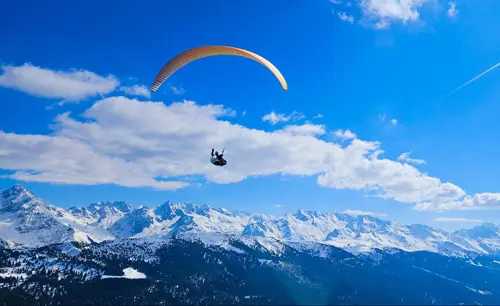
Saint-Hilaire has been at the centre of French paragliding since the sport’s earliest days. The site sits on a plateau above Grenoble, on the eastern edge of the Chartreuse massif, with three launches between 890m and 940m and a 700m vertical to the landing field at Lumbin. Four massifs are visible on a clear day.
FLYING CONDITIONS | XC FLYING | COUPE ICARE | TANDEM FLIGHTS | ACCOMMODATION | GETTING THERE
Why Saint-Hilaire? Simply put, it flies when other sites don’t.
The Chartreuse blocks most Atlantic systems from the west, while Belledonne covers the eastern exposure. Even with strong southerlies coming in, it’s usually flyable at least up until midday. As a result, the site is flyable in conditions that ground pilots elsewhere in the region.
Thermals build reliably from early spring through autumn. Morning glass-offs give way to organised thermal cycles by mid-morning. April to July are peak XC season, though April and May tend to produce the biggest cross-country days. In September, the coaching and tandem seasons start to wind down as the Coupe Icare rolls in — giving the free flight community its annual moment to gather, celebrate the season’s achievements, and send it off properly.
October, meanwhile, is a different kind of reward — the crowds are gone, the light changes, and hike-and-fly season begins.
Altitude: 890–940 m (launches). Landing: 240 m (Lumbin). Vertical: 700 m. Take-off Orientation: E / SE / S. Launches: 3 (North, East, South). XC Potential: High — Chartreuse, Belledonne, Vercors, Bauges. Local School: Prevol Parapente (since 1986). Nearest Airport: Grenoble (30 min) / Lyon Saint-Exupéry (1h 30). Landing Lat/Long: 45.2838, 5.8854. Season: All year (best April–October). Hazards: Lee-side turbulence on South launch in northerly winds; hay fields restrict landing area in summer — stick to mown areas; low overfly of houses near landing prohibited.
Plan Your Trip
✓ The most reliable flying site in the northern Alps — flies when other sites don’t. Three launches, a €5 shuttle, and world-class XC potential from the junction of four massifs.
✗ Shuttle only runs weekends (April–June) and daily in July–August. The historic funicular is currently out of service — access to launch is by road only.
The Launches
Three launches, all accessible from the same plateau.
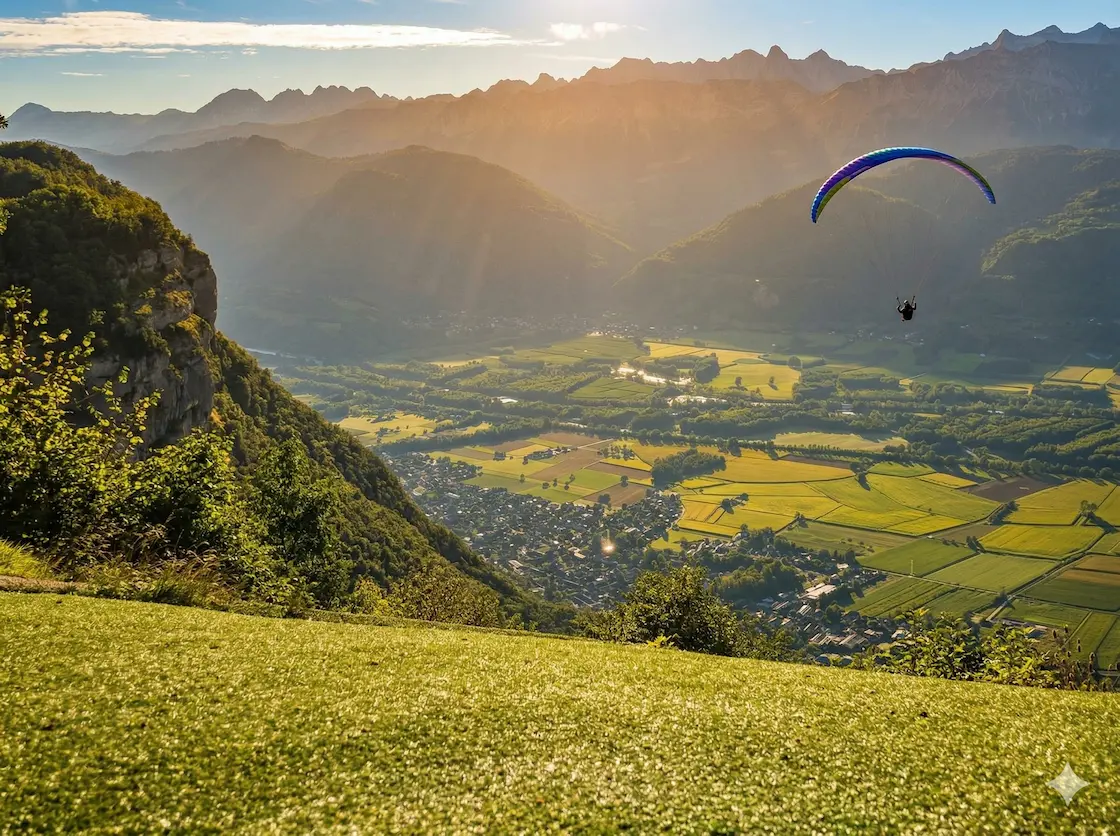
The North launch, sitting on top of the limestone cliff coming up from the valley, is the most used in the early morning — a wide artificial-turf platform facing east to southeast, suitable for all levels including tandems and school flights. The East launch, meanwhile, sits in the deepest notch of the Saint-Hilaire bowl. The bowl channels thermals directly to the windsock, making it a reliable read and a popular choice from mid-morning to the last cycles of the day. The South launch is the largest of the three — as big as a football field and the highest at 940m. Very popular for XC pilots (plenty of space to set up your gear) and acro pilots (every extra metre of height counts when you’re practising tumbles). However, be cautious when the dominant wind is from the north: you’ll be launching in the lee.
All three share the same landing zone at Lumbin — a large flat grass field with easy road access.
The Shuttle
For €5, a dedicated bus runs between the landing field and the plateau throughout the flying day — on weekends from April to June, and all week long in July and August. As a result, most pilots stack four to six flights in a day without thinking twice about it — land, pack your wing, and you’re back on launch in 30 minutes.
The fast turnaround also attracts a specific crowd. Saint-Hilaire is a known training ground for acro pilots — the consistent vertical, accessible launch, and cheap shuttle make repetition easy. Consequently, on busy days in peak season, top-ranked acro pilots share the air with school students. It’s an unusual mix, and a good one.
Top Landing
Behind the three takeoffs, near the town hall and Saint-Hilaire’s main car park, is the training hill. It sees regular use from local schools and independent pilots, and doubles as the best top landing option on the plateau. One caution: when the wind is blowing south, you’ll be in the lee of the car park.
Cross-Country Flying
Saint-Hilaire sits on the eastern edge of the Chartreuse, with Belledonne across the Grésivaudan valley to the east, the Bauges to the north, and the Vercors to the south.
The classic route runs south along the Chartreuse ridge — past the Fort du Saint-Eynard, the Rachais, and the Bastille above Grenoble — then north, running the entire length of the limestone massif, back up to the Granier. From there, the options open up.
The Belledonne crossing is made from the mid-ridge, just south of the Granier. You need a clean exit above 2,200m and a good read of the Grésivaudan valley brise. Connect to the Saint-Genis and you’re a thermal away from the Crêt du Poulet — from there, Belledonne runs 40km north towards Albertville or 20km south towards Chamrousse ski resort. The Bauges crossing, by contrast, starts from the Granier itself. Topped out above the northern end of the Chartreuse, the door opens toward Annecy, where triangles of 130–150km close on good spring and summer days. The Vercors, on the other hand, is reachable from the southern end of the Chartreuse, off the Rachais or the Néron — a longer, more committing day with different terrain and different flying entirely. The crossing itself requires navigating the European Synchrotron’s airspace and, on the other side, connecting to the Vercors massif by getting established over unwelcoming high-voltage power lines.
The site record is currently held by Jonathan Marin — a humbling 324km FAI triangle, flown on the 23rd of April 2021. His flight companions that day were none other than Maxime Pinot and Baptiste Lambert, respectively 2023 and 2025 Paragliding World Champions.

Lloyd’s take
Local pilot and instructor Lloyd Stephan gives us his take on flying at Saint-Hilaire-du-Touvet.
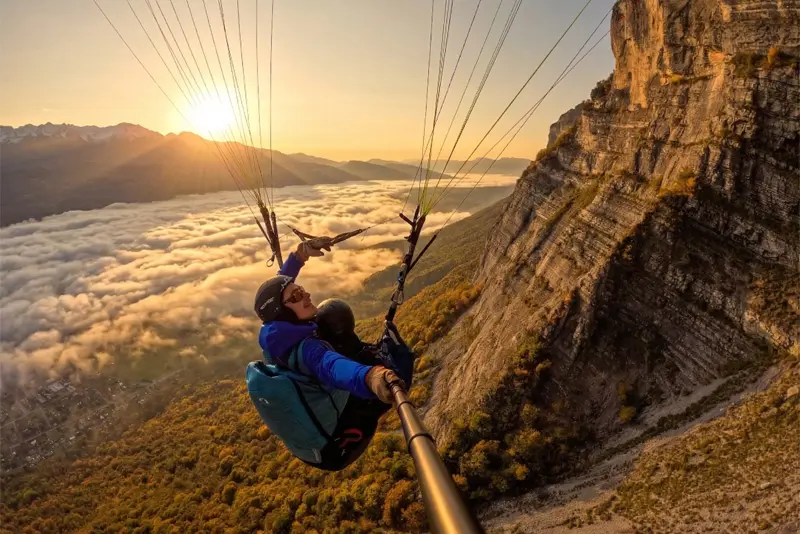
I’ve been flying Saint-Hilaire for ten years and instructing here for a good chunk of them. There’s one thing that still catches me off guard: how often we actually get to fly.
Even when the forecast looks uninspiring, there’s nearly always a window — a couple of hours in the morning, a thermal cycle that builds later than expected, a brief clearing that wasn’t on any model. It’s taught me to stay optimistic and to be ready on launch when the window comes. That’s the other thing people don’t always realise: being on takeoff instead of in the landing field is a game changer. When conditions shift, you’re already there. Add reliable road access to all three launches — no tracks, no guesswork — and you can be reactive in a way that’s genuinely rare on an Alpine site.
On the best days, when the thermals carry you up to the second set of cliffs at 2,000m and the whole Chartreuse massif opens up beneath you, it’s a reminder of how extraordinarily well-preserved this corner of the Alps is. That view never gets old.
For XC pilots, the potential here is consistently underestimated. People arrive knowing about the Coupe Icare. They don’t always arrive knowing that Saint-Hilaire sits at the junction of four major massifs, and that a good pilot on a good day can be over Annecy inside two hours of launching. The Chartreuse-Belledonne connection is one of the great Alpine cross-country routes — technical enough to keep you sharp, reliable enough to plan around.
Another thing I love about this homesite is the proximity — you live on takeoff, and top landing brings you straight back. Some days I’ve logged 100K-plus flights without touching the car. Other days I open the front door, turn right into the forest, and two hours later I’m at 2,000m on the Dent de Crolles, laying out my wing on one of the best hike-and-fly launches in the massif. It never gets old.
Coupe Icare
Every third week of September, Saint-Hilaire hosts the Coupe Icare — originally a hang gliding precision landing competition, it has grown into the world’s largest free flight festival. Now in its sixth decade, it draws over 100,000 visitors across six days and covers every discipline: paragliding, hang gliding, paramotor, wingsuit, hot air balloon.
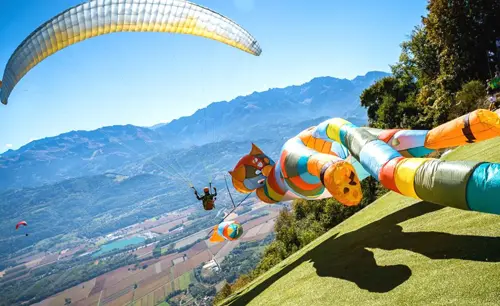
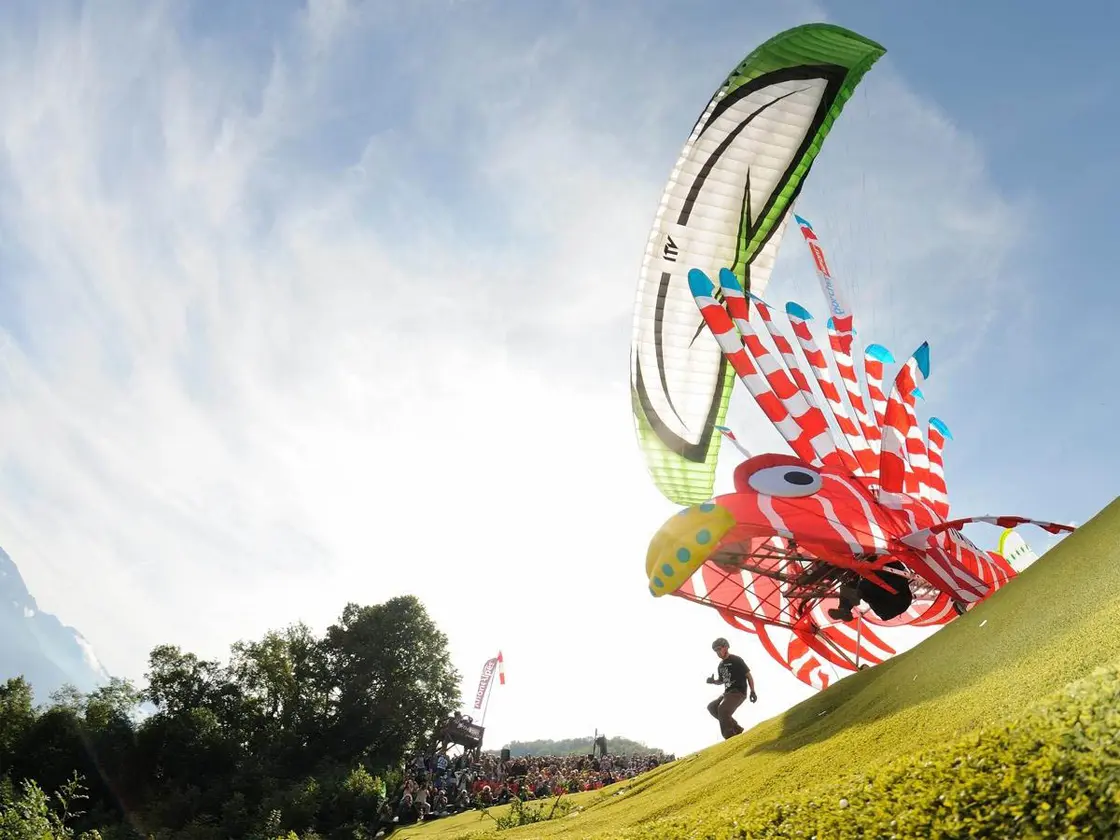
The centrepiece is the Icarnaval — a costumed flight competition that has to be seen to be believed. Pilots spend months engineering outfits that somehow have to fly: dragons, robots, a man riding a flying fish, a full Madagascar ensemble airborne simultaneously. They launch from the North takeoff, the crowd watches from the plateau and from the landing field 700m below.
The Icare du Cinéma is the other pillar — a world-renowned aerial film festival running since 1983, with around a hundred entries competing across seven categories each year. The festival opens on Tuesday with a two-day Testival: the best opportunity of the year to demo the newest gear, which then goes on display at the trade show running Thursday to Sunday with 230-plus professional exhibitors. A morning hike-and-fly to the Dent de Crolles is also part of the tradition for pilots who want to start the day properly.
One thing worth knowing: the airspace is heavily regulated during the event — it is an airshow, after all. Expect queues at takeoff on the main weekend, and pre-registration for certain flight slots. If you’re coming to rack up hours and stack flights, this isn’t the week for it. If you’re coming for the spectacle, there’s nothing else like it.
The 2026 edition runs 15–20 September. Accommodation books up months in advance — Grenoble is the practical base if you leave it late.
Tandem Flights & Paragliding Lessons
Tandem flights and courses at Saint-Hilaire are run by Prevol Parapente, operating on this site since 1986. The school is two minutes from the North launch — which means every available flying window gets used. English-speaking instructors are available throughout the season, and for visiting international pilots, they’re the logical first contact.
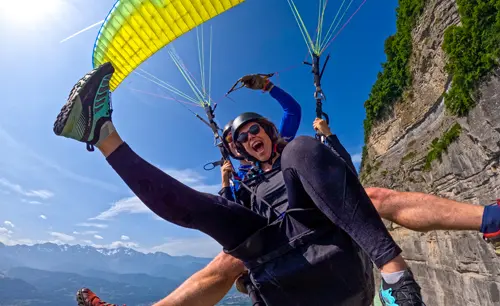
Four tandem options are available: Discovery (10–15 min, €85), Evasion (15–20 min, €105), Performance — a full thermal XC flight lasting around 40 minutes (€170, March–September only), and a Kid flight for ages 6–12 (€75). No experience needed; all flights depart from the North launch with the meeting point at the Prevol school next to the upper funicular station.
For pilots looking to progress, Prevol runs beginner courses, progression stages, and XC coaching throughout the season. Fly Saint-Hilaire is the go-to English-language resource for visiting pilots — full details and booking at flysainthilaire.com.
Book a Tandem Paragliding Flight
Where to Stay
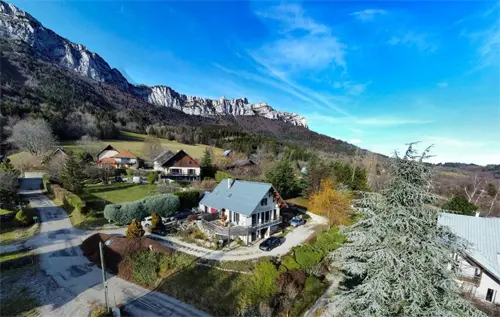
Accommodation on the plateau ranges from pilot-friendly apartments steps from the launch to camping in the valley. The closest option is Ô Déco — an apartment 30m from the Prevol school, from €45/night. Le Fenil, La Bergerie and La Chape are three gîtes 100 metres from Prevol, ideal for groups, from €60/night. For the best value, Camping des Petites Roches is 1km from launch, open April to September, pitches from €8/night. Full listings with contacts at flysainthilaire.com/saint-hilaire-travel-guide.
Find More Accommodation
Use the map below to search for hotels, apartments, guesthouses and campsites across Saint-Hilaire-du-Touvet and the surrounding area.
Beyond the Flying
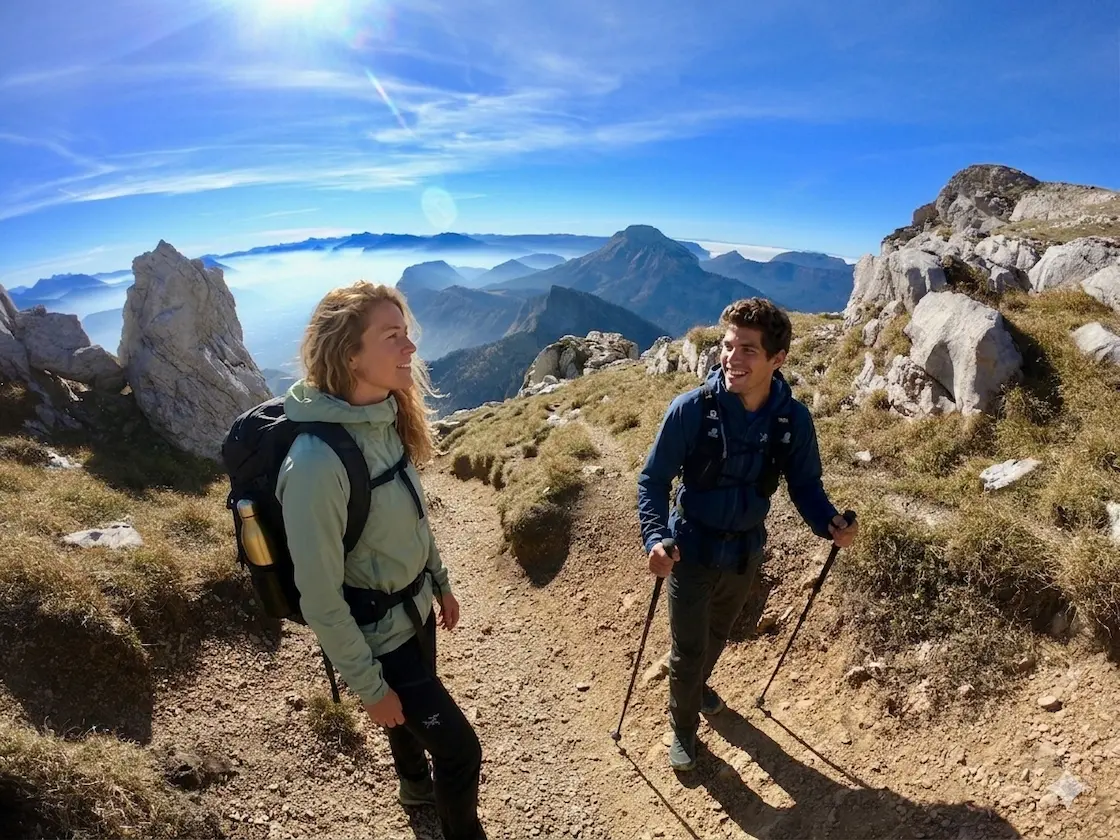
Non-flying days in this part of the Alps are rarely wasted. The Chartreuse Mountains have some of the best walking in the northern Alps — limestone karst, old-growth forest, and a quiet that’s hard to find this close to a city. The obvious objective is the Dent de Crolles (2,062m), but there are trails at every level across the massif. Further into the Chartreuse, the Grande Chartreuse monastery — founded in 1084 and still home to around thirty Carthusian monks — is worth the drive. The monastery itself is closed to the public, but the Musée de la Grande Chartreuse at La Correrie, two kilometres away, tells the story of the order and the famous 130-ingredient liqueur recipe they’ve been guarding for centuries.
For a recovery day, Oréade Balnéo in Saint-Pierre-de-Chartreuse is a wood-fired outdoor spa with nordic baths, two saunas and a yurt — open year-round and about 40 minutes from the plateau. Worth booking in advance at weekends.
If the wind keeps you grounded, Au Perchoir in Crolles (15 minutes down the valley) is a bouldering gym with 1,400m² of walls, a restaurant and a terrace — a solid option for pilots who want to move. For cycling, the Grésivaudan valley runs flat along the valley floor with good dedicated paths and bike rental available locally — ask at the plateau for current options.
Getting There
Saint-Hilaire is 30 minutes from Grenoble by car, 45 minutes from Chambéry, and 1h20 from Annecy. Grenoble has a direct TGV from Paris (3 hours) and its own airport, while Lyon airport is 1h30 by road. From Lyon Saint-Exupéry there’s also an airport shuttle running directly to Grenoble train station. From Geneva airport, it’s 1h45 via the A41.
Without a car, take the B line tram from Grenoble centre then the 85 bus up to the plateau. When the shuttle runs, the C11 from Grenoble station to Lumbin landing field connects directly with the N99 shuttle up to launch — the easiest option if the timing works.
The plateau is reached by car via the D30 from the north (exit junction 23, Le Touvet) or via Saint-Ismier from the south (exit junction 24.1). The main car park is next to the tourist office in Saint-Hilaire village, a short walk from all three launches. Note: the historic funicular suffered storm damage and is not currently operational — check funiculaire.fr for the latest status before your visit.
Weather & Forecast Resources
Check conditions before every flight. These are the tools most pilots at Saint-Hilaire use daily:
Météo Parapente — the French pilot’s go-to forecast tool, built specifically for paragliding. Shows wind, thermals, cloud base, and convergence zones. FFVL Balise — live wind station data from FFVL anemometers at official sites. Windy.com — general weather, good for synoptic overview and wind animation. Météo-France mountain forecast — official French weather service mountain bulletins. SIA / NOTAM — airspace restrictions and temporary flight bans. BipBip — real-time airspace alert app (install on your phone before flying).
Saint-Hilaire FAQ
Yes — it’s arguably the most reliable flying site in the northern Alps. The Chartreuse massif shields it from most Atlantic weather systems, and it regularly flies when other sites in the region are shut down. Even on marginal days, there’s usually a flyable window.
Prevol Parapente offers four tandem options: Discovery (10–15 min, €85), Evasion (15–20 min, €105), Performance — a full thermal XC flight of around 40 minutes (€170, March–September only), and a Kid flight for ages 6–12 (€75). No experience needed.
The Coupe Icare is the world’s largest free flight festival, held at Saint-Hilaire every September since the 1970s. It draws over 100,000 visitors across six days and features the famous Icarnaval costumed flight competition, an aerial film festival, a gear trade show with 230-plus exhibitors, and flying demonstrations across all disciplines. The 2026 edition runs 15–20 September.
April to July is peak XC season — April and May tend to produce the biggest cross-country days. Summer (July–August) is ideal for tandems, beginners, and stacking flights with the daily shuttle. September brings the Coupe Icare. October is quieter, with smooth soaring and excellent hike-and-fly conditions. The site flies year-round.
Saint-Hilaire is 30 minutes from Grenoble by car. Grenoble has a direct TGV from Paris (3 hours) and its own airport. Lyon Saint-Exupéry airport is 1h30 by road with an airport shuttle to Grenoble. Without a car, take the B line tram from Grenoble then the 85 bus to the plateau.
Yes. The North launch is a wide artificial-turf platform suitable for all levels including school flights. Prevol Parapente runs beginner courses and progression stages with English-speaking instructors. The shuttle bus means you can stack multiple flights in a day — ideal for building airtime quickly.
Please leave a comment below if you need specific advice for your paragliding trip to Saint-Hilaire, or if you have any recommendations to help us improve this guide. Happy flying!