

170 km around the highest peak in Western Europe, through three countries, over 10 mountain passes, with 10,000 metres of cumulative ascent — the Tour du Mont Blanc is the most famous multi-day trek in the Alps and one of the great long-distance hikes anywhere in the world. This is everything you need to plan it.
MAP | ROUTE | HIGHLIGHTS | BOOK A GUIDE | ACCOMMODATION | PLANNING YOUR HIKE | FAQ
The Tour du Mont Blanc — the TMB — is a complete circuit of the Mont Blanc Massif, following ancient shepherd paths, mule tracks and marked trails through France, Italy and Switzerland. You don’t climb Mont Blanc itself. Instead, you walk around it, and that’s what makes this trek so extraordinary. Every day brings a different angle on the massif — from the glaciated north face above Chamonix to the soaring granite spires of the Italian Val Ferret, to the pastoral calm of the Swiss valleys. The mountain is always there, but the landscape around it never stops changing.
The TMB is the undisputed flagship of hiking in the French Alps — the trek that every other Alpine circuit is measured against. The Tour des Écrins (GR54) is wilder and harder, the Tour du Queyras (GR58) is quieter and sunnier, but neither has the TMB’s combination of dramatic scenery, three-country variety, and world-class refuge infrastructure. If you’re doing one multi-day trek in the Alps, this is it.
The route traditionally starts and finishes in Les Houches, just outside Chamonix, and runs anti-clockwise through Les Contamines-Montjoie, over the Col du Bonhomme into the Beaufortain, across the Col de la Seigne into Italy, through Courmayeur and the Val Ferret, over the Grand Col Ferret into Switzerland, through Champex-Lac and Trient, and back into France via the Col de Balme — finishing along the spectacular balcony of the Aiguilles Rouges with Mont Blanc filling the horizon.
What sets the TMB apart from other multi-day treks isn’t just the scenery — it’s the infrastructure. A network of well-run mountain refuges means you can walk hut to hut carrying just a light pack, eating hearty meals and sleeping under a roof every night. The trails are well-marked with red and white GR® blazes throughout, and the route crosses through villages and small towns where you can resupply, rest, or simply enjoy a coffee and a slice of tarte aux myrtilles before climbing the next col.
Be warned, though: the TMB is no secret. It’s one of the most popular treks in Europe, and in peak season — mid-July to mid-August — the trail and refuges are busy. Book early, consider travelling in late June or September, and don’t let the crowds put you off. There’s a reason so many people come here.
TMB Gear Guide
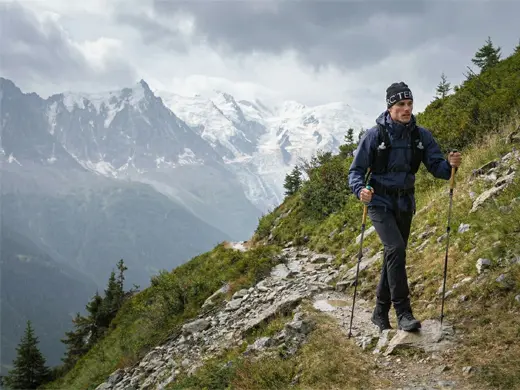
Tour du Mont Blanc Route Map
Follow the Tour du Mont Blanc route on our interactive map below. The trek starts and ends in Chamonix, looping anticlockwise through France, Italy and Switzerland over approximately 170km of high alpine terrain.
When to Hike the Tour du Mont Blanc
The TMB hiking season runs from mid-June to mid-September, dictated by snow conditions on the high passes and refuge opening dates. The window is short, so timing matters.
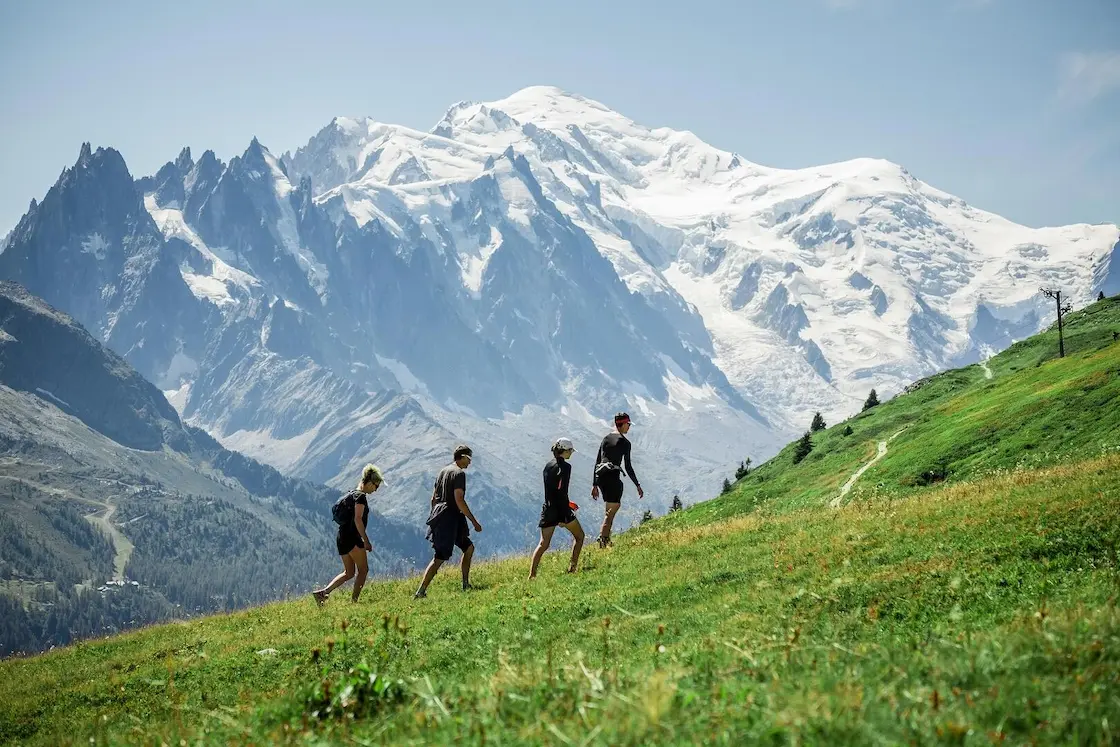
Late June to early July is arguably the best time to hike, especially if you want quieter trails. Most refuges are open, wildflowers carpet the alpine meadows, and the days are long. The trade-off is that lingering snow can linger on the higher passes — the Col des Fours, Fenêtre d’Arpette and the section near Le Brévent are the most affected. You might need microspikes for short sections, and some variant routes may not yet be passable. Check conditions on autourdumontblanc.com before you set out.
Mid-July to mid-August is peak season. Everything is open, the weather is generally settled, and the trails are snow-free. But refuges fill up fast — you’ll need to book months in advance, often the previous autumn — and some stages can feel crowded. If this is your only window, book as early as possible and consider less popular refuge stops to spread the load.
Late August to mid-September offers cooling temperatures, thinner crowds and often the clearest skies of the summer. The light is spectacular. Some smaller refuges start closing from early September, so check availability carefully. One thing to note: the Ultra-Trail du Mont-Blanc (UTMB) takes place in late August, and the trails around Chamonix are packed with runners and spectators for about a week.
The Classic Route — 11 Stages
The standard TMB circuit covers approximately 170 km with around 10,000 m of cumulative ascent, broken into 11 stages. Most hikers walk anti-clockwise — it’s the traditional direction and the one most guidebooks and tour operators follow. You can absolutely walk it clockwise, but the anti-clockwise direction tends to build dramatically, saving some of the most spectacular stages (the Italian Val Ferret, the Fenêtre d’Arpette and the Aiguilles Rouges balcony) for the second half of the trek.
Each stage described below follows the most popular and scenic trail options — including key variants that most experienced hikers prefer over the “official” GR® TMB route where they offer significantly better scenery.
Stage 1: Les Houches to Les Contamines-Montjoie
Distance 16 km. Ascent 730 m. Descent 1,300 m. Duration 6–7 hours.
The TMB begins in Les Houches, a quiet village at the western end of the Chamonix valley. Most hikers take the Bellevue cable car up to 1,800 m to skip the initial forest climb — it saves about 90 minutes and deposits you straight into the alpine zone with views across to the Aiguille du Goûter and the Bionnassay glacier.
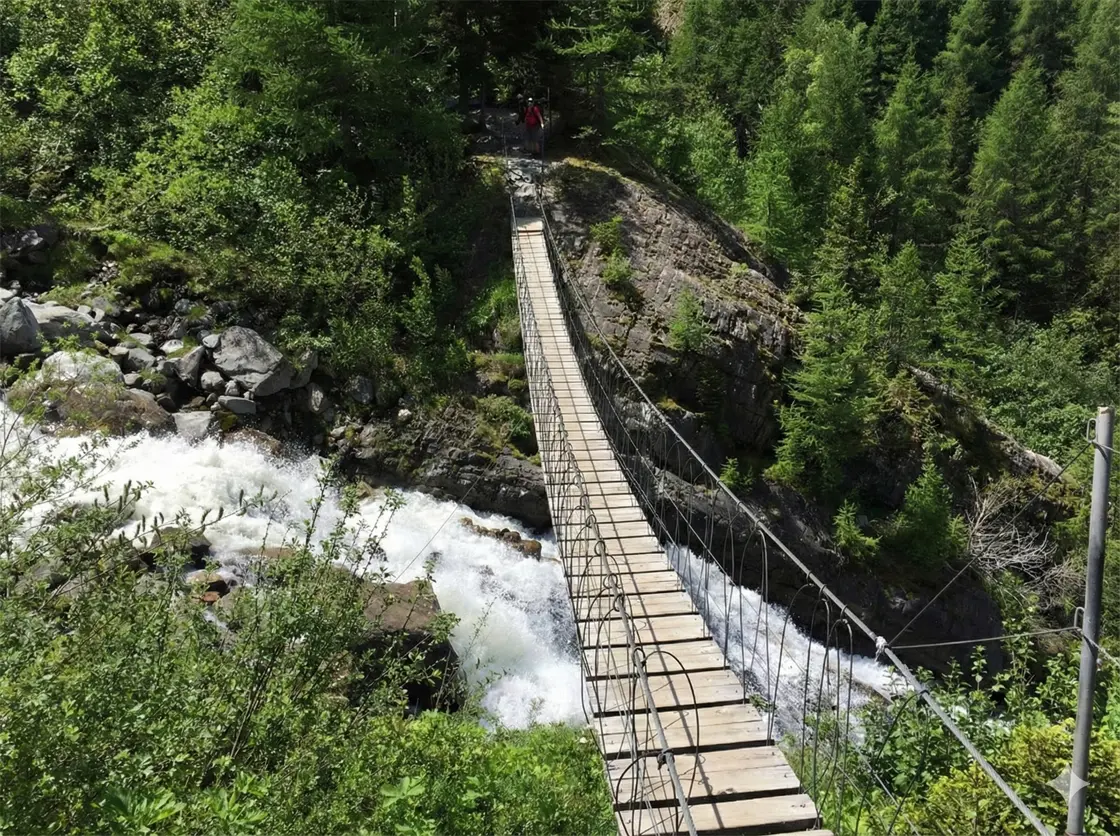
From Bellevue, the recommended variant heads for the Col du Tricot (2,120 m) rather than the standard route via the Col de Voza. This is the more scenic option by a significant margin. The trail crosses a dramatic himalayan-style suspension bridge swaying high above the Bionnassay torrent — it looks terrifying but it’s perfectly safe — before climbing steeply to the col. The views from the top, looking back at the Bionnassay glacier and across to the Dômes de Miage, are a powerful statement of intent for the days ahead.
From the col, the trail descends through the beautiful Chalets de Miage — a cluster of old stone farm buildings in a wide alpine meadow — before dropping into the Val Montjoie and finishing in Les Contamines-Montjoie, a pleasant ski village with shops, restaurants and a range of accommodation. This is a good place to fine-tune your pack and pick up anything you’ve forgotten. If you’ve arrived in the valley a day or two early, there’s excellent day hiking around Chamonix — the Lac Blanc and Mer de Glace balcony trails are both world-class and make for a good warm-up before the main event.
Stage 2: Les Contamines to Refuge de la Croix du Bonhomme
Distance 18 km. Ascent 1,450 m. Descent 250 m. Duration 7–8 hours.
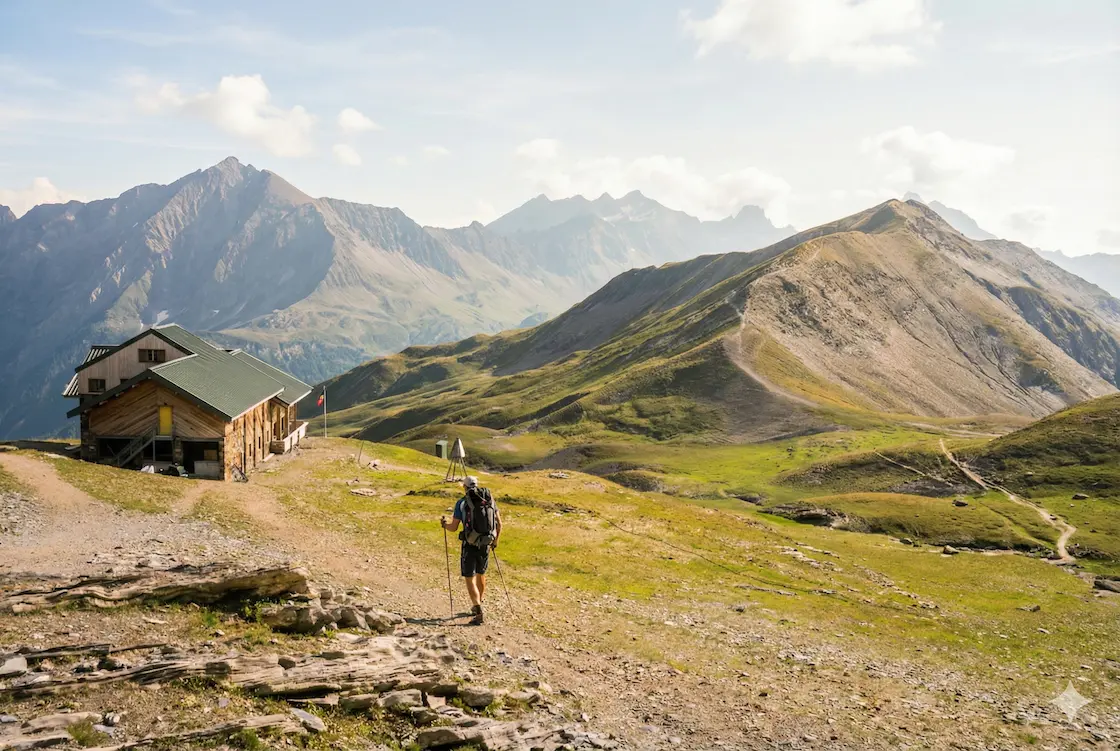
This is the first big day — two high cols and almost 1,500 m of climbing. From Les Contamines, the trail follows the valley south past the beautiful baroque chapel of Notre-Dame de la Gorge, one of the finest churches in the Savoie, before entering the Réserve Naturelle des Contamines-Montjoie. The path climbs steadily through forest and alpine pasture, passing the Chalets du Nant Borrant and the Chalets de Balme — both good options for a coffee stop or an early lunch.
The real work begins after Balme. The trail steepens significantly as it climbs to the Col du Bonhomme (2,329 m), then continues — without much respite — to the Col de la Croix du Bonhomme (2,479 m). This double col crossing is the first genuine alpine passage of the trek, and it can feel exposed in bad weather. If the cloud is down, navigation requires attention, though the path is well-marked.
The Refuge de la Croix du Bonhomme sits just below the col at 2,443 m. It’s a big, well-run CAF refuge with a great atmosphere — tired hikers swapping stories over bowls of soupe de montagne. The sunset views from the terrace are superb.
Important (2026 update): The Refuge de la Croix du Bonhomme is scheduled to undergo major renovation works from mid-August 2026, with closure expected to continue for multiple seasons (reopening currently projected around 2029). Hikers planning a 2026 Tour du Mont Blanc departure should check the refuge’s official website for the latest opening dates and consider alternative stage planning if walking later in the season.
Variant — Col des Fours (2,665 m): If you want to reach the highest point on the classic TMB, take the Col des Fours variant from just below the Col du Bonhomme. It adds about 200 m of climbing and offers panoramic views across to Mont Pourri and the Vanoise. From the col, you descend directly to the hamlet of Les Chapieux, bypassing the Croix du Bonhomme refuge.
Stage 3: Croix du Bonhomme to Rifugio Elisabetta
Distance 20 km. Ascent 820 m. Descent 1,100 m. Duration 7–8 hours.
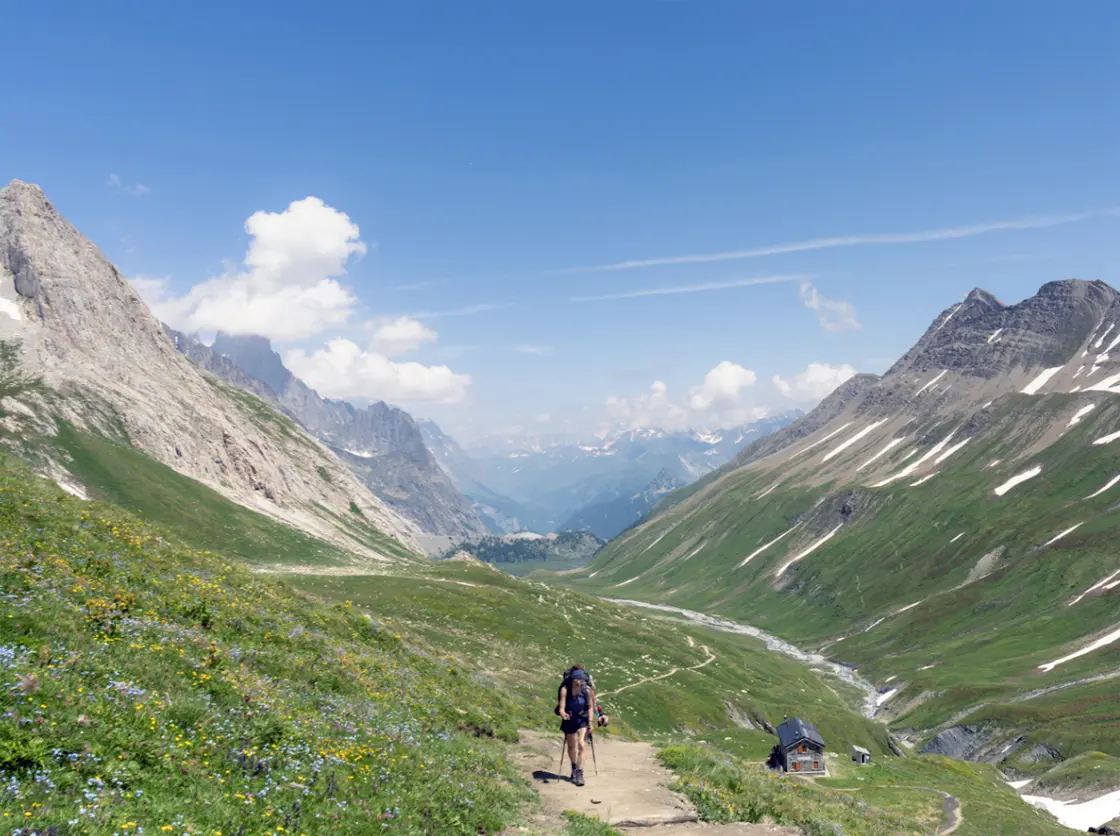
The day begins with a long descent from the refuge to the valley floor at Les Chapieux (1,549 m), a tiny hamlet with a gîte and a fromagerie where you can buy excellent Beaufort cheese. From here, the trail climbs gradually through alpine pasture past the farm at La Ville des Glaciers — another cheese stop if you haven’t already loaded your pack — before steepening for the final push to the Col de la Seigne (2,516 m).
This col is one of the defining moments of the TMB. You cross from France into Italy, and the view that opens up on the other side is genuinely dramatic — the entire south face of the Mont Blanc massif revealed for the first time, with the Aiguille des Glaciers, the Aiguille de Tré la Tête and the sweeping glacial valley of Val Veny stretching out below. Take your time here. Everyone does. As you descend into Italy from Col de la Seigne, you’ll pass the Casermetta Hut an educational facility and museum that’s interesting enough for a quick stop before continuing down into Val Veny.
The descent into Italy passes the beautiful Lac Combal, a glacial lake at the foot of the Miage glacier, before arriving at the Rifugio Elisabetta (2,195 m). This Italian mountain hut has a wild, high-altitude feel — perched on a moraine with glaciers on three sides. The food is a step up from the French refuges, as you’d expect. Pasta, polenta and a carafe of red wine are the standard reward.
Stage 4: Rifugio Elisabetta to Courmayeur
Distance 18 km. Ascent 350 m. Descent 1,400 m. Duration 5–6 hours.
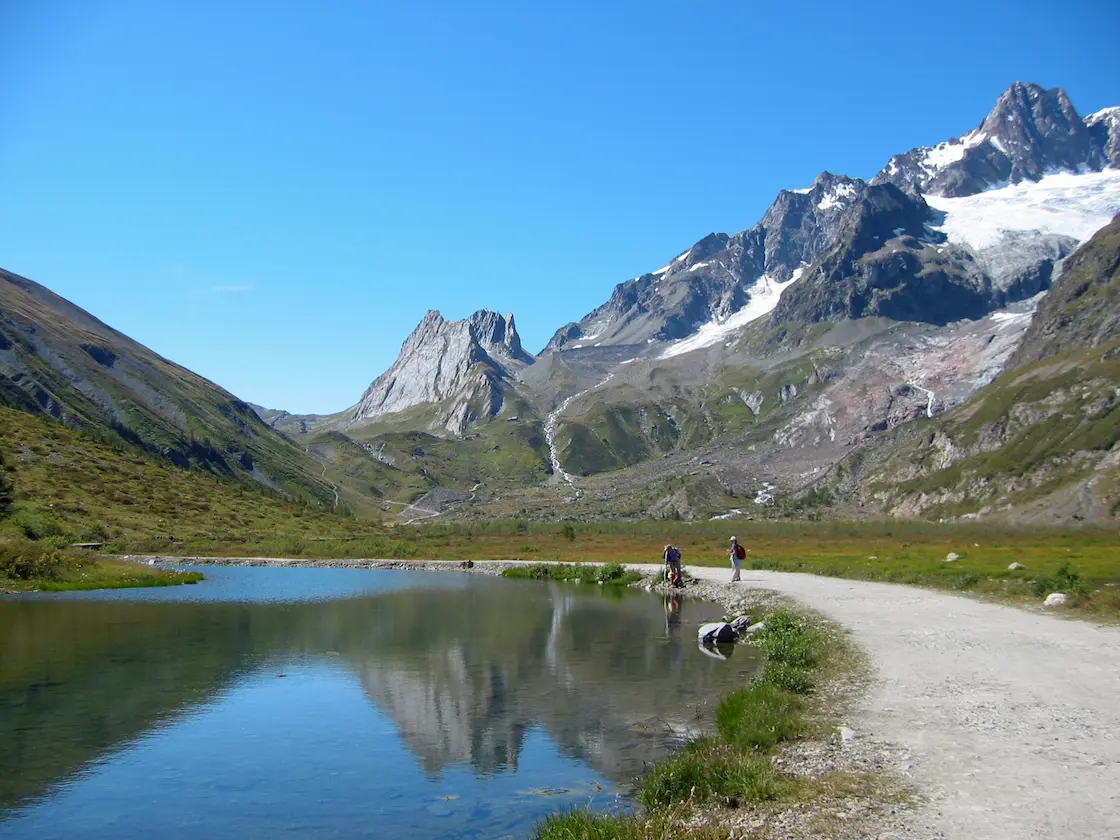
A shorter day — and a welcome one after the big efforts of stages 2 and 3. The trail follows a superb balcony path along the right side of the Val Veny, contouring high above the valley floor with the south face of Mont Blanc — enormous and close — dominating the view to your left. This is some of the finest walking on the entire TMB.
The path eventually descends through larch forest and past the ski lifts of Maison Vieille before dropping steeply into Courmayeur, the Italian counterpart to Chamonix. It’s smaller, warmer and — dare we say it — has better food. Take a rest day here if your schedule allows. Wander the pedestrianised old town, eat pizza, drink espresso, and let your legs recover before the next section.
If the steep descent into town doesn’t appeal, there’s a cable car from the Maison Vieille area that drops you directly into Courmayeur. No shame in that.
Stage 5: Courmayeur to Rifugio Bonatti
Distance 13 km. Ascent 1,100 m. Descent 300 m. Duration 6–7 hours.
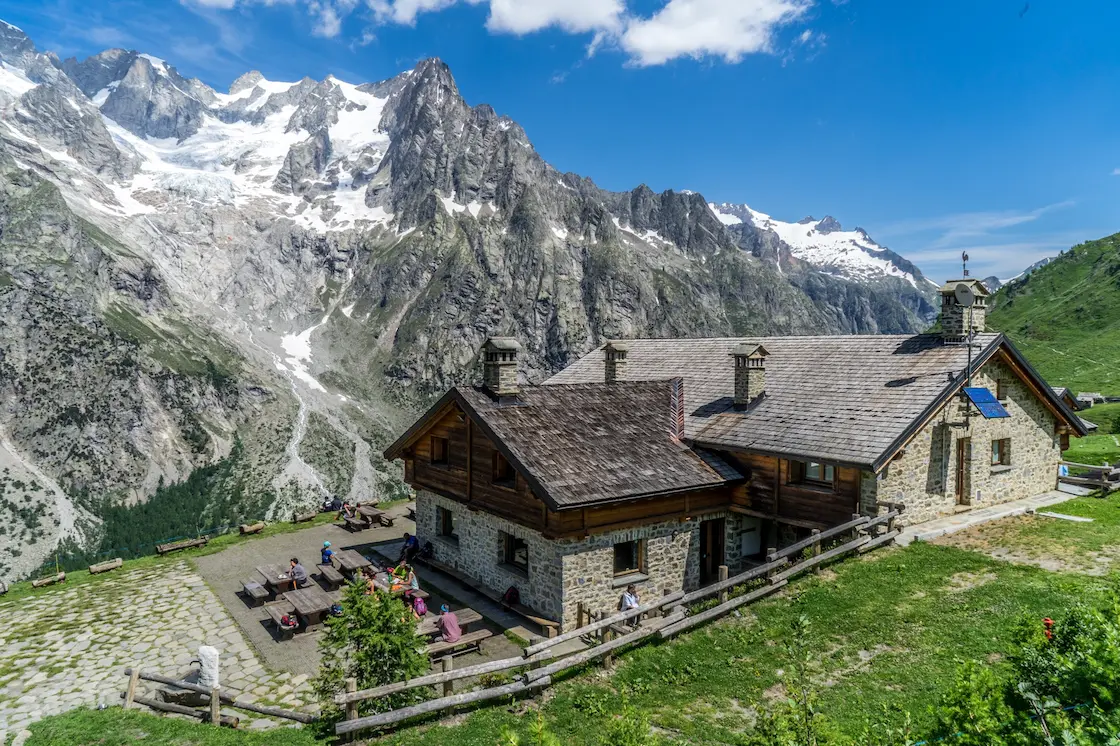
Leaving Courmayeur, the trail climbs steeply to the Rifugio Bertone (1,989 m), which sits on a shelf above the Val Ferret with one of the most celebrated viewpoints on the entire trek — a full panorama of the south face of Mont Blanc, the Grandes Jorasses, the Dent du Géant and the Aiguille Noire de Peuterey. Arrive for lunch if you can, because you’ll want to sit on the terrace and stare.
From Bertone, you have a choice. The standard TMB route traverses the hillside on a gentle path through the forest. The Mont de la Saxe variant takes the ridge instead — it’s harder (more exposed, more climbing) but the views are extraordinary, with the entire Italian side of the massif laid out beside you for hours. On a clear day, it’s one of the best ridge walks in the Alps.
Both routes converge near the Rifugio Bonatti (2,025 m), named after the legendary Italian mountaineer Walter Bonatti. The refuge was rebuilt in 2013 and is modern, comfortable and beautifully positioned. The sunset here, with the last light hitting the Grandes Jorasses while you sit on the terrace with a beer, is one of those moments you’ll remember long after the blisters have healed.
Stage 6: Rifugio Bonatti to La Fouly
Distance 21 km. Ascent 950 m. Descent 1,350 m. Duration 7–8 hours.
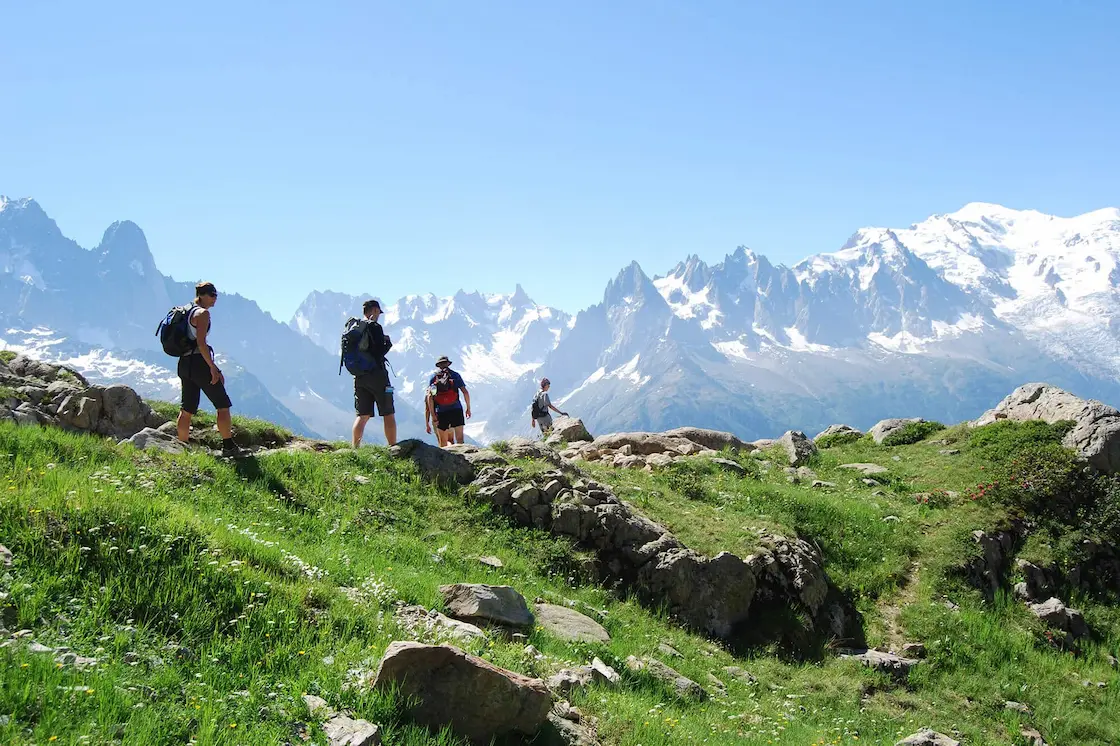
From Bonatti, the trail descends briefly into the Val Ferret before climbing to the Grand Col Ferret (2,537 m), which marks the border between Italy and Switzerland. The ascent is steady rather than steep, and the views back towards the Grandes Jorasses improve with every step. At the col, you leave Italy behind — and the landscape changes noticeably. The Swiss side is greener, gentler, more pastoral.
The descent into the Swiss Val Ferret is long but beautiful, passing through flower-filled meadows and scattered farmsteads before reaching the small village of La Fouly (1,600 m). Switzerland immediately feels different — quieter, more orderly, more expensive. La Fouly has a couple of hotels, a campsite and a small shop for resupply.
Stage 7: La Fouly to Champex-Lac
Distance 15 km. Ascent 600 m. Descent 700 m. Duration 5–6 hours.
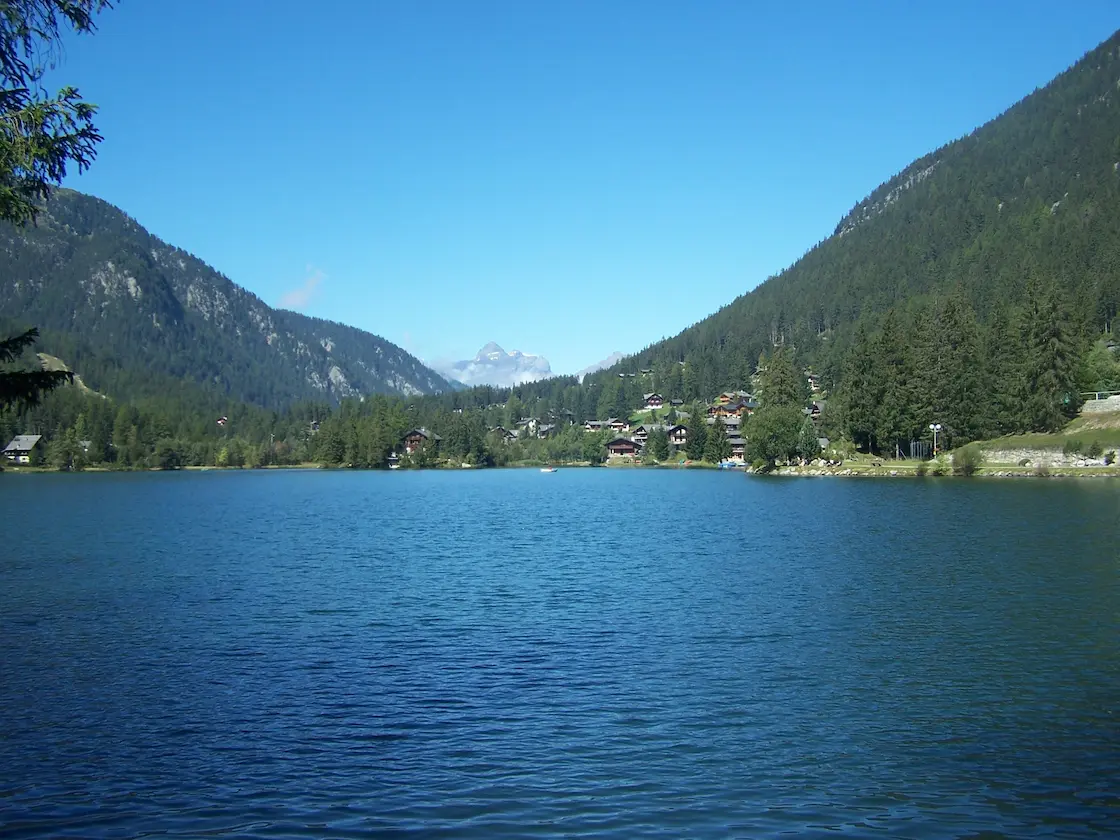
The easiest day on the TMB, and a chance to let your body recover. The trail follows the Swiss Val Ferret downstream through alpine meadows and small villages — Praz-de-Fort, Issert, Orsières — before climbing gently to Champex-Lac (1,466 m), a picture-postcard mountain village set around a beautiful mountain lake surrounded by forest.
Champex-Lac is an excellent place for a rest day. Swim in the lake (it’s cold but refreshing), eat raclette at one of the lakeside restaurants, and mentally prepare for the Fenêtre d’Arpette the following day. There’s a reasonable range of accommodation here, from hotels to a campsite.
Stage 8: Champex-Lac to Trient
Distance 16 km. Ascent 1,200 m. Descent 1,100 m. Duration 7–8 hours (Fenêtre d’Arpette variant).
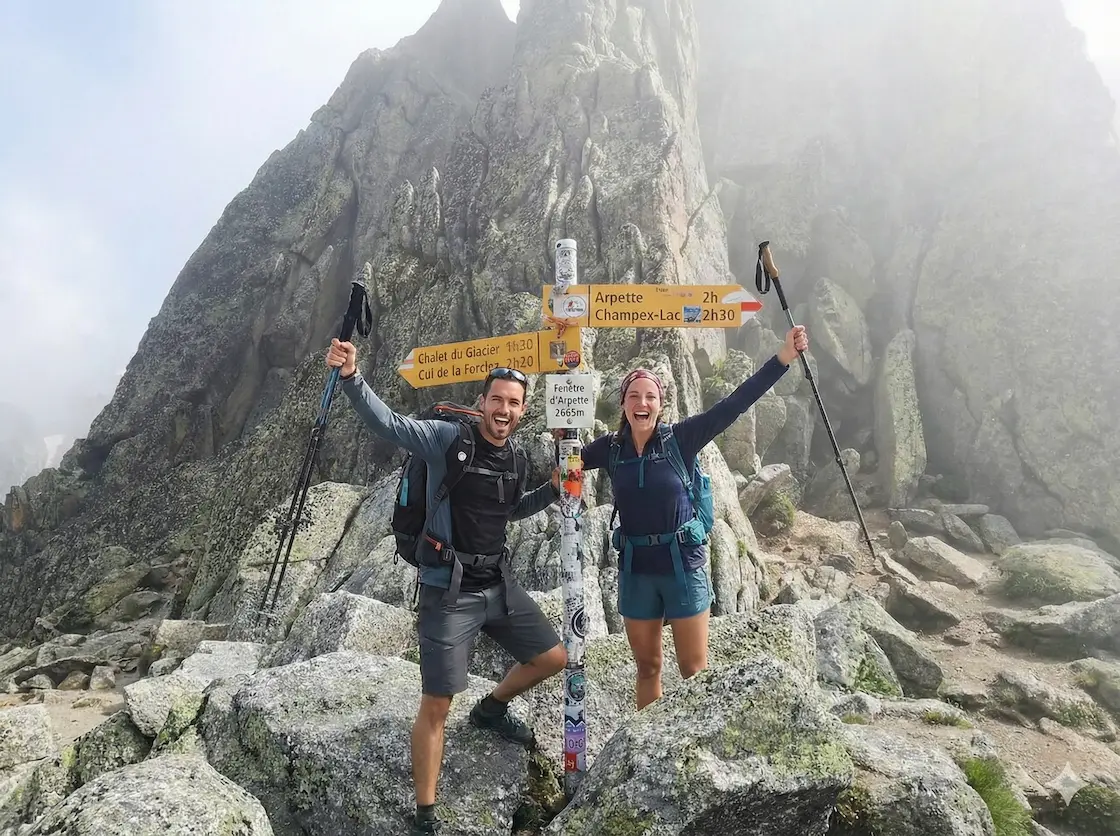
This stage offers one of the great decisions of the TMB: the gentle route over Alp Bovine, or the hard route over the Fenêtre d’Arpette (2,665 m).
The Fenêtre d’Arpette is the more demanding option — a steep, rocky climb on an increasingly rough trail that culminates in a narrow notch between cliffs, with the Trient glacier spilling away below. The final approach is on loose scree and can hold snow well into July. It’s not technically difficult, but it demands good fitness and confidence on rough terrain. In bad weather, don’t attempt it — take Bovine instead.
The Alp Bovine route is the official GR® TMB path and follows a much easier trail through forest and across high pastures with wide views over the Rhône valley. It’s a beautiful walk in its own right, and there’s no shame in choosing it. The two routes converge above Trient, a small village in a deep, narrow valley.
If the weather is clear and you have the fitness, take the Fenêtre d’Arpette. The view from the top — looking down over the crevassed Trient glacier to the peaks beyond — is one of the most spectacular on the entire trek.
Stage 9: Trient to Tré-le-Champ
Distance 15 km. Ascent 980 m. Descent 850 m. Duration 5–6 hours.
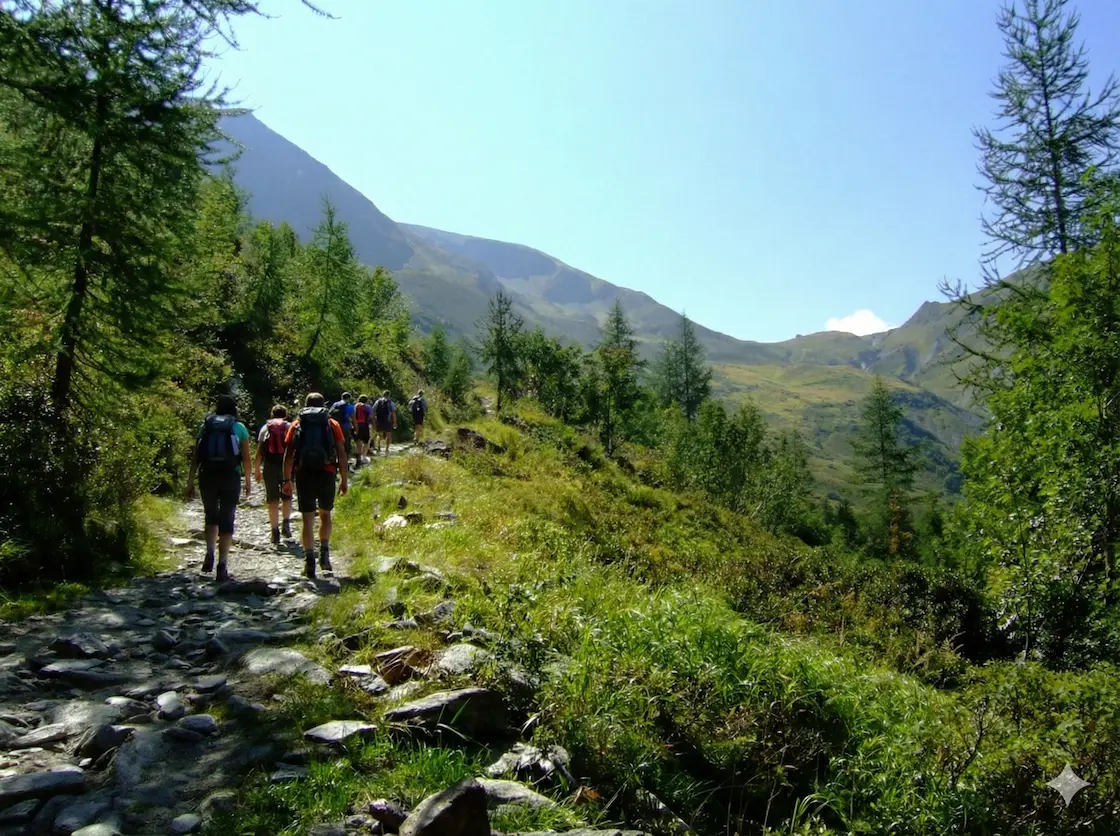
From Trient, the trail climbs through forest and open pasture to the Col de Balme (2,191 m), which marks the Swiss/French border. This is an emotional moment for many hikers. After days of walking through Italy and Switzerland, you’re back in France — and the entire Chamonix valley opens up below you, with Mont Blanc towering directly ahead. You’ve almost come full circle.
The descent from the col follows the ridge of the Aiguillettes des Posettes, with constant views over the valley, before dropping to the hamlet of Tré-le-Champ (1,417 m). There are a couple of gîtes here — it’s a quiet, peaceful overnight stop before the final two stages along the Aiguilles Rouges.
Stage 10: Tré-le-Champ to La Flégère
Distance 17 km. Ascent 1,100 m. Descent 800 m. Duration 7–8 hours.
For many hikers, this is the finest stage of the entire TMB. From Tré-le-Champ, the trail climbs steeply through forest before reaching the famous échelles — a series of nine metal ladders bolted into the rock face. The highest is about 8 metres. They’re well-secured and not technically difficult, but they are exposed and can be intimidating if you’re uncomfortable with heights. In wet conditions, the metal is slippery — take your time and wait for the person ahead to clear the ladder before starting.
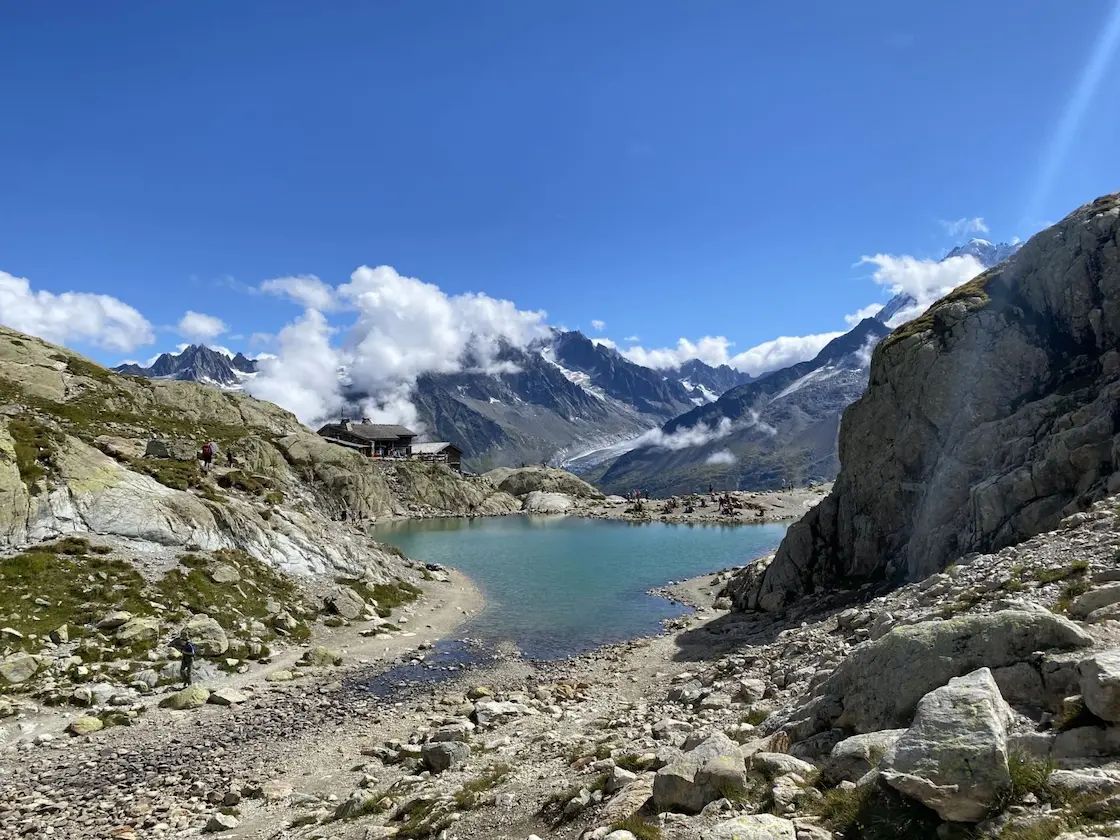
Above the ladders, the trail enters a spectacular high-altitude landscape of lakes and granite. The optional detour to Lac Blanc (2,352 m) is one of those side trips that has become almost compulsory — on a calm day, the Mont Blanc massif is reflected perfectly in the lake’s surface, and it’s easily one of the most photographed spots in the Alps. The Refuge du Lac Blanc serves drinks and food if you want to linger.
From Lac Blanc — or from the junction if you skip it — the trail follows the Grand Balcon Sud, a wide balcony path with non-stop views across the valley to the glaciers, aiguilles and the summit of Mont Blanc. The path eventually descends to the Refuge de la Flégère (1,877 m), which has both a cable car down to Chamonix and overnight dormitory accommodation. If you prefer to sleep in town, the cable car makes it easy.
Stage 11: La Flégère to Les Houches
Distance 17 km. Ascent 780 m. Descent 1,550 m. Duration 6–7 hours.
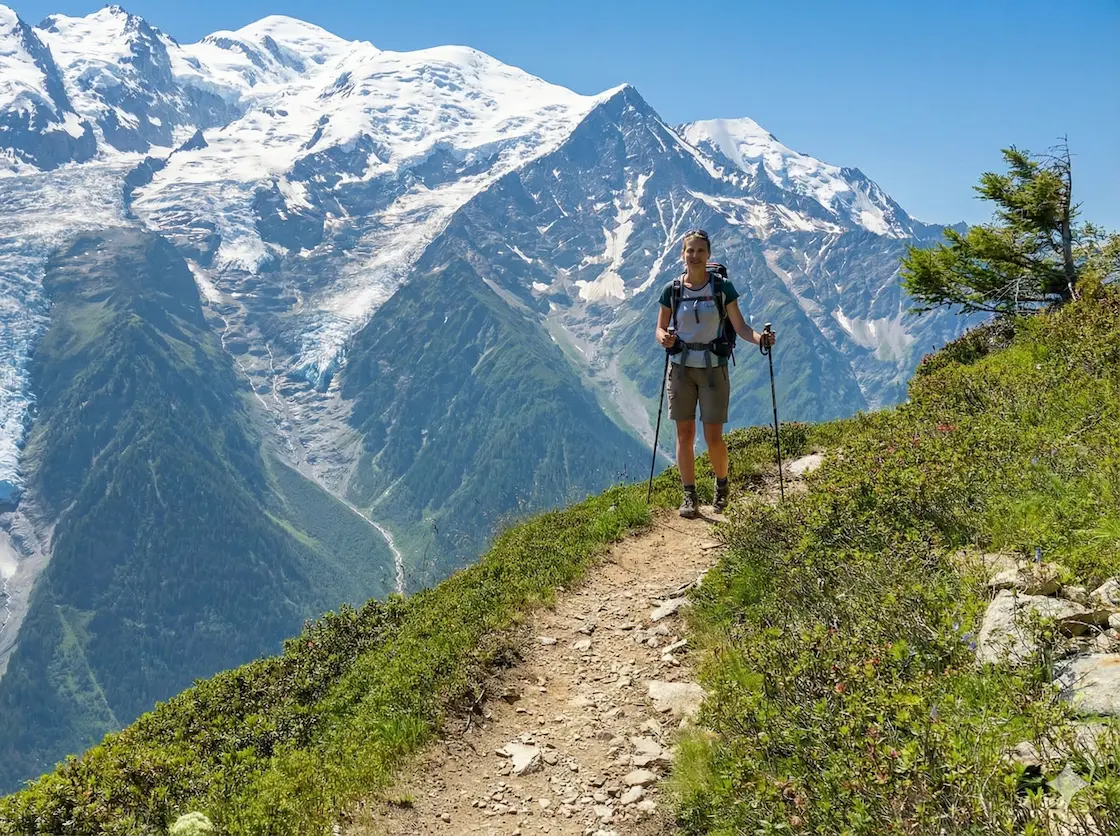
The last day. From La Flégère, the trail continues along the Grand Balcon Sud towards Le Brévent (2,525 m), the high point of this final stage. You can either hike to the summit — a steep but rewarding climb — or take the cable car from Planpraz. Either way, the view from the top is staggering: you’re standing directly opposite Mont Blanc, at almost the same height as the glaciers, with the entire massif stretched out before you. It’s the view that makes the TMB legendary.
From Le Brévent, it’s a long, knee-testing descent of over 1,500 m back to Les Houches. The trail drops through rocky terrain, then forest, before finally reaching the village where you started. The descent is relentless and can be hard on tired legs — trekking poles earn their keep here more than anywhere.
When you arrive in Les Houches, the circuit is complete. You’ve walked around Mont Blanc. Time for a cold beer and a long shower — you’ve earned both.
Highlights & Points of Interest
The TMB is packed with memorable moments, but some stand out above the rest.
Col de la Seigne (Stage 3). The border crossing from France into Italy. The view from the col — the south face of Mont Blanc opening up for the first time — is one of those genuine stop-in-your-tracks moments. Plan to spend at least 20 minutes here.
Rifugio Bonatti sunset (Stage 5). Sit on the terrace with a drink and watch the last light hit the Grandes Jorasses. It’s the best sunset of the trek and one of the finest viewpoints in the Alps.
Lac Blanc (Stage 10). The classic postcard image of the TMB — Mont Blanc reflected in a high-altitude lake. Arrive early in the morning for the calmest water and the fewest people.
Fenêtre d’Arpette (Stage 8). The toughest pass on the route and one of the most rewarding. The view from the top, looking down over the Trient glacier, is worth every step of the climb.
The échelles (Stage 10). Nine metal ladders bolted to a cliff face. They’re safe, but they get the adrenaline going — especially if you look down.
Courmayeur (Stage 4). A rest day in this Italian mountain town is one of the great pleasures of the TMB. The food, the espresso, the atmosphere — it’s a world away from the refuges.
Wildlife. You’ll almost certainly see marmots — their whistles are the soundtrack of the TMB. Ibex and chamois are common on the higher sections, and golden eagles patrol the skies above the cols. Keep your eyes open.
Refuges & Where to Stay on the Trail
The TMB’s network of mountain refuges is one of the reasons the trek works so well. Most hikers walk hut to hut, booking demi-pension (dinner, bed and breakfast) at each refuge. This means you carry just a day pack — no tent, no stove, no heavy food supplies.
Refuge dormitories typically sleep 4–12 people in bunks. Bring earplugs and a silk liner — some refuges provide blankets, others expect you to have a liner. Dinner is communal, often generous (soup, meat or pasta, cheese, dessert), and served at a set time. Breakfast is usually bread, jam, coffee and sometimes cereal. Most refuges also sell packed lunches for the trail.
Booking is essential. Since Covid, the TMB has become enormously popular, and refuge capacity hasn’t kept pace. For peak-season dates (mid-July to mid-August), you’ll need to book 6–9 months ahead — many hikers book the previous autumn. The official online booking platform for many TMB refuges is montourdumontblanc.com, which covers refuges across all three countries. Some refuges have their own booking systems.
The Rifugio Bonatti (Stage 5) is the standout — modern, comfortable, with exceptional food and arguably the best view of any mountain hut in the Alps. The Rifugio Elisabetta (Stage 3) has a wild, remote atmosphere and excellent Italian cooking. The Refuge de la Croix du Bonhomme (Stage 2) is a classic French CAF hut with a great communal vibe. The Refuge de la Flégère (Stage 10) is convenient for the final stages and has a cable car link to Chamonix if you want a night in town.
Note for 2025: The Casermetta Espace Mont-Blanc, located near the Col de la Seigne, will be closed for the entire 2025 summer season for renovation work on its water treatment and sanitary systems. Plan your Stage 3 accommodation accordingly.
If you prefer more comfort, several stages pass through or near villages (Les Contamines, Courmayeur, Champex-Lac, Trient) where you can stay in hotels or gîtes instead of refuges. This adds flexibility but may require some road-walking or short taxi transfers to rejoin the trail.
Book a Guided TMB Trek
If you’d rather not deal with the logistics of booking refuges, planning stages and navigating independently, a guided or self-guided tour is a smart option — especially for first-time TMB hikers.
Guided TMB Treks
Explore-Share offers fully guided 13-day Tour du Mont Blanc treks covering the complete 170 km circuit across France, Italy and Switzerland. Over ten days of hiking, you’ll cross high passes, gain more than 9,000 m of elevation, and experience the full sweep of the Mont Blanc massif without worrying about logistics. Accommodation is arranged in welcoming mountain hotels and traditional refuges, with regional cuisine to keep you fuelled throughout.

Accommodation in Chamonix
Most TMB hikers spend at least a night in Chamonix before or after the trek. It’s the natural base — the nearest town to the start point at Les Houches, with excellent transport connections, gear shops, restaurants and a buzzing mountain-town atmosphere.
For a comfortable mid-range option, the Hôtel Le Faucigny in the centre of Chamonix has well-appointed rooms and is a short walk from the train station. Budget-conscious hikers will find several hostels and gîtes in town — the Chamonix Lodge offers good-value dormitory and private rooms. If you want something special after 11 days on the trail, treat yourself to a night at the Hameau Albert 1er, one of Chamonix’s finest hotels, with a spa that will do wonders for tired legs.
Les Houches itself has a smaller selection of accommodation, including the Hôtel Chris-Tal and several gîtes. Staying here the night before you start means you can walk straight out the door and onto the trail.
Planning Your Hike
Maps
The TMB crosses three countries, so you’ll need multiple map sheets if you’re using paper. The key IGN (Institut Géographique National) maps are 3531 ET (Saint-Gervais-les-Bains) and 3630 OT (Chamonix–Massif du Mont-Blanc). For the Swiss and Italian sections, the Swiss Topo 1:25,000 sheets or a dedicated TMB single-sheet map cover the full route.
For digital navigation, the IGN Rando app and Outdooractive both have the TMB route available for download. GPX tracks for the complete circuit — including major variants — can be downloaded from autourdumontblanc.com.
The trail is waymarked throughout with red and white GR® blazes in France, and equivalent national waymarks in Italy and Switzerland. Navigation is straightforward in good visibility, but a map or GPS is essential in poor weather — cloud can descend quickly on the high passes.
The most popular guidebook is Kev Reynolds’ Tour of Mont Blanc (Cicerone Press), available in English with detailed stage descriptions, maps and practical information.
Getting There & Parking
Les Houches is the traditional start and finish point for the TMB. If you’re driving, the most direct route is via Geneva, then the A40 autoroute (Autoroute Blanche) through the Arve valley to Les Houches — approximately 1 hour 15 minutes from Geneva Airport. There is free parking in Les Houches, but for a 10-day trek, check locally for secure long-term options. Some hotels and gîtes offer parking for guests.
Getting there without a car
Geneva Airport (GVA) is the main gateway, with direct flights from most European cities and connections worldwide. From Geneva, several bus services run directly to Chamonix — FlixBus and Easybus operate regular transfers taking approximately 1 hour 30 minutes. Book in advance, especially in summer.
By rail, take the SNCF TGV to Saint-Gervais-Le Fayet, then transfer to the Mont Blanc Express narrow-gauge train, which stops at both Les Houches and Chamonix. The train journey from Saint-Gervais to Chamonix takes about 40 minutes and runs through some beautiful scenery — a fitting warm-up for the trek ahead.
From Chamonix, local buses (the Chamonix Bus network) connect to Les Houches throughout the day, or you can walk the 6 km if you want to start as you mean to go on.
What to Pack
The TMB is a hut-to-hut trek, so your pack should be light — aim for 7–10 kg including water. You don’t need a tent, sleeping bag or cooking equipment if you’re staying in refuges.
Essentials: Sturdy hiking boots (broken in before you go), moisture-wicking base layers, insulating mid-layer (fleece or lightweight down), waterproof jacket and trousers, sun hat, warm hat and gloves (for early mornings and high passes), trekking poles, headtorch (for early starts), sunglasses, sunscreen (SPF 50 — the UV is intense at altitude), basic first aid kit, water bottle or hydration system (at least 1.5 litres), blister kit.
For a detailed breakdown of the shell jackets, insulation layers, and packs that perform best on the TMB, see our Arc’teryx gear guide for the French Alps — every piece is mapped to the conditions you’ll face on the trail.
Refuge essentials: Silk or cotton sleeping bag liner (required in most refuges), earplugs (non-negotiable), quick-dry towel, toiletries, flip-flops or light shoes for evenings in the hut.
Documents: Your passport — you’re crossing three international borders. Cash and card — refuges in France and Italy generally accept cards, but some Swiss huts and smaller establishments are cash-only. Euros for France and Italy, Swiss francs for Switzerland (though euros are often accepted).
Difficulty & Fitness
The TMB is not technically difficult — you don’t need climbing skills, ropes or mountaineering experience. But it is physically demanding. You’ll be hiking 15–20 km per day over mountain terrain, with daily ascent and descent of 800–1,200 m. That’s sustained, day after day, for 7–11 days.
Training: If you’re not a regular hill-walker, start training at least 3 months before your trip. Aim for at least one long hike per week with 500–800 m of ascent, carrying a loaded pack. Build up to back-to-back days to condition your body for consecutive days on the trail.
Altitude: The highest point on the classic route is the Grand Col Ferret at 2,537 m (or 2,665 m if you take the Fenêtre d’Arpette). This is well below the threshold where altitude sickness becomes a concern for most people.
Bivouac & Camping Rules
Wild camping is not permitted within the French or Italian sections of the TMB. In France, bivouacking (setting up a tent between 7pm and 9am at least one hour’s walk from a road or trailhead) is tolerated in some areas but not within the Réserve Naturelle des Contamines-Montjoie. In Switzerland, rules vary by canton — check locally. Several designated campsites exist along the route in Les Contamines, Courmayeur, La Fouly and Champex-Lac if you want to camp.
Chamonix — Beyond the TMB
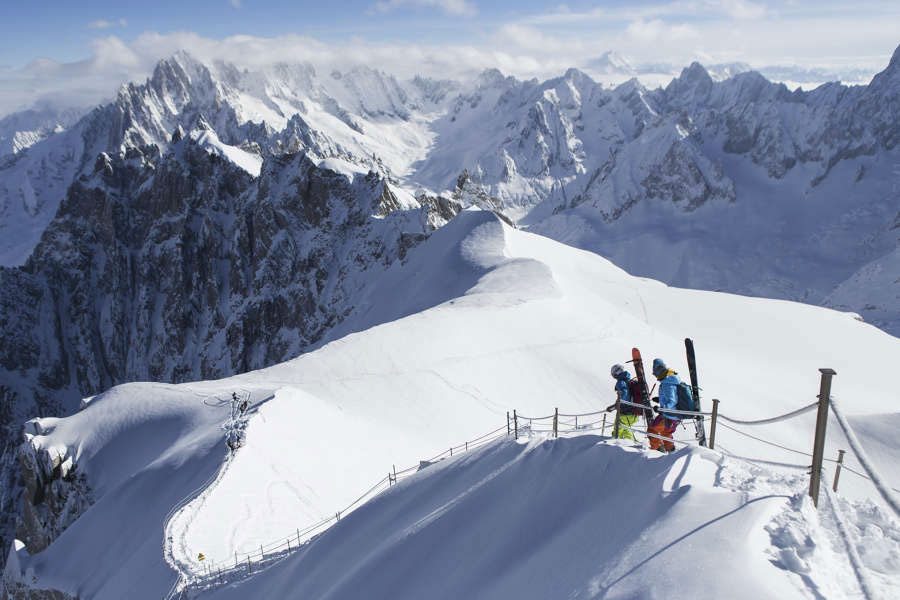
Most TMB hikers spend at least a night in Chamonix before or after the trek, and it’s worth knowing what else the valley offers. In winter, Chamonix is one of the world’s great ski destinations — the Vallée Blanche descent from the Aiguille du Midi is a 20 km backcountry run through the heart of the massif you’ve just walked around. In summer, the same lifts access some of the best mountain biking in the Alps, and for those with the experience and ambition, the Mont Blanc ascent starts from right here in the valley. Chamonix doesn’t do things by halves.
FAQ
The classic circuit takes 7–11 days, depending on your fitness level and how many rest days you include. The standard 11-stage itinerary allows a comfortable pace with daily distances of 13–21 km. Strong hikers can complete it in 7 days by combining stages. Most hikers find 9–10 days to be the sweet spot.
Physically demanding but not technically difficult. You need good fitness for sustained daily hiking with 800–1,200 m of ascent and descent over mountain terrain. The trails are well-maintained and well-marked. The only mildly exposed section is the metal ladders on Stage 10. If you can comfortably hike 20 km with 1,000 m of ascent in a day, you’ll manage the TMB.
Late June to early July for quieter trails and wildflowers (possible snow on high passes). Mid-July to mid-August for guaranteed snow-free conditions (but crowds). September for clear skies and fewer hikers (some refuges close). Refuges are generally open from mid-June to mid-September.
Yes — absolutely. TMB refuges fill up quickly, especially in July and August. Book 6–9 months ahead for peak-season dates. The official booking platform is montourdumontblanc.com.
Wild camping is generally not permitted along the TMB. Bivouacking is tolerated in some areas of France but not within nature reserves. Designated campsites exist at Les Contamines, Courmayeur, La Fouly and Champex-Lac.
No — the TMB is well-waymarked and can be hiked independently by anyone with reasonable mountain experience and good fitness. However, a guided or self-guided tour simplifies the logistics considerably, especially the challenge of booking refuges.
We’ve put together a detailed technical hiking gear guide covering the layering system, shell jackets, packs, and footwear we’d recommend for the TMB — every piece mapped to the conditions you’ll actually face on the trail.
On the classic route, the highest point is the Grand Col Ferret at 2,537 m. If you take the Fenêtre d’Arpette variant (Stage 8), you’ll reach 2,665 m. The Col des Fours variant (Stage 2) also reaches 2,665 m.
Budget approximately €80–120 per day for refuge demi-pension. Over 10 days, that’s roughly €800–1,200 for accommodation and meals. A guided tour typically costs €1,500–3,000 depending on the operator. A self-guided tour runs €1,200–2,000.
Yes, with caveats. Children need to be strong walkers. Families with children aged 10+ who are used to hiking can manage the TMB with shorter stages and rest days. The échelles on Stage 10 require a head for heights. Several tour operators offer family-specific TMB itineraries.
Anti-clockwise is the traditional and most popular direction. It builds dramatically, saving the Aiguilles Rouges balcony and the face-to-face Mont Blanc views from Le Brévent for the final days. Most first-timers should go anti-clockwise.
Planning a Tour du Mont Blanc trek and need specific advice? Please leave a comment below – whether it’s about refuge bookings, route variants, gear choices or anything else. We’ll do our best to help. Bonne randonnée!
You May Also Like

Hiking French Alps
Tour des Écrins

Tour du Queyras

Chamonix Skiing
Vallée Blanche
