THE CLIMBS | RAID PYRÉNÉEN | WHEN TO GO | PLAN YOUR TRIP | FAQ
Road cycling in the Pyrenees is the sport in its original form. The Tour de France came here in 1910 — a year before it dared the Alps — and the mountains haven’t softened since: steeper roads, narrower passes, greener valleys, and a fraction of the traffic.
That 1910 stage created cycling’s first great legend: 326 km from Luchon to Bayonne over the Peyresourde, Aspin, Tourmalet and Aubisque — a route the riders christened the Circle of Death. Octave Lapize crossed the Aubisque on foot, spat “assassins!” at the organisers, and won the Tour anyway. Every one of those four cols is on this page, and every one is open to you.
The Pyrenees reward riders who like their mountains personal. Where the Alps deal in scale and spectacle, the Pyrenees deal in intimacy: cols stacked so close together that the Tourmalet, Aspin, Hautacam and Luz Ardiden can all be ridden from one village base, café stops where the owner asks about your ride, and high pastures where the loudest sound is cowbells. It’s also noticeably cheaper than the Alps — accommodation, food and everything else.
This guide covers the legendary climbs of the French Pyrenees, the end-to-end Raid Pyrénéen, when to come and where to base yourself. Comparing ranges? See our French Alps climbs guide and the South of France — or start with the full road cycling in France overview.
The Legendary Pyrenean Cycling Climbs
The heart of Pyrenean cycling is remarkably compact: most of the climbs below start within 40 km of each other, clustered around the valleys of Luz-Saint-Sauveur, Arreau and Bagnères-de-Luchon. That density is the region’s gift — legendary col mornings, valley café lunches, and a second col before dinner.
Here are the six climbs that define the range:
Col du Tourmalet
Length: 19 km from Luz-Saint-Sauveur
Summit: 2,115 m
Altitude gain: 1,404 m
Avg gradient: 7.4% (max ~10.5%)
The most-climbed mountain in Tour de France history — nearly 90 crossings and counting — and the spiritual summit of the Pyrenees. From Luz-Saint-Sauveur the gradient is brutally consistent, the hairpins through La Mongie save their hardest ramps for last, and the statue of Octave Lapize gasping at the col reminds you whose wheel you’re following. Descend the other side to Sainte-Marie-de-Campan and you can loop back over the Col d’Aspin for one of the great Pyrenean days.
Col d’Aubisque
Length: 16.6 km from Laruns
Summit: 1,709 m
Altitude gain: ~1,190 m
Avg gradient: 7.2% (sustained 10%+ sections)
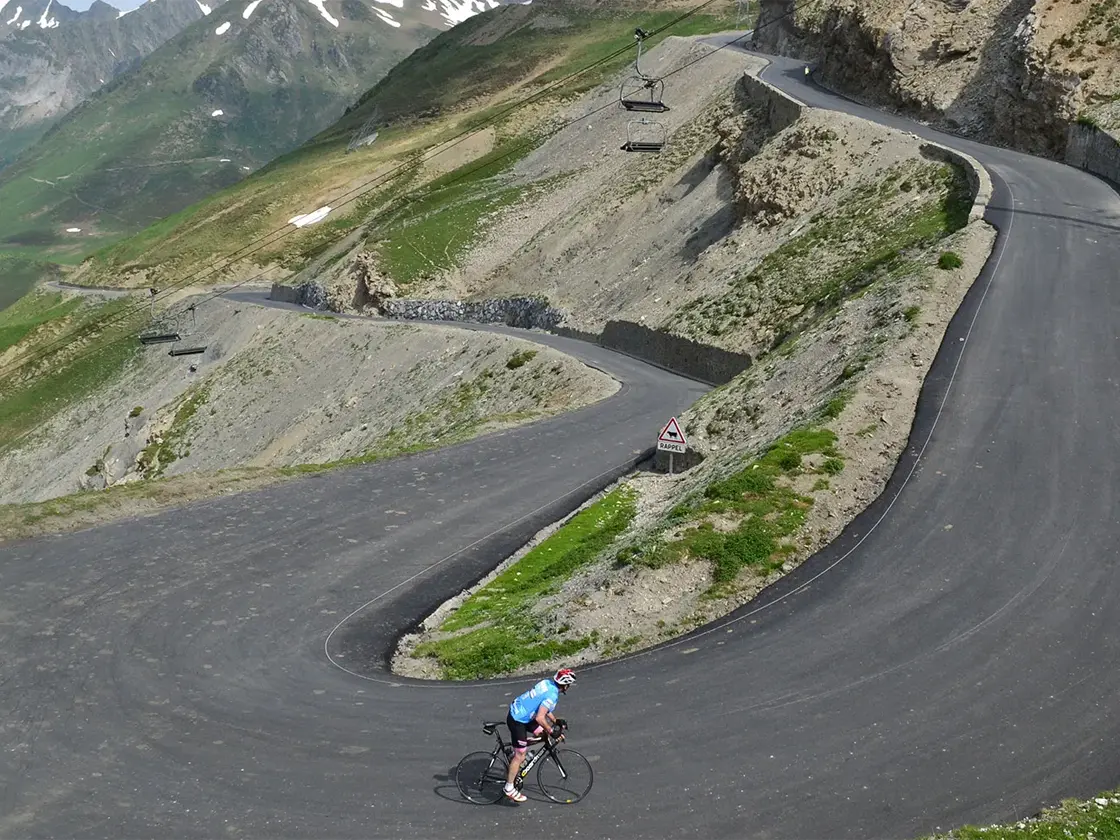
The most beautiful col in the Pyrenees — and the climax of the original Circle of Death. From Laruns the road climbs hard through Eaux-Bonnes and the ski station at Gourette, with long sections above 10%, before easing onto the open summit ridge with its famous giant bicycle sculptures. Then comes the bonus: the corniche road to the Col du Soulor, carved into a cliff face, is the most spectacular two kilometres of balcony riding in France. Watch for free-roaming cows, sheep and the occasional llama.
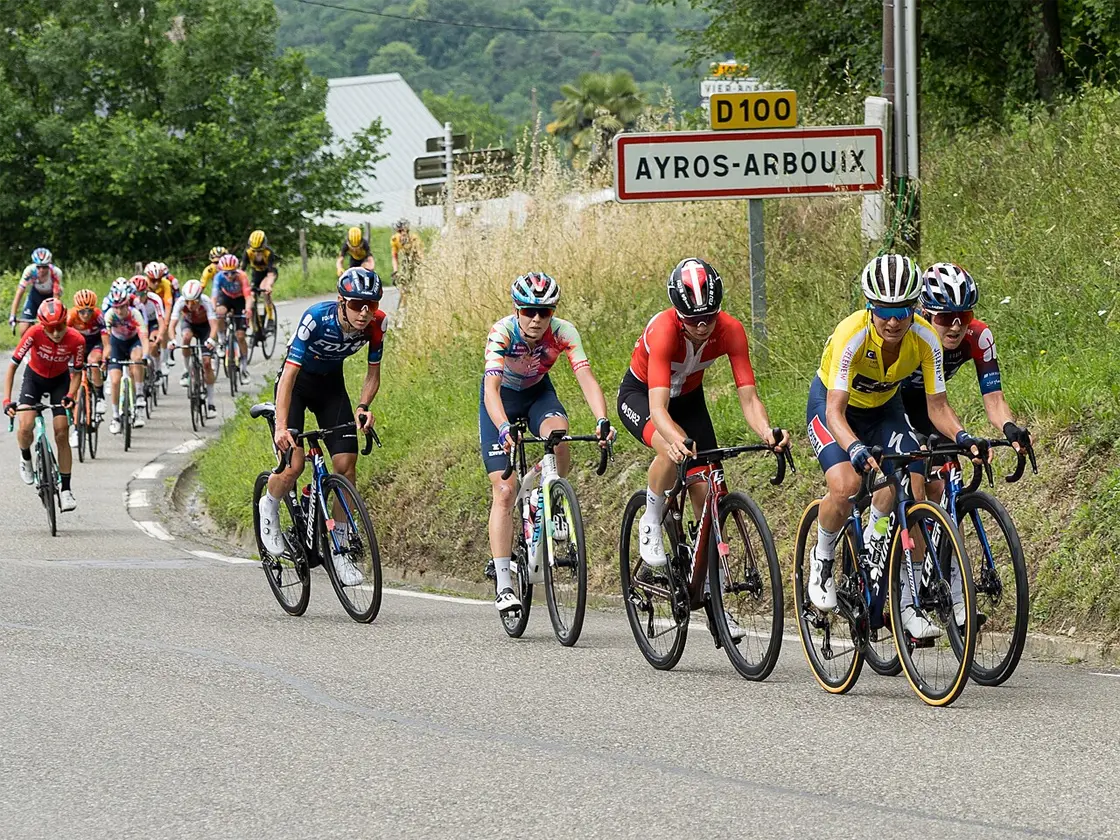
Hautacam
Length: 13.6 km from Ayros-Arbouix
Summit: 1,635 m
Altitude gain: ~1,060 m
Avg gradient: 7.8% (irregular, 10%+ ramps)
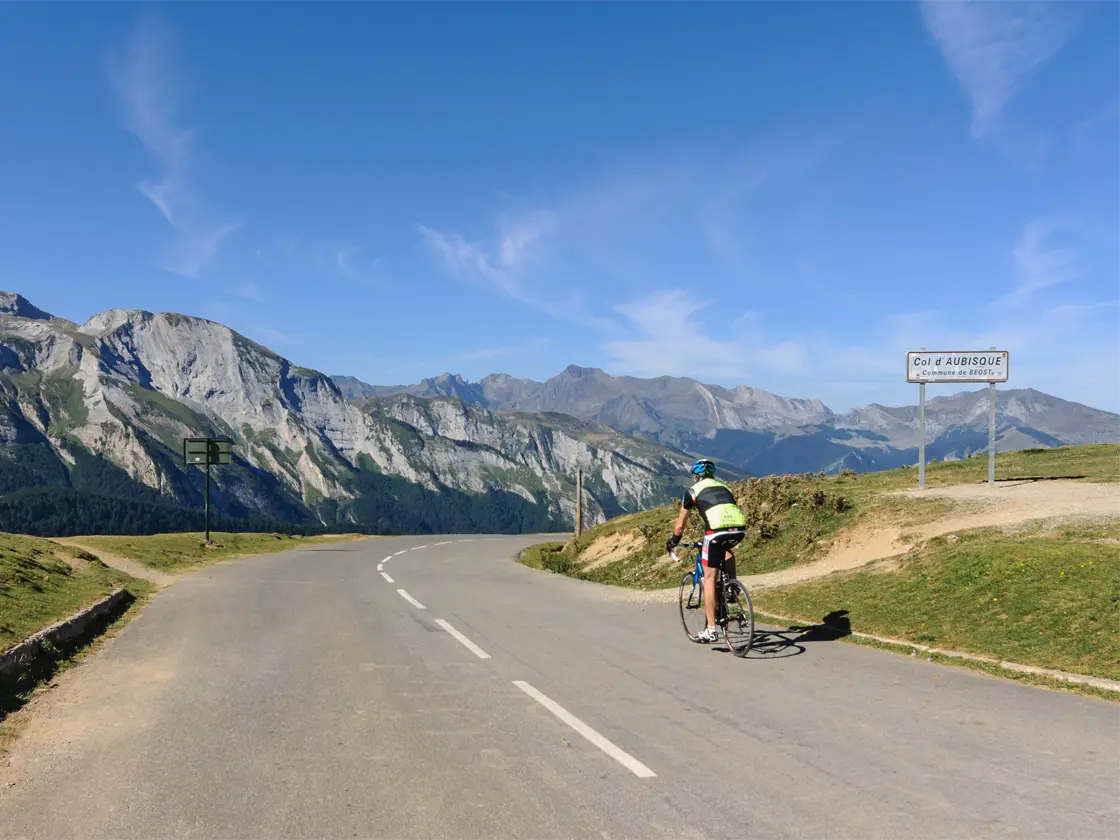
The Tour’s favourite Pyrenean summit finish — a dead-end climb above Lourdes whose irregular gradient makes it harder than its numbers. The road never settles: 10% ramps alternate with brief false flats, wrecking any rhythm, which is exactly why the race keeps coming back to crown champions here. The reward is a green amphitheatre of pasture with the whole Lavedan valley below. Pair it with nearby Luz Ardiden for a day of legendary summit finishes.
Col d’Aspin
Length: 12 km from Arreau
Summit: 1,490 m
Altitude gain: ~790 m
Avg gradient: 6.5% (steeper final 5 km)
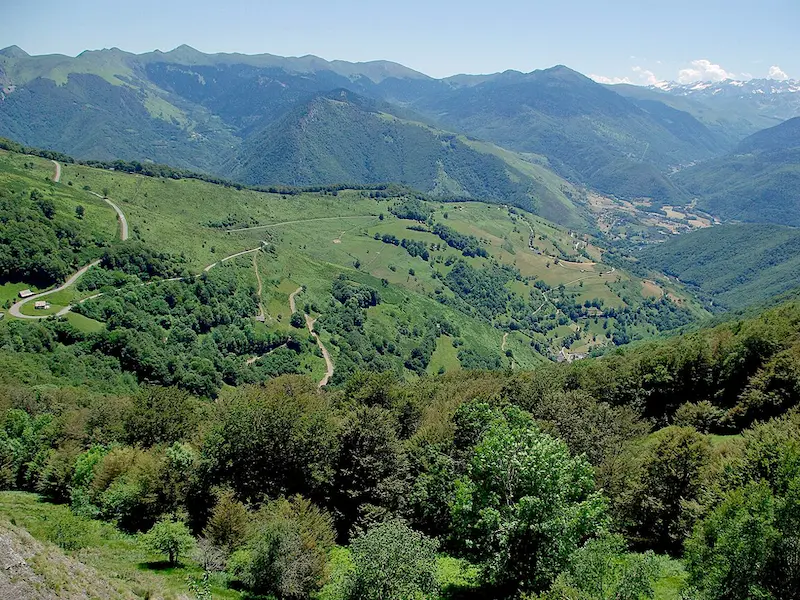
The friendly one — and don’t let that fool you into skipping it. The Aspin has crossed the Tour more than 70 times as the connective tissue of the great Pyrenean stages, and from Arreau it’s a lovely, rideable climb through beech forest to an open summit with one of the best views in the range: the Pic du Midi de Bigorre and the wall of the Tourmalet filling the western sky. The perfect first Pyrenean col, and the natural partner to the Tourmalet in a loop from either valley.
© JLCP – Wikipedia
Col de Peyresourde
Length: 14 km from Bagnères-de-Luchon
Summit: 1,569 m
Altitude gain: ~940 m
Avg gradient: 6.9% (max ~10%)
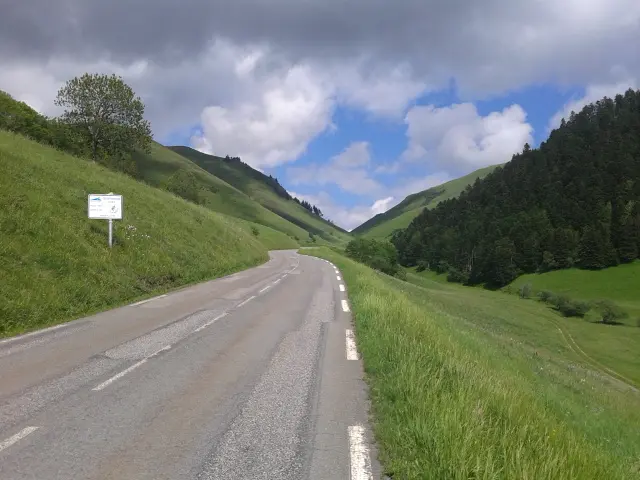
The first climb of the original Circle of Death, rising from the spa town of Bagnères-de-Luchon through open pasture on a steady, honest gradient. The Peyresourde is a Tour fixture — over 70 appearances — and the tradition at the top is non-negotiable: the little crêperie at the col serves plates of sugar crêpes to anything in lycra. Descend west and you’re at the foot of Loudenvielle, the Pyrenees’ mountain biking capital, with the Col d’Azet waiting behind it.
Col du Portet
Length: 16 km from Saint-Lary-Soulan
Summit: 2,215 m
Altitude gain: ~1,400 m
Avg gradient: 8.7% (max 12.5%)
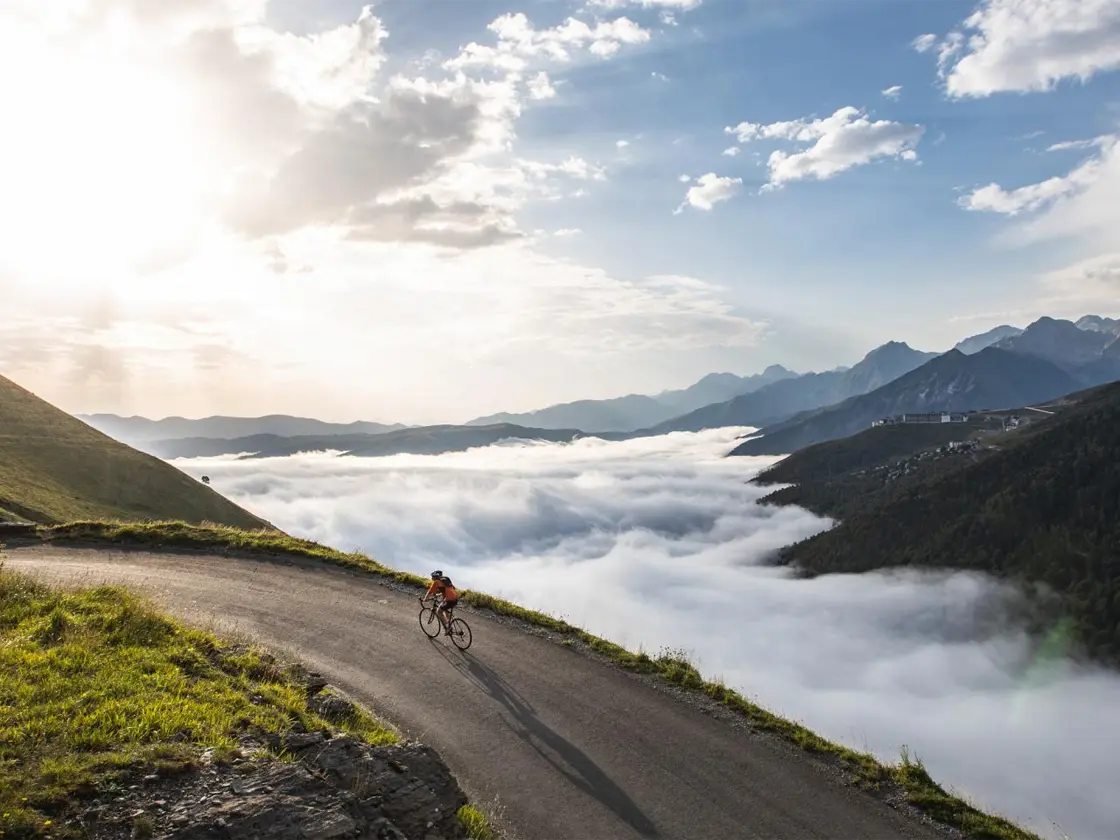
The hardest climb in the Pyrenees — the range’s answer to the Col de la Loze. Introduced to the Tour in 2018 and dubbed “the Tourmalet of the 21st century”, the Portet climbs out of Saint-Lary at a merciless 8.7% average, the second half on a narrow mountain road above the treeline with 12% ramps in increasingly thin air. No café, no crowds, no mercy — just one of the great high-mountain finishes in modern cycling. The route du col du Portet is closed to motor vehicles and open exclusively for cyclists and pedestrians during July and August. Saint-Lary makes the natural base, with gondola-served mountain biking for the rest day.
The supporting cast would headline anywhere else: Luz Ardiden and its amphitheatre of hairpins, Superbagnères above Luchon, the brutal little Port de Balès, the Basque country’s deceptive Col de Marie-Blanque, and the Col de Portet d’Aspet, where a memorial honours Fabio Casartelli. We’ll be adding detailed climb guides over time.
The Raid Pyrénéen — Coast to Coast
The Pyrenees’ signature challenge is also one of cycling’s oldest: the Raid Pyrénéen, roughly 720 km from Hendaye on the Atlantic to Cerbère on the Mediterranean, over 18 cols and around 11,000 m of climbing. The classic randonneur version, run by the Cyclo Club Béarnais since the 1950s, must be completed within 100 hours — riders carry a card stamped at checkpoints along the way. Finish and your name joins seventy years of company.
You don’t have to race the clock. The same west–east line makes a magnificent 6–10 day tour at touring pace, riding the Aubisque, Tourmalet, Aspin and Peyresourde in their natural sequence and finishing with a swim in the Mediterranean. Several operators run supported crossings with luggage transfer; self-supported riders will find gîtes and small hotels in every valley. Either way, ride it west to east — the prevailing wind is at your back and the climbs come at you in historical order.
When to Ride the Pyrenees
The big cols are open from roughly May to October — earlier than the highest Alpine passes, since only the Tourmalet and Portet top 2,100 m. June and September are the sweet spots: settled weather, quiet roads, and every col open. July brings the Tour and its caravan of campervans to whichever cols feature that year — electric to watch, busier to ride.
One Pyrenean rule the Alps don’t teach: respect the Atlantic. The western half of the range catches ocean weather, and a blue morning in Luz can turn to thick mist on the Tourmalet by noon — the locals call it the brouillard. Pack a proper waterproof jacket whatever the forecast, and check conditions before committing to the high cols in May or October. The eastern, Mediterranean end stays drier and rideable for longer — often well into November at lower altitude.
Plan Your Trip
Where to Base Yourself
Luz-Saint-Sauveur or Argelès-Gazost are the classic central bases — Tourmalet, Hautacam, Luz Ardiden and the Aubisque (via the Soulor) all within riding distance. Bagnères-de-Luchon, the grand old spa town, puts the Peyresourde, Superbagnères and Port de Balès on the doorstep. Saint-Lary-Soulan covers the Portet, Aspin and Azet, with lift-served mountain biking for mixed groups. All three are proper towns with bike shops, rental (approximately €35–80 per day for quality road bikes) and cyclist-friendly accommodation at prices the Alps forgot decades ago.
Getting There
By air: Toulouse is the main gateway (90 minutes–2 hours to the central valleys), with Pau, Lourdes-Tarbes and Biarritz closer to the western cols. Airport transfers carry bike boxes — confirm capacity when booking. By train: TGV and Intercités reach Pau, Lourdes and Tarbes direct from Paris (bagged bike, ~€10 reservation); Lourdes is 30 minutes from Argelès-Gazost. By car: the valleys are barely an hour apart, making a two-base trip — west then east — the natural way to ride the whole range.
Beyond the Bike
The Pyrenees are made for mixed trips: hiking in the Néouvielle reserve and the Gavarnie cirque, lift-served mountain biking at Loudenvielle, Saint-Lary and Cauterets, spa soaks in the thermal towns after a big col day, and the Basque country an easy drive west when the legs are done.
Road Cycling in the Pyrenees — FAQ
The Col de Portet above Saint-Lary-Soulan — 16 km at 8.7% average to 2,215 m, with 12% ramps on a narrow road above the treeline. Of the classics, the Tourmalet is the biggest single ascent (19 km, 1,404 m of gain from Luz-Saint-Sauveur) and the Aubisque from Laruns has the most sustained steep sections.
Different, and many riders end up preferring them. The Pyrenees are steeper, quieter, greener and cheaper, with legendary cols packed closer together — the Tourmalet, Aspin, Hautacam and Luz Ardiden can all be ridden from one base. The Alps win on sheer scale, the highest passes and infrastructure. First trip for the famous names: Alps. For atmosphere and empty roads: Pyrenees.
Roughly May to October for the big climbs — the Pyrenees open earlier than the Alps because only the Tourmalet and Col de Portet exceed 2,100 m. June and September offer the best mix of weather and quiet roads. The Mediterranean end of the range stays rideable at lower altitudes well into November.
A classic coast-to-coast challenge: roughly 720 km from Hendaye on the Atlantic to Cerbère on the Mediterranean over 18 cols, traditionally completed within 100 hours with a checkpoint card stamped along the way. It’s been run by the Cyclo Club Béarnais since the 1950s. Ridden at touring pace over 6–10 days, it’s also simply the best cycle tour in the Pyrenees.
Luz-Saint-Sauveur or Argelès-Gazost for the central giants (Tourmalet, Hautacam, Luz Ardiden, Aubisque via the Soulor); Bagnères-de-Luchon for the Peyresourde group; Saint-Lary-Soulan for the Col de Portet and Aspin. All are real towns with bike shops, rental and good-value accommodation — noticeably cheaper than Alpine resorts.
Toulouse has the most flights and reaches the central valleys in 90 minutes to 2 hours. Pau and Lourdes-Tarbes are closer to the Tourmalet region; Biarritz suits the western cols and a Raid Pyrénéen start. Most transfer companies carry bike boxes if you confirm when booking.
Please leave a comment below if you need specific advice for your Pyrenees cycling trip, or if you have any recommendations to help us improve this page. Allez!