
Biarritz is where France’s Atlantic coast puts its best clothes on. An imperial resort of belle époque villas and clifftop promenades wrapped around six sandy beaches — and the town where European surfing started. In one square kilometre you get seawater spas, pintxos bars, an 1888 golf course and the longest, friendliest longboard wave in France.
HIGHLIGHTS | ACTIVITIES | BOOK A TRIP | ACCOMMODATION | PRACTICAL INFO
The town owes its existence to a whim. Napoléon III built the Villa Eugénie above the Grande Plage for his Basque-born empress in 1854, the European aristocracy followed, and the fishing village became a resort. That villa is now the Hôtel du Palais. A century later the surfers arrived: Jo Moraiz opened his surf school on the Côte des Basques in 1966 and has been teaching there ever since, which makes it the oldest surf school in continental Europe.
Those two worlds still share the same seafront, and that’s the appeal. You can spend the morning being pummelled by seaweed wraps in a thalassotherapy centre and the afternoon eating a pintxo standing up in a market bar. Biarritz is also the most accessible town on this stretch of France’s Atlantic coast — the airport sits five minutes from the centre, Bayonne is under 30 minutes by tram-bus, and the Spanish border is 20 minutes down the road.
Biarritz Highlights
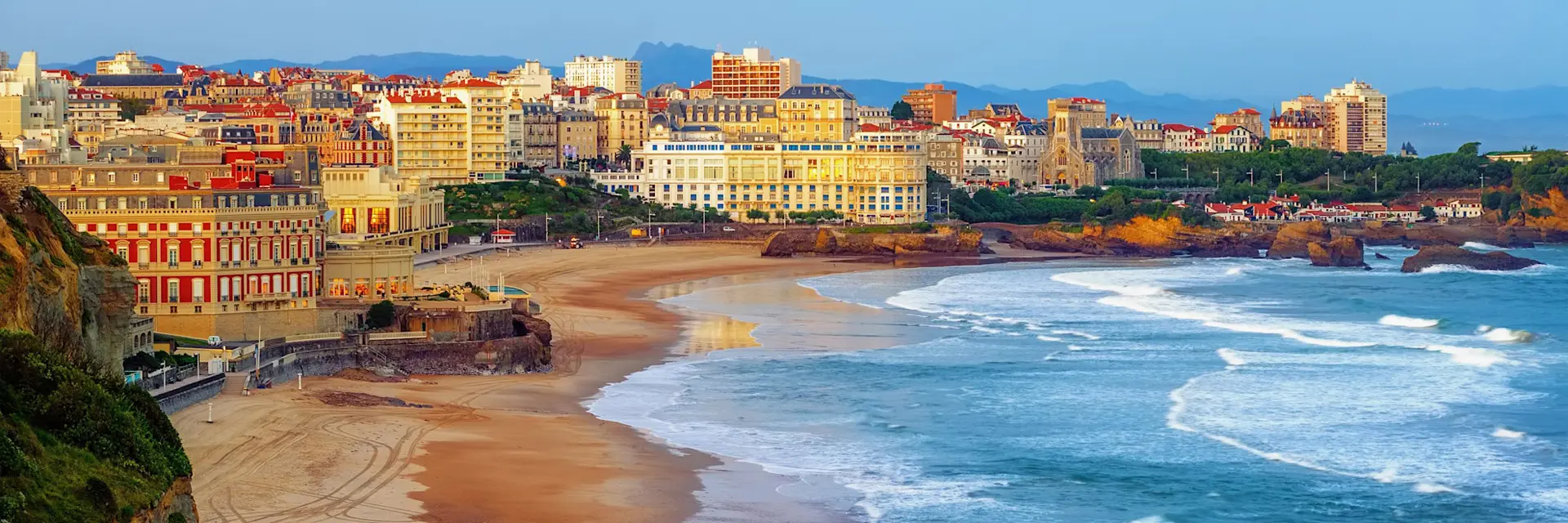
Beaches: Biarritz has six beaches and each has its own atmosphere. The Grande Plage is the postcard — a curve of sand under the casino, lined with brightly striped bathing tents in July and August. The Côte des Basques, ten minutes’ walk south, is the long, exposed one where the surfers go. Port Vieux is a pocket-sized cove for swimming, and Milady and Marbella at the southern end give you space when the centre is heaving.
Rocher de la Vierge: The rock stack off the headland, reached by a footbridge, is the most visited thing in town by a mile — and rightly so, because on a big swell the waves detonate underneath you. Walk on to the Port des Pêcheurs, a huddle of white fishermen’s huts with coloured shutters, then climb the 248 steps of the Phare de Biarritz on Pointe Saint-Martin for the view down the whole Basque coast into Spain.
Basque food: This is the serious reason to come. Les Halles opens at 07:30 every day of the year bar two, and the bars around it serve pintxos, Iberian ham and txakoli from mid-morning. Add gâteau basque from a house that has been baking since 1660, plancha-grilled fish on the harbour and the local Espelette chilli in everything, and you’ll eat better here than almost anywhere on the coast.
Plan Your Trip

Things to Do in Biarritz
Biarritz packs an unusual amount into a small town. You can surf, paddle, swim, walk the coast path, play a links course laid out in 1888 and be wrapped in warm seaweed before dinner — all without moving the car. Drive 30 to 40 minutes inland and the Pyrenean foothills open up: whitewater on the Nive, canyons to drop into, and villages strung with drying chillies. Here’s our guide to the best things to do in Biarritz and the Basque country behind it:
Biarritz Beaches
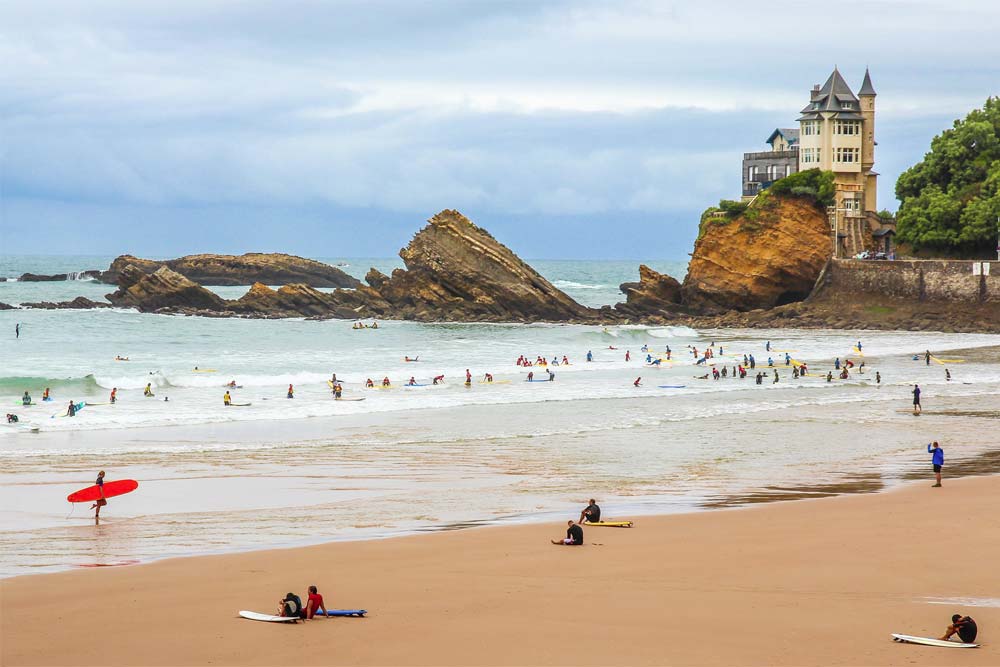
Biarritz officially has six beaches, and they run in a line from the lighthouse in the north to the Bidart boundary in the south. Start at Plage Miramar, tucked under Pointe Saint-Martin — quieter than its neighbour and the natural place to walk to if the Grande Plage looks like a festival crowd. Keep going north past the headland and you’re onto the four kilometres of sand at Anglet, which is where the locals go when they want room to spread out.
La Grande Plage is the town beach and the busiest — sand right under the casino, lifeguards through the season, and those striped bathing tents that turn up on every Basque country postcard. It’s a proper swimming beach, but the shore break can be punchy at mid-tide and it fills up fast on a hot August afternoon. South of it, the rocks of the Rocher de la Vierge shelter Plage du Port Vieux, a tiny sandy cove that is easily the best place in town for a calm swim or a first go with a mask.
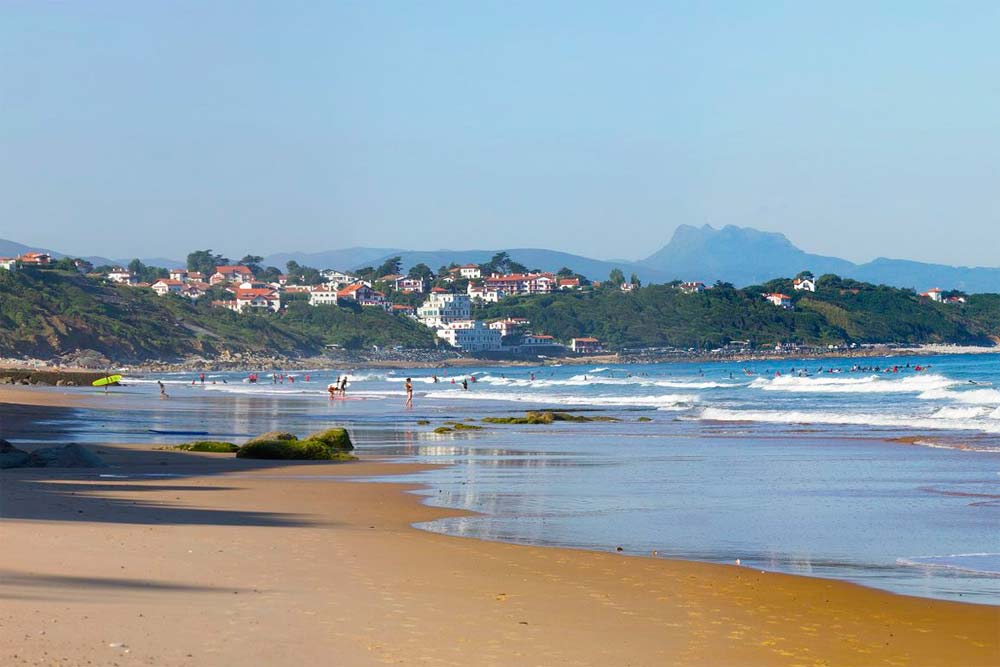
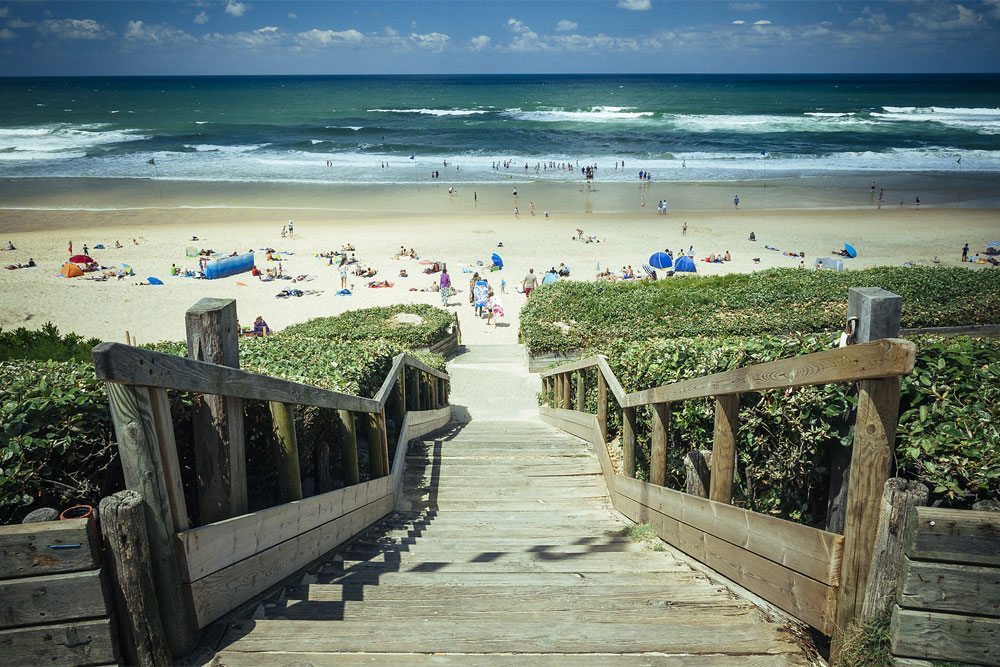
A few hundred metres on, the cliffs open into the Côte des Basques — a long, exposed beach that all but disappears at high tide and stretches for ever at low. This is the surf beach, the sunset beach and the one you’ll remember. Carry on south and you reach Plage de Marbella and Plage de la Milady, both good for surfing and both quieter, though Milady has more rock underfoot so check the tide before you swim. Worth knowing: the Milady, Marbella and Ilbarritz car parks have been paid in season since June 2024, so budget for it or arrive on two wheels. If you want the full run of the coast, our guide to the Basque country beaches covers the beaches either side of town.
Surfing & Surf Lessons
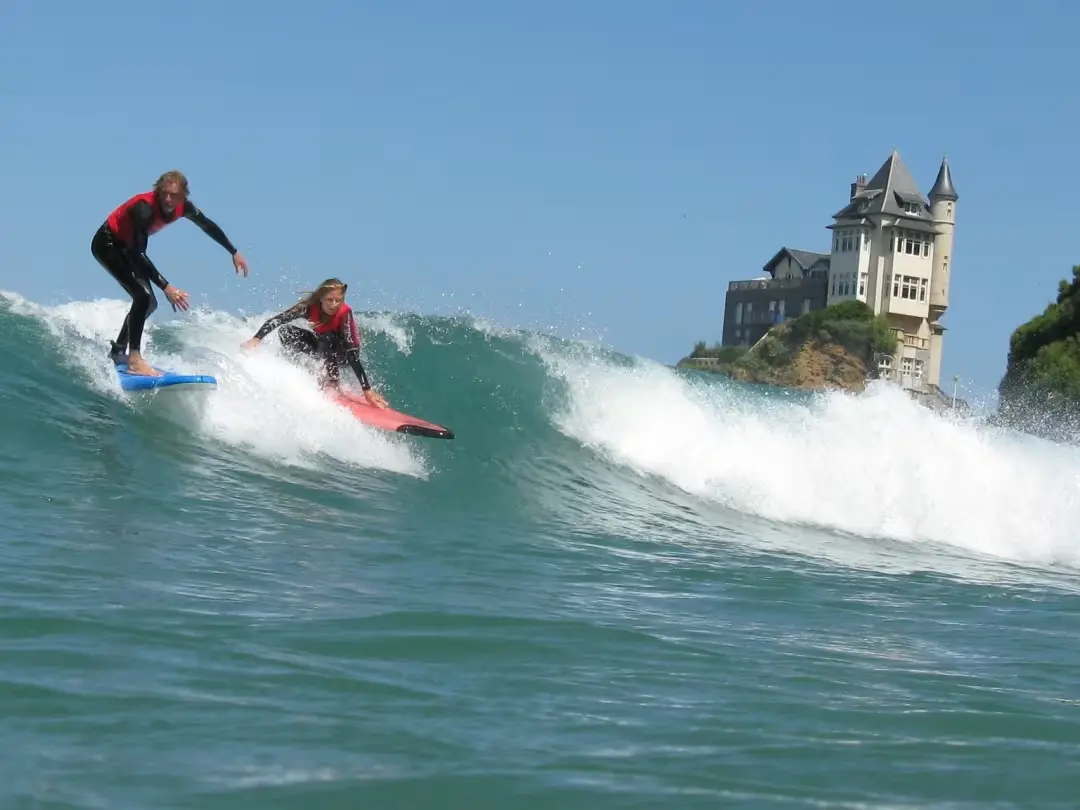
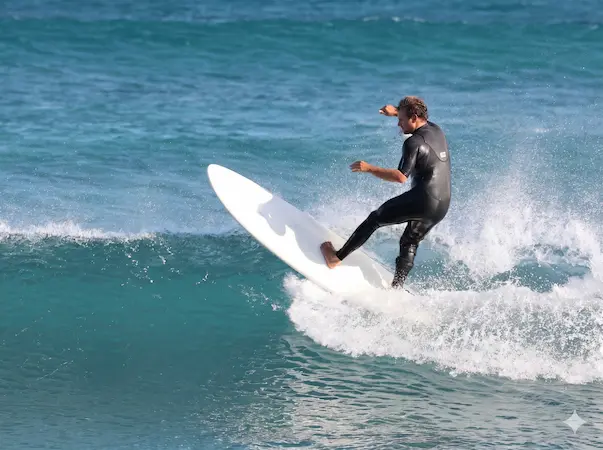
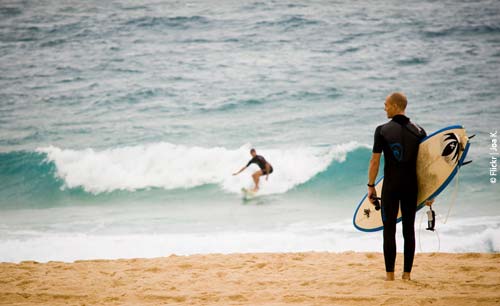
European surfing began on this beach, and the culture that grew out of it still runs the town. The Côte des Basques is a soft, sand-bottomed wave that peels a long way on a small swell — which is why it became the continent’s original learners’ beach and why it’s still full of longboards on any clean summer morning. When the swell gets big it turns into something more serious, and the peaks in front of the Grande Plage take over.
The honest summary: Biarritz is a brilliant place to learn and an average place to score if you already surf well. The waves are gentler than the heavy beachbreaks up the coast at Hossegor, and in July and August the line-up at Côte des Basques can hold a hundred people. For where each break works, which tide it likes and where to go when it’s onshore, read our Biarritz surf spot guide — and the wider surfing in south-west France guide for the whole stretch.
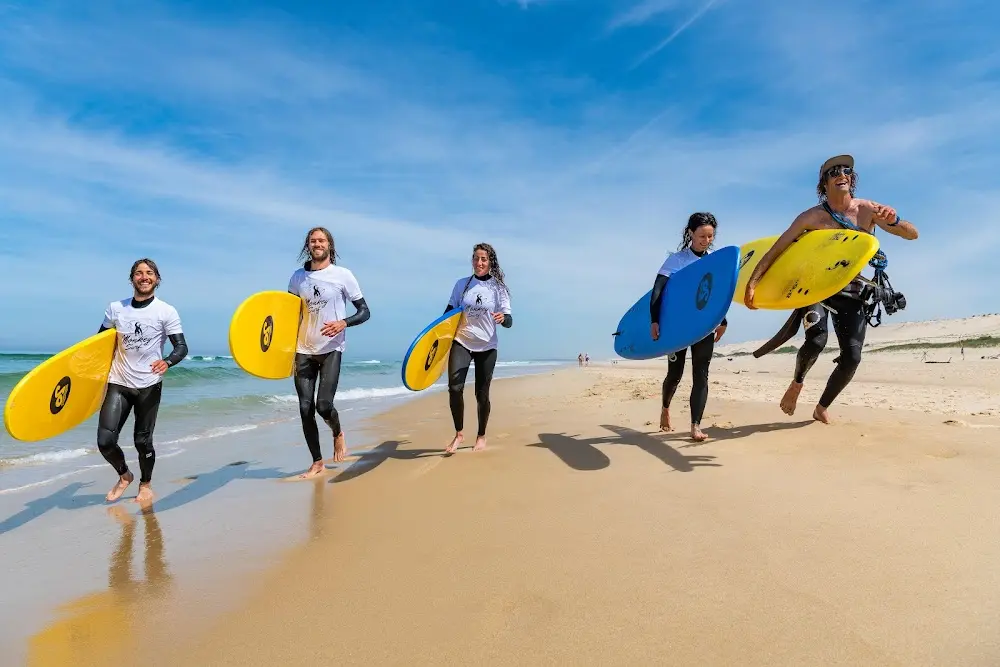
Lessons are the town’s oldest industry after tourism itself. La Vague Basque, on the Boulevard du Prince de Galles, has been running since 1997, carries the École Française de Surf label, caps groups at eight per instructor and takes children from five — from around €45 for a group lesson and €100 one-to-one. Jo Moraiz has been teaching on the same beach since 1966, and Biarritz Surf Training runs bilingual coaching with state-certified instructors 30-odd years in.
Complete beginner? Book a lesson, or learn in your own time with our learn to surf guide.
Stand-Up Paddleboarding
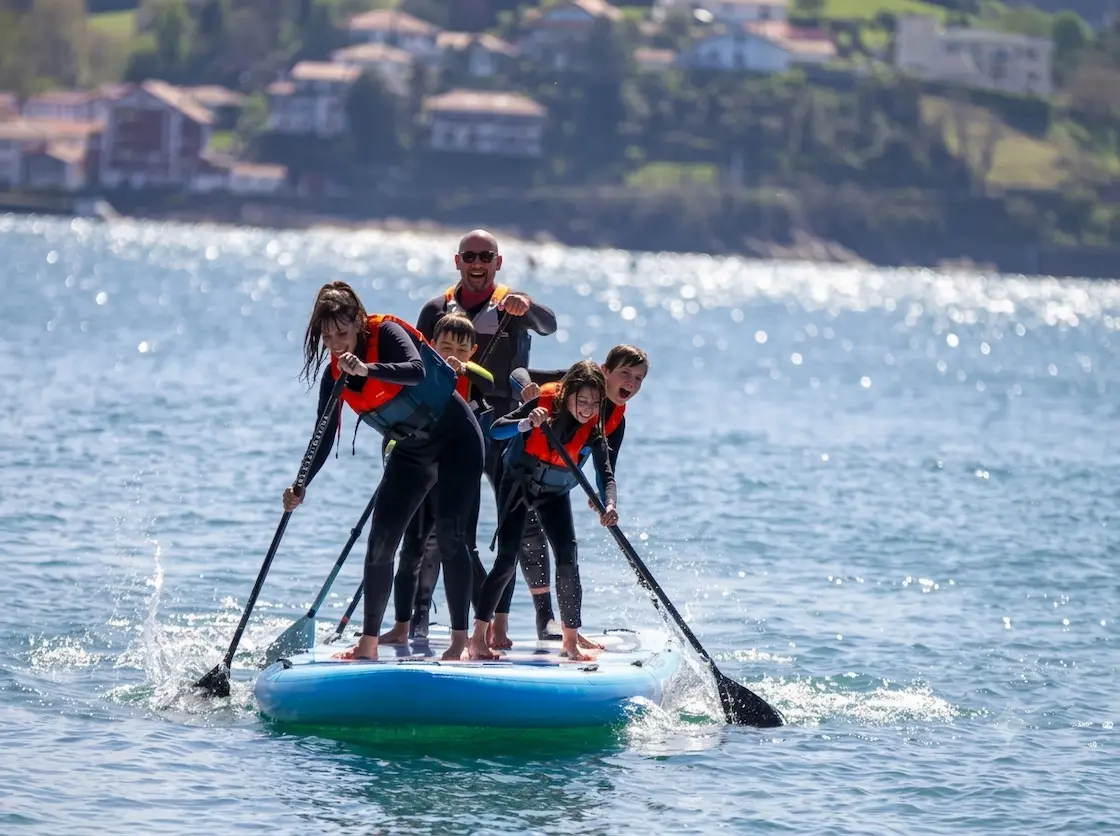
Be clear what Biarritz is: a wave-riding paddleboard town, not a flat-water one. If you’re comfortable on a board in swell, it’s superb — the same peaks that suit longboarders work just as well on a SUP, and you can pick a wave up further out and kick off before the shortboarders start paddling into the shorebreak.
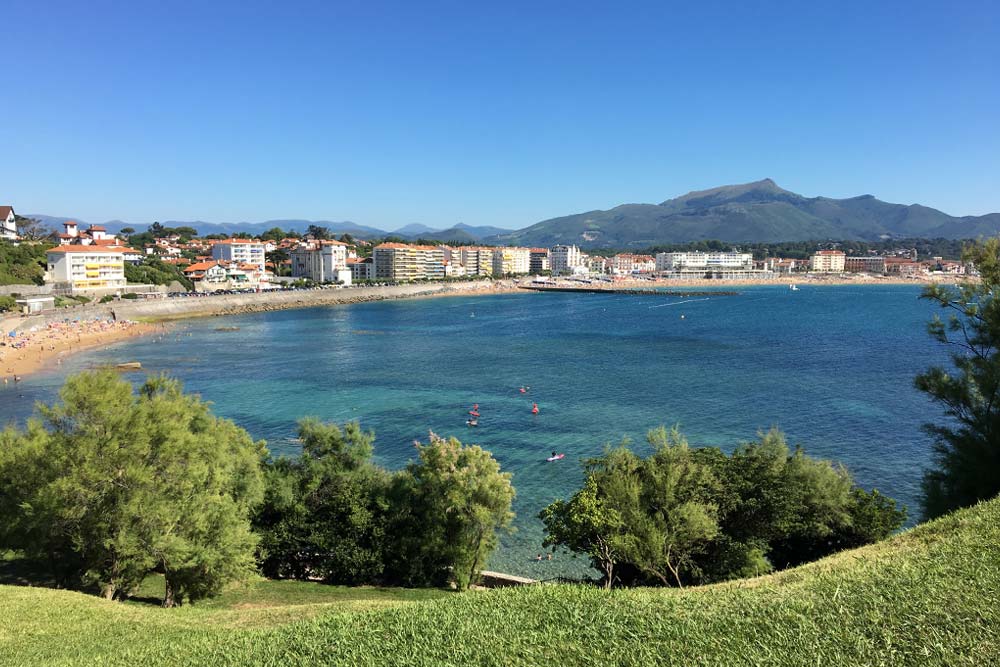
If you just want a mellow cruise on flat water, Biarritz isn’t your spot, instead, head 20 minutes south to Saint-Jean-de-Luz. The sheltered bay is closed off by three breakwaters, which makes it the calmest stretch of water on the French Basque coast and a great place to learn.
Luzpaddle Aquasens runs guided paddleboarding trips from there. You’ll paddle out of the bay towards the cliffs and rocky coves at Erromardi with the Pyrenees stacking up behind you. Instructors are used to helping beginners get up and paddling, and the calm sea is a world away from the Biarritz breakers.
Trips run through the season and can be booked online in advance — worth doing in August, when the boards go quickly.
Rocher de la Vierge & Belle Époque Biarritz
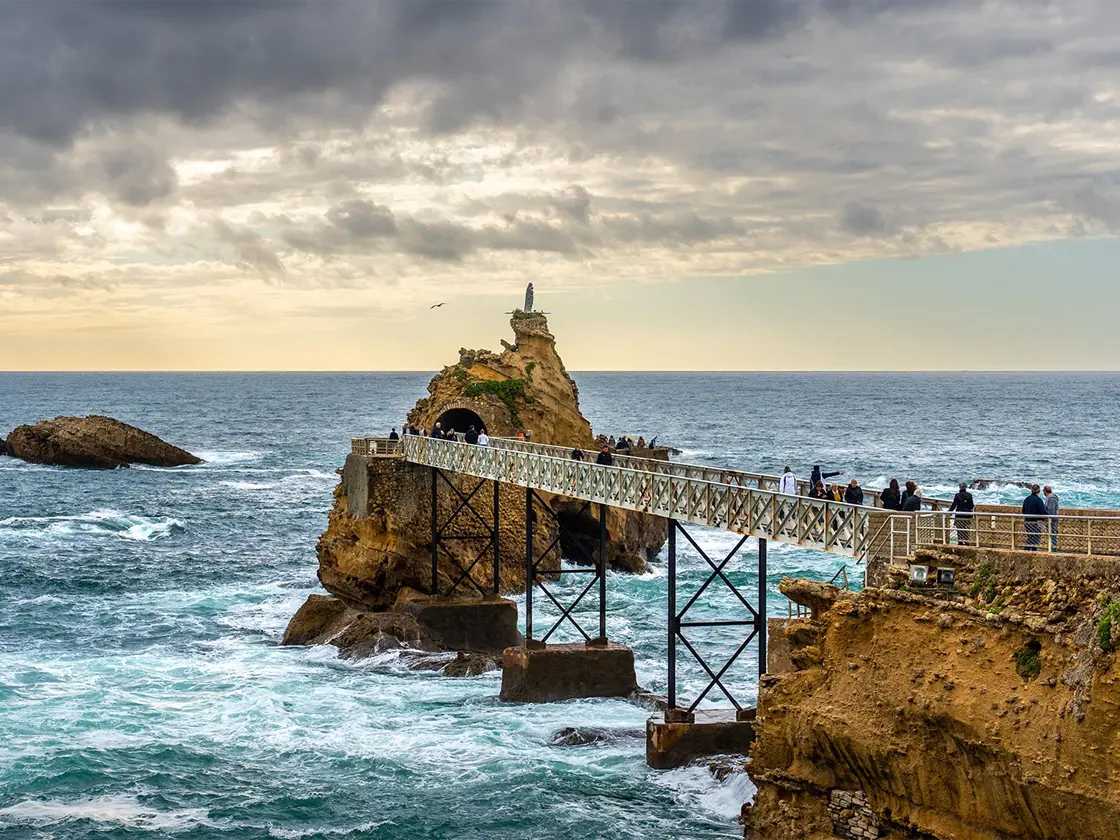
The Rocher de la Vierge is a sea stack topped with a statue of the Virgin, joined to the mainland by an iron footbridge. It costs nothing, it’s open whenever you fancy, and it’s the single most reviewed sight in Biarritz — go at high tide in a westerly swell and you’ll understand why, because the sea explodes through the gap beneath your feet. Time it for late afternoon and stay for the sunset.
The whole clifftop is a walk in its own right. From the rock, the esplanade runs past the Musée de la Mer — Biarritz’s art deco aquarium, open 09:30 to 19:00 and until 22:00 from 11 July to 23 August, with adults at €17 and children 4–12 at €12 — and down into the Port des Pêcheurs, where white fishermen’s huts with painted shutters cluster round a working slipway. North of the Grande Plage, the Phare de Biarritz on Pointe Saint-Martin gives you 248 steps and a view that runs from the Landes forest to the mountains of Spain.
For the imperial side of town, walk the seafront past the Hôtel du Palais — Napoléon III’s 1854 villa for Empress Eugénie, reopened in June 2022 after a four-year restoration and now part of The Unbound Collection by Hyatt. You don’t need a room to see inside: book lunch or afternoon tea in its dining room, La Rotonde, and get the sea view and the chandeliers for the price of a decent meal. Two wet-weather options worth knowing: the Cité de l’Océan at Milady (€15 adult, €11 for 6–12s; a €28 combined ticket with the aquarium works out cheaper) and the Musée Asiatica behind the Gare du Midi, which holds the largest private collection of Asian art in Europe for a €10 ticket.
Thalassotherapy & Sea Spas
Biarritz has been selling the healing power of cold Atlantic seawater since the 19th century, and thalassotherapy is still one of the reasons people come here in February. The treatment is exactly what it sounds like: heated seawater, seaweed wraps, jet showers and a lot of lying still afterwards. After three days of surfing it is not indulgence, it’s maintenance.
The town’s dedicated centre, Thalmar, closed at the end of October 2024 and a rebuilt centre above Milady has been announced — but the opening date has moved more than once, so don’t plan a trip around it. The address that is definitely operating is the Sofitel Biarritz Le Miramar Thalassa Sea & Spa, above Plage Miramar, which has been running seawater and seaweed programmes for more than 50 years and takes day guests as well as residents. Alternatively, Atlanthal in neighbouring Anglet does the same thing a little more cheaply, ten minutes up the coast.
Basque Food, Pintxos & Les Halles
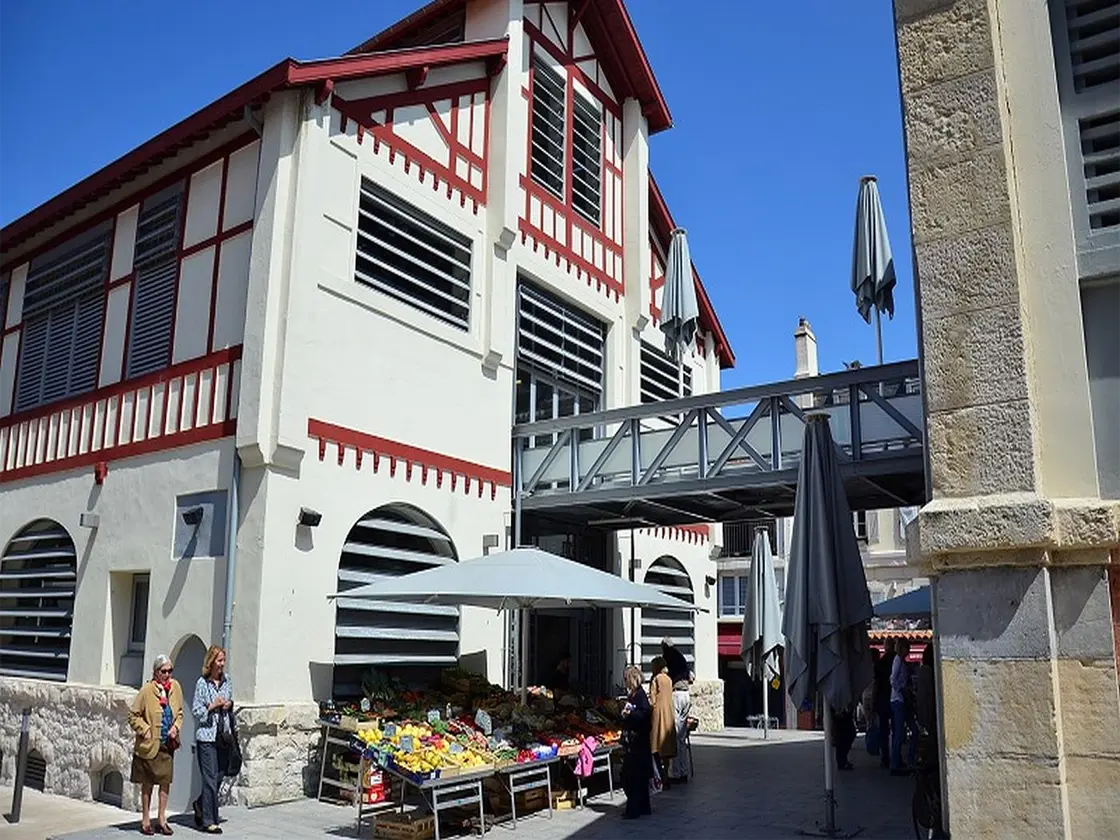
Everything in Biarritz eventually leads back to Les Halles. The covered market runs 07:30 to 14:00 every day of the year except Christmas Day and New Year’s Day, reopens in the evening from 18:00 to 21:00 in July and August, and is flanked by the open-air Marché du Carreau on Saturday mornings. Come for Bayonne ham, sheep’s cheese from the mountains, Espelette chilli and whatever the boats landed — then eat standing up at one of the bars around the edge.
Where to Eat in Biarritz
Start at the harbour. Chez Albert at the Port des Pêcheurs is the town’s best-known seafood address — wild fish off the Saint-Jean-de-Luz auction, a terrace over the boats and a bill to match at €30–80 a head. A few doors along, Casa Juan Pedro does the same idea for half the money: fish and squid grilled à la plancha in front of you, no reservations, so turn up early or wait. Both close for parts of the winter, and Casa Juan Pedro also shuts on Mondays and Wednesdays.
In town, LE CAB on Rue Gambetta has been the burger of record since 2014 and is the highest-rated restaurant in town by a distance — closed Mondays, split lunch and dinner service. Next door, Saline Ceviche Bar covers the modern end, Haragia handles the Basque grill, and Restaurant Marius out on Rue Alan Seeger is the local pick for a proper dinner. For pintxos, La Belloteka on Rue du Centre — Iberian ham, small plates, beside the market — is the one we’d send you to. Italian? Il Giardino is still going, but note it has moved: it’s at 5 Rue du Centre now, not the old Rue Gambetta address, and it’s shut on Mondays.
Coffee & Breakfast
The Milwaukee Café on Rue du Helder is still the surf-town breakfast institution — American-diner decor, local produce, brunch that will hold you until an afternoon session, and closed on Mondays. Matchy on Avenue de Verdun is the best specialty coffee in town, and Coffee Ekia roasts its own. For the sweet Basque canon, Maison Adam on Place Clemenceau has been making macarons since 1660 and its gâteau basque is the souvenir to take home.
Bars & Sunset Spots
Watch the sun go down from the top of the Cent Marches steps, then drop into Etxola Bibi, the hut with the 180-degree ocean view above the Côte des Basques — beer, tapas, live music at weekends, and open 1 April to 31 October only. In the centre, the Newquay Pub on Place Clemenceau has been the reliable late one since 2003, La Tireuse on Rue Mazagran pours the best craft beer, and Les Contrebandiers on Avenue Victor Hugo is the pick for a long evening. Bar Jean, beside Les Halles, is a 1930s institution with a mediocre rating and a magnificent room — go for the atmosphere, order simply, and don’t expect miracles. Le Surfing, above the Côte des Basques, gets the same caveat: unbeatable view, average food.
Golf in Biarritz

The British visitors who followed the empress brought golf with them, and Golf de Biarritz Le Phare opened in 1888 — one of the oldest courses in continental Europe and, unusually, still inside the town. It’s 18 holes, par 69 and 5,402 metres, so it’s short: this is a course about placement and wind rather than brute distance, and you can walk to the first tee from the Grande Plage.
Green fees for 2026 run at €80 in low season (January to March, November and December), €95 in the shoulder months and €110 in July and August, with juniors at half price. You’ll need a licence and a handicap of 36 or better to play. If you want a view instead, Golf d’Ilbarritz just down the coast is a compact, technically demanding training centre laid out above the sea — a good half-day and a lot of fun in a crosswind.
Rafting the Nive River
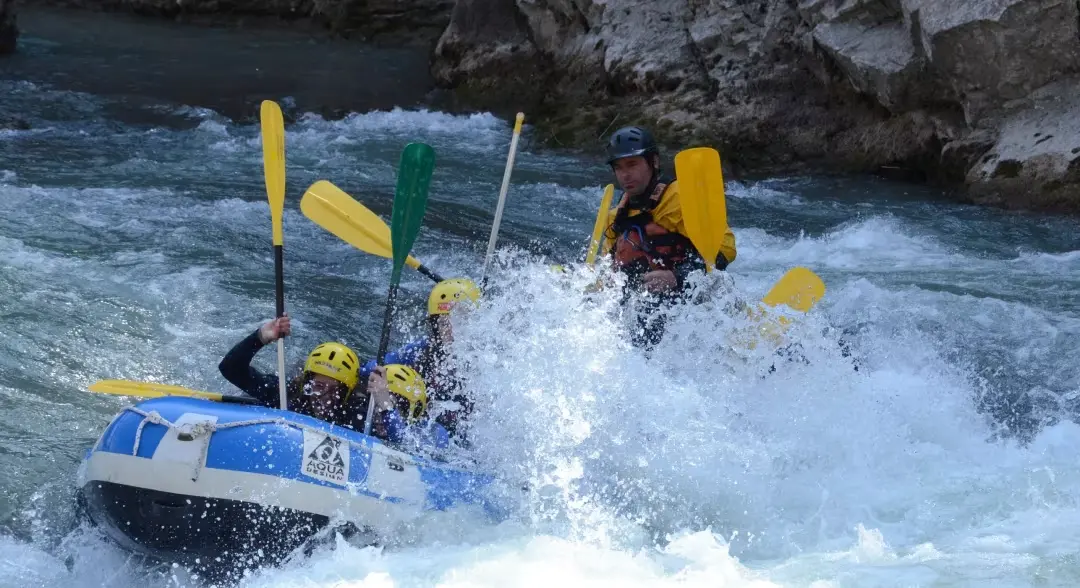
Forty minutes inland from the seafront, the Nive drops out of the Pyrenean foothills between Itxassou and Bidarray, and NCKD runs rafting trips down it in French and English. It’s not a Class V river — expect friendly rapids, a few surf waves to play on and long green stretches between them with vultures overhead and the Pas de Roland cliffs above.
That makes it a good family day and a good first raft: children and complete beginners cope fine with a guide in the boat. Water levels are highest in spring and after mountain rain, which is when the rapids have most punch, and lower in high summer when it becomes a float with a few splashy bits. Trips can be booked in advance online, and it pairs neatly with a stop in Espelette on the way home.
Canyoning in the Basque Country
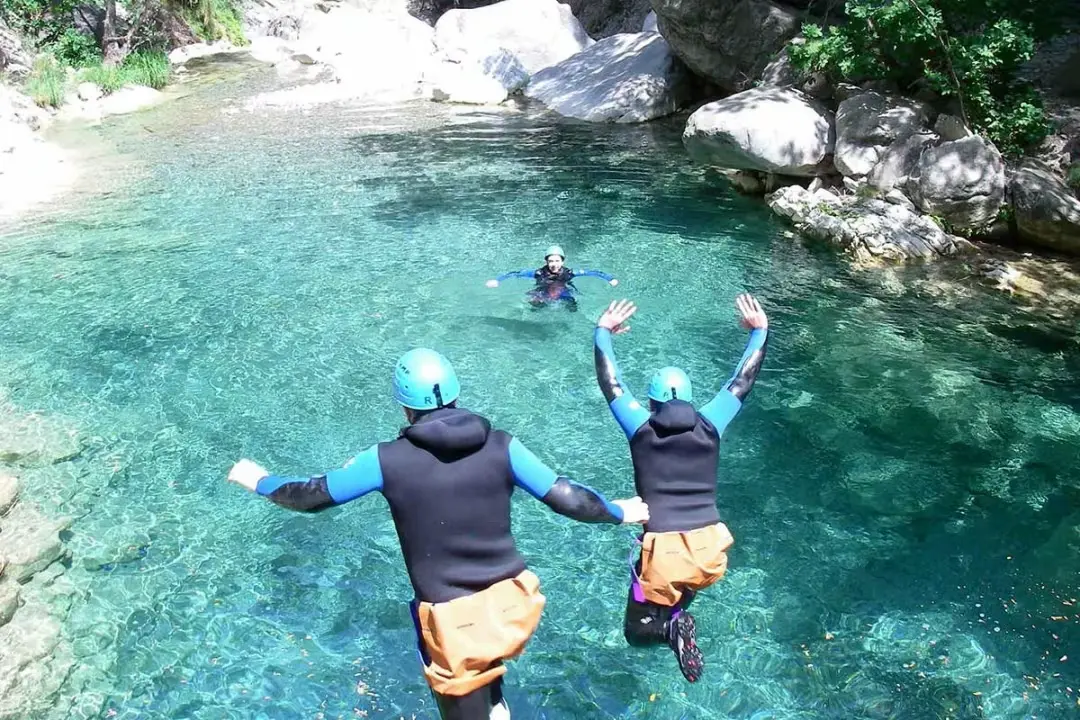
The beginner-friendly canyons of the Basque country, 40 minutes inland from Biarritz, are the right pick if your group has mixed nerve. You slide down water-polished rock chutes, jump into clear pools and swim short passages, with a couple of optional abseils and a bypass around anything anyone doesn’t fancy.
Half a day gets you there, through it and back, which leaves the afternoon free for the coast. Wetsuits, helmets and harnesses come with the guide, so all you need is a swimsuit, trainers you don’t mind soaking and a towel. Sessions run through the summer and can be booked online.
Via Ferrata at Bidarray

Les Rochers du Batzan, 30 minutes from Biarritz above the village of Bidarray, is the best via ferrata within reach of the coast. You clip onto a steel cable and work your way up ladders, footbridges and bare rock above the Batzan gorge, with zip lines and a monkey bridge thrown in and the green Basque hills rolling away in every direction.
No climbing experience is needed — the route has easier variants at the harder sections and staff on hand at the crux moves, so it works for families and for anyone who wants the exposure without the technical grade. Harness, lanyard and helmet are provided. Book a session for the morning and you’ll be back on the beach by mid-afternoon.
Hiking & Day Trips from Biarritz

The mountains start closer than you’d think. Guided walks run year-round and take in both halves of the region — the clifftop coast path with the ocean below you, and the inland routes over rounded green summits where the only traffic is sheep. A local guide is worth it here: the stories about Basque farming, smuggling and language are half the walk. Book a guided hike or plan your own from our hiking in France guides.
For a car day, string together Espelette, its house fronts hung with drying red chillies, and Ainhoa, one of France’s officially listed prettiest villages — both within about 40 minutes — and finish at Saint-Jean-Pied-de-Port, the walled town where pilgrims start the Camino over the Pyrenees. Closer to home, Saint-Jean-de-Luz is 20 minutes south for its sheltered bay and its harbour restaurants, and Bayonne is under 30 minutes on the T1 tram-bus for the cathedral, the ramparts and the chocolate shops.
Then there’s Spain. Take the SNCF train to Hendaye, walk out of the station, turn right and get on the Euskotren — roughly 30 minutes and no booking needed to reach San Sebastián, which has as good a case as anywhere in Europe to be the best eating city on the continent. It’s about 45 minutes by car. Go for the day, come back full.
Learn to Surf Where It All Began
The Côte des Basques is the beach that taught the continent to surf, and it is still one of the kindest waves in France to stand up on for the first time.
The schools on the Boulevard du Prince de Galles work the beach all season. La Vague Basque holds the École Française de Surf label, caps groups at eight per instructor and teaches from age five; Jo Moraiz has been coaching on the same sand since 1966.
Reckon on about €45 for a group lesson and €100 for one-to-one coaching, board and wetsuit included. Beginners get the inside reforms, improvers get taken out the back.
Browse and compare what’s available for your dates, then book before the August rush fills the timetable.
Where to Stay in Biarritz
Biarritz is not a cheap town, and the seafront is the expensive part of it. Pick your quarter first — imperial grandeur on the Grande Plage, surf-lodge simplicity above the Côte des Basques, or the quieter streets behind the lighthouse — and the prices follow.
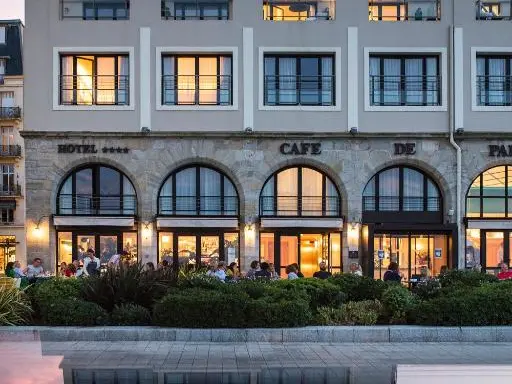
On the Grande Plage, the Hôtel du Palais is the one everybody knows: Napoléon III’s 1854 villa for Empress Eugénie, reopened in June 2022 after a four-year restoration with 86 rooms and 56 suites, and now part of The Unbound Collection by Hyatt. It is a genuine landmark and priced like one. A short walk inland, the Regina Experimental Biarritz is the design-led alternative — a 1907 Beaux-Arts building above the bay, reworked by the Experimental Group in 2022 with 72 rooms by Dorothée Meilichzon, a heated pool, a spa and Gregory Marchand’s restaurant Frenchie downstairs.
Above the Côte des Basques, the Hôtel Saint-Julien is the sensible one — a restored 1895 residence with around 30 rooms, a courtyard garden and a cocktail bar from Wednesday to Sunday, five minutes’ walk from the surf beach. This is the quarter to stay in if you’re here for the water: you can check the swell from the clifftop and be in it inside ten minutes, and you won’t spend your holiday looking for a parking space.
On Plage Miramar, the Sofitel Biarritz Le Miramar Thalassa Sea & Spa is the address for a spa-led trip, with more than 50 years of seawater and seaweed programmes attached to the hotel. One warning about an old favourite: the Hôtel Florida on the Grande Plage is no longer the cheap-and-cheerful option it used to be — it now trades as a four-star seafront hotel with a spa, so check the rate before you assume it’s a bargain. For genuinely lower prices, look at Anglet and Bidart, five to fifteen minutes up and down the coast, and take the bus in.
Find More Accommodation
Use the map below to search hotels, surf lodges, apartments and campsites across Biarritz, Anglet and the Basque coast.
Practical Info
Getting There
Biarritz is the easiest town on this coast to reach. Biarritz Pays Basque airport (BIQ) sits five minutes from the centre — 11 airlines and around 25 destinations as of summer 2026, with Ryanair flying from London Stansted five times a week and easyJet from Gatwick, plus Ryanair routes from Dublin, Brussels, Edinburgh and Milan. By rail, TGV INOUI runs direct from Paris Montparnasse in about 4 h 17 at best, with roughly nine trains a day over the 668 km. Note that the Gare de Biarritz is 3 km from the seafront, so plan the last leg: buses and taxis wait outside. Driving down for a surf trip with boards? Compare rates for a hire car before you fly.
Getting Around
The Txik Txak network covers the whole Basque coast from Hendaye to Ondres. Single tickets rise to €1.40 on 29 June 2026, a day pass is €3.80 and under-sixes travel free. The T1 Tram’bus gets you to Bayonne in under 30 minutes and runs 24 hours a day through the summer, as does line 18 south to Saint-Jean-de-Luz — every 30 minutes from June to September, hourly Monday to Saturday in winter. One correction worth having: the free navette only runs airport to station to town centre, mornings until about 13:30. There is no free shuttle to Saint-Jean-de-Luz or Hendaye, whatever you may have read. In summer the free N30 shuttle links the Bidart campsites, the town centre and the beaches from 29 June to 30 August.
Parking
Parking is the one genuine headache here, and the rules changed recently. The town has around 2,500 surface spaces split into red, orange, green and yellow zones — and the useful bit almost nobody tells you is that the first hour is free, once per day, taken in one go. From 1 September to 30 June only the red and orange zones are charged, Monday to Saturday. In July and August every zone is charged, seven days a week, 09:00 to 20:00. Reckon on about €10 for three hours in the central red zone and €6.50 in orange. The Milady, Marbella and Ilbarritz beach car parks have been paid in season since June 2024, though three free supervised car parks open from 12:00 to 19:00 in July and August at the Grande Plage, Milady and Ilbarritz. Cheapest of all: leave the car at the Parking Relais Iraty — 290 free spaces — and take bus line 5 into town.
Bike Hire
Given the parking, two wheels are the smart way to do Biarritz. Joe Bike at 47 Avenue de Verdun hires from about €11 for four hours on a manual hybrid or mountain bike and €20 for four hours on an e-bike, opens seven days a week in season, delivers within 20 km and runs guided e-bike tours into the Basque country. Biarritz Bike, in the Les Halles quarter, has been renting two wheels since 1985 and covers scooters and motorbikes as well as bikes. The hills between the beaches are short but steep — take the e-bike if you’re touring with kids.
Best Time to Visit
June and September are the sweet spot — warm water, working surf, everything open and a fraction of the crowds. July and August are loud, expensive and fully charged in every parking zone, but they’re also when the town is at its most alive. September and October are the best months for surfing, when the Atlantic starts firing and the line-ups thin out. Winter is for spas, golf at €80 and empty restaurants, but check before you travel: Etxola Bibi opens only from 1 April to 31 October, Chez Albert closes for chunks of November to February, and the Cité de l’Océan shuts for most of January.
Biarritz FAQ
Yes, and for more reasons than the beach. Biarritz combines six sandy beaches, the wave where European surfing began, belle époque architecture built for an empress, a serious Basque food scene around Les Halles market, seawater spas and an 1888 golf course inside the town. It is also 40 minutes from the Pyrenean foothills and 45 minutes from San Sebastián. The trade-off is price and summer crowds.
June and September give you the best balance of warm water, working surf, open restaurants and manageable crowds. July and August are the liveliest and by far the busiest, with every parking zone charged seven days a week. Surfers should aim for September and October, when the Atlantic swells return and the line-ups empty out. Winter suits spa and golf trips, but several seasonal bars and attractions close.
The Côte des Basques, ten minutes south of the town centre. It is a sand-bottomed beach with a long, gentle wave that became the original learners’ beach in continental Europe, and the surf schools on the Boulevard du Prince de Galles teach there all season. Expect around 45 euros for a group lesson and 100 euros for private coaching, board and wetsuit included. It gets very crowded in July and August.
Partly. The first hour is free once per day, taken in a single go, across the town centre zones. From 1 September to 30 June only the red and orange zones are charged, Monday to Saturday. In July and August every zone is charged seven days a week from 09:00 to 20:00, at roughly 10 euros for three hours in the red zone. The Milady, Marbella and Ilbarritz beach car parks have been paid in season since June 2024, and the free Parking Relais Iraty has 290 spaces with bus line 5 into the centre.
Take an SNCF train south to Hendaye, walk out of the station and turn right for the Euskotren, which runs into San Sebastián in about 30 minutes with no booking needed. Trains go roughly every half hour. By car it is around 45 minutes. It is one of the best day trips on the French Basque coast.
Les Halles de Biarritz opens from 07:30 to 14:00 every day of the year except Christmas Day and New Year’s Day, and reopens in the evening from 18:00 to 21:00 during July and August. The open-air Marché du Carreau runs alongside it on Saturday mornings from 07:30 to 13:00. The bars around the market serve pintxos from mid-morning.
Green fees at Golf de Biarritz Le Phare, the 1888 course in the middle of town, are 80 euros in low season from January to March and November to December, 95 euros in the shoulder months and 110 euros in July and August. Juniors pay half price. You need a licence and a handicap of 36 or better to play the 18-hole, par 69 course.
Please leave a comment below if you need specific advice for your trip to Biarritz, or if you have any recommendations to help us improve this guide. Happy holidays!
Thank you so much for this blog article. We’re off to Biarritz in a couple of weeks, and had no idea what to expect. Thanks for all the tips & advice – really looking forward to visiting the place now 🙂